Last summer’s Second World Theatre Festival in Astana, Kazakhstan, felt more like a film festival with its red carpets and limos, and Juliette Binoche reading Kazakh poetry at the closing ceremony. Asanali Ashimov and Meruert Utekesheva, stars of Kazakh theatre and cinema since the Soviet era, were guests. The festival was financed by the culture and sports ministry and the state organisation Qazak Concert, and is linked with a national programme, Ruhani Zangyru (Understanding Modernity), launched in 2017 by President Nursultan Nazarbayev. whose regime, criticised as politically closed, is keen to show itself culturally open.
Once head of Kazakhstan’s communist party, Nazarbayev became president in 1990 and has been regularly re-elected since without any real opposition, maintaining what he calls an ‘enlightened dictatorship’. He wants to modernise Kazakhstan’s identity because ‘it is impossible to occupy a place in the advanced group of nations while preserving the old model of identity and thinking.’
Kazakhstan, which became independent with the collapse of the Soviet Union in 1991, is peopled by descendants of the Mongols and Turkic-speaking peoples; the name Kazakh means ‘free’ and ‘wandering’. Much of its traditional culture survived the Soviet era, especially legends and music; the museum of folk musical instruments in Almaty (the old capital) has digital exhibits as well as a collection of instruments such as the dombyra (a long-necked lute) and kobyz (a bowed string instrument). The Bayterek (‘tall poplar’), a monument and observation tower in central Astana, is a stylised representation of the tree in which the Samruk, the mythical bird of happiness, laid its egg.
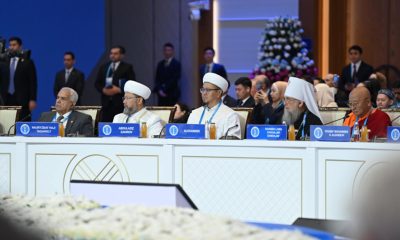
Kazakhstan has 18 different religions — 70% of the population is Muslim, though the state remains resolutely secular — and 127 ethnic groups.