Conflicts
Elmar Brok on challenges abroad: 'The neighbourhood is on fire'

 Every day news about armed conflicts in Ukraine, Iraq and now also in Israel and in Palestine abound. While in Israel one party has agreed to a ceasefire, in Ukraine European leaders are still negotiating a solution with Russia. As all conflicts are situated in Europe's wider neighbourhood, the EU plays an important role as mediator. Elmar Brok, a German member of the EPP group who is the chair of the foreign affairs committee, presents his assessment of the conflicts.
The Shiites want to establish a majority government, but if they do not include other parties, there will be division.
Furthermore the fundamentalists will be more active, also in Syria. The region could collapse. Iraq would split into three parts. One part would be connected to parts of Syria. The regional order would be totally messed up.
If we do not manage to solve this conflict, it could lead to long-term tensions and even wars.
Moving north, the conflict in Ukraine is now going on for half a year already. What steps should be taken next with regards to the Ukrainian conflict?
We should make sure that Ukraine can implement the association agreement and the negotiation contract. The country has to become economically and politically stable and able to implement necessary reforms.
We have to support Ukraine, so that the separatists cannot progress further. It is important that we expand the OSCE mission together with the Ukrainians, so that the borders to Russia can be controlled and personnel as well as arms cannot enter Ukraine this way.
All these conflicts are located at the eastern borders or in the wider region of the European Union. Do these conflicts have consequences for the way the EU’s foreign policy is organized?
We need an experienced EU foreign minister. We must use the synergy effects of the European Union and agree on one common policy for the crucial issues.
We do not have real policies with regards to Russia; we do not have a real policy in terms of energy and foreign affairs. The member states have to realise that with many of these issues common European action helps to enforce our interests. Now is the moment to understand that.
Over 70% of citizens want to have a stronger common foreign and security policy in Europe. Unlike some national ministries citizens have realised that only by working together we have a chance to survive in this system.
The neighbourhood is on fire. We have to pay attention that we are still able to calm down the situation. Otherwise it could be damaging for us.
The interview took place on Wednesday 16 July.
Share this article:
EU Reporter publishes articles from a variety of outside sources which express a wide range of viewpoints. The positions taken in these articles are not necessarily those of EU Reporter. Please see EU Reporter’s full Terms and Conditions of publication for more information EU Reporter embraces artificial intelligence as a tool to enhance journalistic quality, efficiency, and accessibility, while maintaining strict human editorial oversight, ethical standards, and transparency in all AI-assisted content. Please see EU Reporter’s full A.I. Policy for more information.



Astana's congress of world religions: A global platform for dialogue in an age of division

Protect children from online sexual abuse: Call for urgent negotiations and permanent solution

Solana company partners with Kazakhstan on $6B Alatau Crypto Megacity

Will the Gulf monarchies rise above internecine disputes in the interest of collective security?

Europe must double down on nuclear progress to achieve its long-term ambitions

International Plastic Bag Free Day – from single use to reuse

Study: Europe's defense runs on American servers

Commission proposes five joint defence projects to strengthen Europe's industrial capabilities

Safer cars, safer roads: New rules take effect

Survey of city economic experts: Cities are driving Draghi’s competitiveness agenda, but need EU recognition to scale action

Europe's Cloud moment: The DMA must now deliver

EU-Mexico: While others build walls, Europe builds bridges

New EU strategy must help farmers move toward a more humane food system

Kashmir's 9,765 missing women and girls demand international attention

Quarterly reports show a surge in solar energy and e-vehicles, with record highs in 2025

EU deploys wildfire support to face multiple fires across Portugal and France

Kazakhstan reforms under scrutiny at Brussels Press Club round table

Japan should face up to history and contribute more to regional peace

Ambassador calls for 'speeding up' of co-operation between EU and Kazakhstan

Timur Turlov at Smart Moves Summit 2025: How chess can transform global education

Shevtsova’s case: Out-of-court sanctions dismantling trust in Ukrainian cause

The future of European transport

Trump Vs Trueman

US 'no longer' an 'unconditional ally' for Europe - MEP
-
 Kazakhstan4 days ago
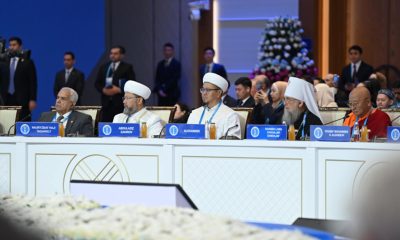
Astana's congress of world religions: A global platform for dialogue in an age of division
-
 Child sexual abuse4 days ago
Protect children from online sexual abuse: Call for urgent negotiations and permanent solution
-
 Kazakhstan4 days ago
Solana company partners with Kazakhstan on $6B Alatau Crypto Megacity
-
 Iran4 days ago
Will the Gulf monarchies rise above internecine disputes in the interest of collective security?