Conflicts
Rhodes Forum 2014: Preventing world war through global solidarity - 100 years on


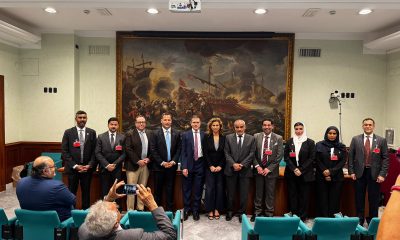
Around 400 thinkers from 56 countries gathered on Greek island of Rhodes to discuss possibilities of harmonization of international relations and strengthening of stability in the world during the Rhodes Forum – 12th annual session of the World Public Forum - Dialogue of Civilizations. The event is being held every autumn since 2003 and brings together public figures and statesmen, academics, religious figures and representatives of the arts, mass media and business spheres from all over the world. The first day of the Forum was attended by: founding president of the World Public Forum Dialogue of Civilizations Vladimir Yakunin, President of the Czech Republic Miloš Zeman, Minister of Infrastructure, Transport and Networks of the Hellenic Republic Michalis Chrisochoidis, German politician Matthias Platzeck, Austrian politician Alfred Gusenbauer, Princess of Bahrain HH Shaikha Dheya bint Ebrahim Al Khalifa and other prominent figures.
The main theme of the 12th Rhodes Forum is Preventing World War Through Global Solidarity: 100 years on, commemorating the 100th anniversary of World War I. The theme is as relevant today as it has ever been in light of the numerous military conflicts raging in different parts of the world today, when it’s imperative to promote the culture of non-violence, and the spirit of co-operation, peace, and justice in the world.
As Vladimir Yakunin underlined in his speech: “As we have noted many times in previous years, the dialogue of civilizations is not a merely speculative concept of "wishing well". This is a natural process of approaching other nations, penetrating into the depths of one's own culture and becoming familiar with other cultures, as well as searching for the principles and forms of co-existence, revealing one's own potential and actual possibilities… The main goal of the 12th annual session of Rhodes Forum is to analyze the main directions of the "worldwide dialogue community" theoretical and practical activities and suggest some fair and peaceful models for the coexistence of human communities.”
The president of the Czech Republic Miloš Zeman in his welcome speech noted: “The sanctions should be canceled, they are not only useless, but on the contrary produce the opposite effect and block dialogue. The dialogue between civilized states should be developed, based on interaction in religion, business and information. We should fight against the international terrorism.”
Chairman of the German-Russian Forum Matthias Platzeck said: “I came to the Rhodes Forum to listen to the arguments of the EU and Western critics in terms of differences of our civilizations and also to try to understand them. At the same time I see my role as the Chairman of the German-Russian Forum in an attempt to restore destroyed bridges and to rediscover lost similarities. Perhaps due to the conflict, in which we rush straight into fatal misunderstandings, that need to be fixed.”
The first plenary meeting, moderated by WPF "Dialogue of Civilizations" Co-chairman Prof Fred R. Dallmayr (USA), was titled “Culture of Nonviolence: Tolstoy, Gandhi and the Legacy of J.C. Kapur. The Role of Spirituality in Creating a New Modernity”. This plenary paid tribute to J.C. Kapur's visionary stand by paying close attention to different aspects of Mahatma Gandhi's thought and praxis. The participants of the forum emphasized that for Gandhi, it was not sufficient to oppose British colonial presence in India, but to ensure that Indians were not cognitively enslaved to the intellectual and socio-political and economic outlooks of their colonial masters.
In the plenary meeting “World Order and the Politics of Regime Change”, moderated by Prof. Dr. Hans Köchler (Austria), has been discussed, that in the unilateral power constellation that emerged after the end of the Cold War, the United Nations’ system of collective security has increasingly become dysfunctional. The effective absence of checks and balances has encouraged the dominant global player to pursue its national interests also by use of armed force. In this context, “régime change” has become an ideological buzzword for a geostrategic approach, which resembles the arrogance of former colonial powers and is in outright contradiction to the principle of sovereign equality of states.
During the first day of the Rhodes Forum participants have also discussed peace and security in Europe and Asia in the context of US Power during the session, moderated by Dr. Chandra Muzaffar (Malaysia), President of International Movement for a Just World. In the course of the last one year, issues of peace and security in Europe and Asia have come to the fore as a result of the crisis in Ukraine on the one hand and tensions in Northeast and Southeast Asia, on the other. In the case of Ukraine, at the root of the problem is the US-led NATO push for power eastwards which has brought that military alliance to the very doorsteps of Russia and threatens the peace and security of the region. China’s friction with Japan and also Vietnam and the Philippines has been heightened by the US’s pivot to Asia which is essentially a systematic attempt to re-assert its power in the continent. The US drive to preserve and perpetuate its power in both Europe and Asia is part and parcel of its larger agenda to ensure that it remains the world’s sole superpower.
In the midst of the unfolding new Cold War a monstrous specter is emerging: the threat of a Third World War with truly global proportions. The session of World Public Forum -"Dialogue of Civilizations" will continue discussion of global problems in workshops during 27-28 of September. International NGO's representatives, human rights activists, trade unionists of Europe, independent intellectuals will discuss how to avoid possible future conflicts, problems of youth living in so-called disputed zones (Kosovo, Palestine, Armenia, Ukraine, etc.), migration problems as well as economic issues (trade union movement, Silk road industrial and trade cooperation), ecology issues, intercultural and interreligious dialogue in different aspects.
The World Public Forum “Dialogue of Civilizations” (WPF DoC) is a large-scale, international, European-based discussion platform as well as the World Economic Forum and World Social Forum, and has been active more than 12 years. Currently, the activities of the WPF DoC are focused on the creation of a new multi-polar world picture; aimed at producing a vision for future development paths while considering actual socio-political situations. The organization enjoys United Nations Economic and Social Council (ECOSOC) Special Consultative Status since 2013 and unites into a single network various international and national nongovernmental organizations (NGOs), representatives of public and state institutions, civil society organizations and faith-based groups, academics, representatives of cultural, spiritual, business, and media spheres from different countries, members of diverse civilizations and cultural traditions, and individuals who share the principles of openness mutual respect which form the basis of the contemporary dialogue of civilizations.
The WPF DoC seeks to create effective and democratic instruments to solve global problems and set in motion evolutionary changes in the structure of modern society. Among the Forum's tasks are protecting and promoting the co-existence of diverse ideas, and combining liberal standards with humanitarian values. Implementation of the “Dialogue of Civilizations” program is closely connected with inter-confessional dialogue that brings together representatives of world religions to face the global challenges of extremism and terrorism.
The International Coordinating Committee (ICC) of the Forum is leaded by the former Secretary-General of the Council of Europe and WPF Co-Chairman Walter Schwimmer. Among the ICC’s members are the President of the International Progress Organization Hans Koechler (Austria), Director of Research Emeritus at the Centre National de la Recherche Scientifique of France Henri Favre, among many other prominent scholars and researchers of the current “dialogue of civilizations” agenda.
The Endowment for the World Public Forum Dialogue of Civilizations (DofC) was registered in July 2013 in Geneva. The activity of the endowment is aimed to support research in the study of political and social sciences, religion, and culture; develop communication between countries on political and economic matters; and seek compromise in cases of social unrest and international dispute. All donations are allocated to the development of The World Public Forum “Dialogue of Civilizations” programs.
Follow the direct video broadcasting of the Forum.
Dialogue of civilizations Worldwide integrated web-platform.
Share this article:
EU Reporter publishes articles from a variety of outside sources which express a wide range of viewpoints. The positions taken in these articles are not necessarily those of EU Reporter. Please see EU Reporter’s full Terms and Conditions of publication for more information EU Reporter embraces artificial intelligence as a tool to enhance journalistic quality, efficiency, and accessibility, while maintaining strict human editorial oversight, ethical standards, and transparency in all AI-assisted content. Please see EU Reporter’s full A.I. Policy for more information.



Can digital sovereignty survive an open trading system?

Friedman Institute and Trends Group at the Italian parliament: Countering the Muslim brotherhood

Can the EU resist US pressure on medicine prices?

From a remote island to shelves around the world: The story of Azorean canned fish

EU deploys wildfire support to face multiple fires across Portugal and France

Europe’s job market is shifting, and EURES is ready to lead the way into 2030

EU agricultural markets remain robust despite uncertainties and rising input costs

Commission report highlights achievements of EU rules on animal health

Safer cars, safer roads: New rules take effect

Survey of city economic experts: Cities are driving Draghi’s competitiveness agenda, but need EU recognition to scale action

Europe's Cloud moment: The DMA must now deliver

EU-Mexico: While others build walls, Europe builds bridges

New EU strategy must help farmers move toward a more humane food system

Kashmir's 9,765 missing women and girls demand international attention

Quarterly reports show a surge in solar energy and e-vehicles, with record highs in 2025

EU deploys wildfire support to face multiple fires across Portugal and France

Kazakhstan reforms under scrutiny at Brussels Press Club round table

Japan should face up to history and contribute more to regional peace

Ambassador calls for 'speeding up' of co-operation between EU and Kazakhstan

Timur Turlov at Smart Moves Summit 2025: How chess can transform global education

Shevtsova’s case: Out-of-court sanctions dismantling trust in Ukrainian cause

The future of European transport

Trump Vs Trueman

US 'no longer' an 'unconditional ally' for Europe - MEP
-
 Digital economy4 days ago
Can digital sovereignty survive an open trading system?
-
 Islam4 days ago
Friedman Institute and Trends Group at the Italian parliament: Countering the Muslim brotherhood
-
 Health5 days ago
Can the EU resist US pressure on medicine prices?
-
 Maritime4 days ago
From a remote island to shelves around the world: The story of Azorean canned fish