Human Rights
Iran’s execution crisis: Bloodiest month in recent Iranian history


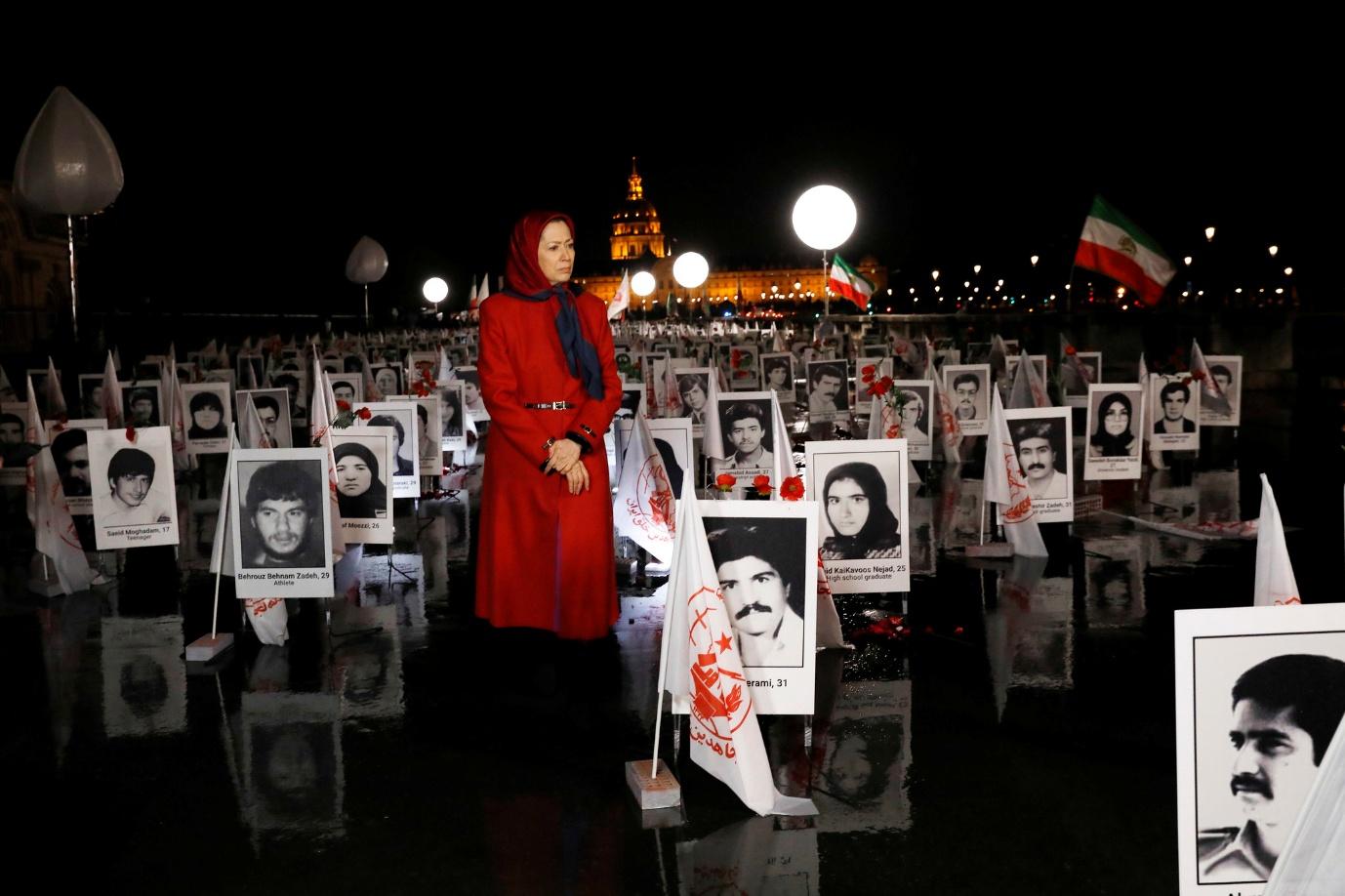
©flikre Maryam Rajavi – President-elect of the National Council of Resistance of Iran at I'ran: Crime against Humanity' exhibition- October 29, 2019
According to a statement of the National Council of Resistance of Iran (NCRI), the democratic alternative to the clerical regime in Iran, in just one month—Ordibehesht 1404 (21 April to 21 May 2025)—Iran has plunged into an unprecedented wave of state violence that has left the world aghast. At least 168 people were executed, including four women and two juveniles, making it the bloodiest month in recent Iranian history. These are not mere figures on a spreadsheet. They are lives stolen, families torn apart, and a nation buried deeper under the regime’s machinery of terror, writes Ali Bagheri, Ph.D. President of the International Freedom of Speech Alliance.
Since Massoud Pezeshkian took office ten months ago, 1,211 executions have been recorded. This horrifying average - more than four executions per day - is not coincidental. It is a calculated move by the regime to suppress a volatile population whose anger over repression, poverty, and hopelessness continues to mount.
This is not justice—it is mass murder masked as law enforcement. It is a campaign of terror designed to silence dissent, sow fear, and keep a crumbling regime afloat.
A regime in crisis
Supreme Leader Ali Khamenei’s regime is cornered. Internally, it faces a population battered by economic collapse, rampant corruption, and political repression. Externally, it reels from the collapse of regional allies like Bashar al-Assad and the setbacks suffered by proxy groups across the Middle East. In this fragile moment, the clerical establishment sees mass executions and nuclear talks not as contradictions, but as twin pillars of survival. Rather than reform or reconciliation, the regime opts for the gallows.
Inaction of the international community
Despite this accelerating human rights catastrophe, the international response been disturbingly muted. While European and American diplomats engage in negotiations over Iran’s nuclear program, the regime continues its internal slaughter, unchecked and unpunished.
Maryam Rajavi, President-elect of the NCRI, rightly observed that this surge in executions reveals the regime’s fear of uprising and growing unrest. “Such barbarity,” she stated, “will not prevent the regime's inevitable downfall. On the contrary, it only intensifies public outrage.” She called for urgent international action: a halt to the executions, intervention by the UN Human Rights Council, and referral of the regime’s crimes to the UN Security Council.
Belgium and Europe must lead
The Iranian community in Belgium has not remained silent. On May 14, demonstrators gathered in front of the Belgian Ministry of Foreign Affairs, and again on May 17, hundreds rallied in Antwerp’s Groenplaats. Their message to Belgian and EU leaders was clear:
- Stop the executions in Iran immediately, especially in the cases of political prisoners, particularly, Mehdi Hassani and Behrouz Ehsani, who have been transferred to Ghezel Hesar Prison, the execution site.
- Designate the IRGC as a terrorist organization, acknowledging its central role in domestic oppression and regional terror and warmonger.
- Recognize the Iranian people’s right—especially the youth—to resist and stand up to the regime’s brutal repression, and build a democratic future
These calls follow growing support inside Belgium itself. The Flemish Parliament recently passed a resolution condemning the execution of political prisoners. And in December 2024, more than 110 Belgian MPs, including the Prime Minister and Foreign Minister, signed a declaration demanding an end to the executions in Iran.
This is not the time for symbolic gestures. Europe must act decisively. The EU has the tools—economic leverage, diplomatic channels, and political weight—to hold Tehran accountable. It must now show the will.
Silence and inaction of democratic countries cost lives in Iran
Every day the world stays silent, the gallows in Iran stay busy. Iranian regime is waging war against its own people with ropes and nooses. If we, as members of a global democratic community, fail to act—fail even to speak—then we become enablers of this horror. We must support the Iranian youth and resistance units who dare to challenge the power of the Ayatollah and confront the repressive forces on daily basis in Iran.
Photo by Johannes Blenke on Unsplash
Share this article:

EU Reporter publishes articles from a variety of outside sources which express a wide range of viewpoints. The positions taken in these articles are not necessarily those of EU Reporter. Please see EU Reporter’s full Terms and Conditions of publication for more information EU Reporter embraces artificial intelligence as a tool to enhance journalistic quality, efficiency, and accessibility, while maintaining strict human editorial oversight, ethical standards, and transparency in all AI-assisted content. Please see EU Reporter’s full A.I. Policy for more information.





EU foreign ministers to discuss options for restricting trade with Israeli communities in Judea and Samaria

European operation dismantles €10 million illicit cigarette network in Spain

Srebrenica's lesson is prevention. Why isn't the world applying It to Kashmir?

AIFC to host Astana Finance Days 2026 in September

ALROSA Re-elects Supervisory Board with Minimal Changes

Energy Union Task Force takes stock of oil and gas security of supply in the EU

Joint statement by High Representative/Vice-President Kallas and Commissioner Kos on the 31st anniversary of the Srebrenica genocide

NESBp: Strengthening maritime spatial planning across the North Sea and Baltic Sea

Britain’s leadership crisis is a symptom, not the disease

Chinese “leadership and coordination”

Shared commitment to advance EOSC through new EOSC Nodes and EOSC projects

Why young jobseekers struggle to find roles abroad that fit their expertise

Farmers, fair markets and consumers: new report highlights the role of EU competition rules in agriculture

EU and South Africa kick off intergovernmental dialogue on Clean Trade and Investment Partnership

Seveso - 50 years on: EU strengthens its commitment to industrial safety in a changing landscape of risk

Commission opens formal investigation into possible gun jumping in XXXLutz's acquisition of Porta

Kazakhstan reforms under scrutiny at Brussels Press Club round table

Japan should face up to history and contribute more to regional peace

Ambassador calls for 'speeding up' of co-operation between EU and Kazakhstan

Timur Turlov at Smart Moves Summit 2025: How chess can transform global education

Shevtsova’s case: Out-of-court sanctions dismantling trust in Ukrainian cause

The future of European transport

Trump Vs Trueman

US 'no longer' an 'unconditional ally' for Europe - MEP
-
 Israel3 days ago
EU foreign ministers to discuss options for restricting trade with Israeli communities in Judea and Samaria
-
 Cigarettes2 days ago
European operation dismantles €10 million illicit cigarette network in Spain
-
 Kashmir2 days ago
Srebrenica's lesson is prevention. Why isn't the world applying It to Kashmir?
-
 Kazakhstan1 day ago
AIFC to host Astana Finance Days 2026 in September