Russia
EU trade of goods with Russia remains low


EU trade with Russia has been strongly affected by import and export restrictions imposed by the EU following Russia's invasion of Ukraine.
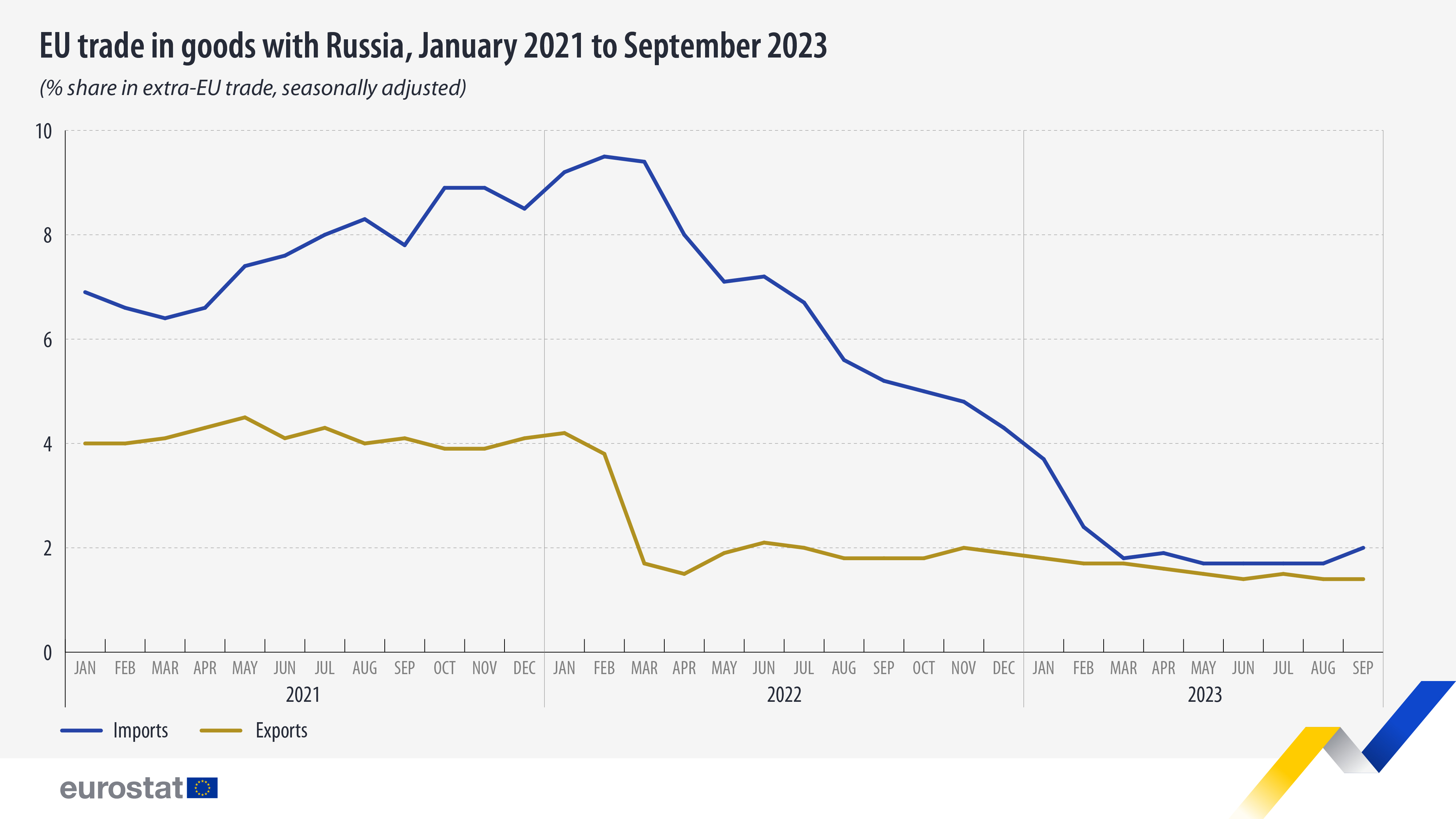
Both exports and imports have dropped considerably below the level prior to the invasion. Seasonally adjusted values show that Russia’s share in extra-EU imports fell from 9.5% in February 2022 to 2.0% in September 2023, while the share of extra-EU exports fell from 3.8 % to 1.4% in the same period.
Source dataset: ext_st_eu27_2020sitc
In March 2022, a peak trade deficit with Russia amounted to €18.6 billion due to high prices of energy products. This deficit was brought down to €0.1bn in March 2023 and did not change much until September 2023 when it amounted to €1bn. This change was heavily influenced by the drop in the monthly value of imports from Russia.
Russia’s share in extra-EU imports has decreased for the majority of key products
Altogether, natural gas, petroleum oils, nickel, iron and steel and fertilisers account for around two-thirds of total extra-EU imports from Russia.
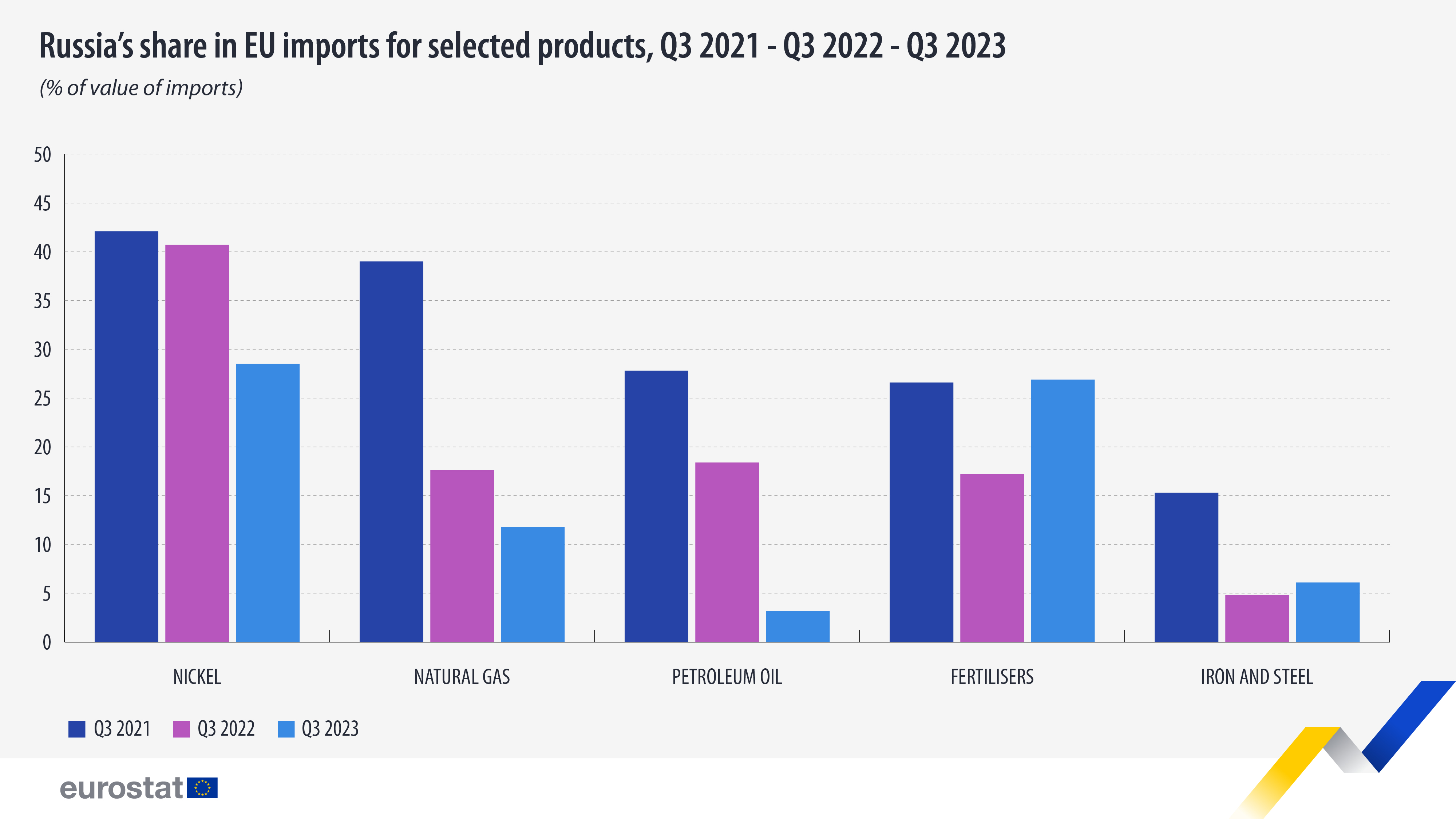
Between the third quarter of 2021 and the third quarter of 2023, Russia’s share in extra-EU imports of natural gas decreased significantly (-27 percentage points, pp) while the opposite was observed for imports from the United States (+14 pp), Norway (+7.6 pp) and Algeria (+5.5 pp).
A similar phenomenon was observed for extra-EU imports of petroleum oils, with a decrease of Russia's share (-25 pp), while the respective shares of the United States (+7 pp), Norway (+4 pp), and Saudi Arabia (+2 pp) increased.
In the case of nickel imports, the United States expanded their share (+5 pp) while Russia's share declined (-14 pp).
China emerged as the primary supplier for iron and steel (share increasing by 5 pp) following a drop in imports from Russia (share decreasing by 9 pp).
However, trade in fertilisers shows a different pattern. Russia's share in extra-EU imports decreased from 27% in the third quarter of 2021 to 17% in the third quarter of 2022, but bounced back to 27% in the third quarter of 2023.
Source dataset: ds-059322
More information
- Statistics Explained article on EU trade with Russia - latest developments
- Thematic section on international trade in goods
- Database on international trade in goods
Methodological notes
The following Harmonised System (HS) codes were used for selected products:
- HS 75: nickel and articles thereof.
- HS 271111 + 271121: petroleum gases and other gaseous hydrocarbons; liquefied, natural gas and petroleum gases and other gaseous hydrocarbons; in gaseous state, natural gas.
- HS 2709 + 2710: petroleum oils and oils obtained from bituminous minerals; crude and petroleum oils and oils from bituminous minerals, not crude; preparations n.e.c, containing by weight 70% or more of petroleum oils or oils from bituminous minerals; these being the basic constituents of the preparations; waste oils.
- HS 31: fertilizers.
If you have any queries, please visit the contact page.
Share this article:
EU Reporter publishes articles from a variety of outside sources which express a wide range of viewpoints. The positions taken in these articles are not necessarily those of EU Reporter. Please see EU Reporter’s full Terms and Conditions of publication for more information EU Reporter embraces artificial intelligence as a tool to enhance journalistic quality, efficiency, and accessibility, while maintaining strict human editorial oversight, ethical standards, and transparency in all AI-assisted content. Please see EU Reporter’s full A.I. Policy for more information.







Friedman Institute and Trends Group at the Italian parliament: Countering the Muslim brotherhood

Competition policy: Enforce without fear

Setting sustainable livestock farming on a strong footing

Portugal achieves major milestone with permit for offshore aquaculture facility

New EU plan to address the risks and opportunities of advanced AI for cybersecurity

Kashmir's 9,765 missing women and girls demand international attention

How hair extensions can transform your look naturally

EU deploys wildfire support to face multiple fires across Portugal and France

EU clarifies rules to allow continued waste recovery shipments to Switzerland

European Commission’s Annual Tax Report (ART) provides latest insights into the revenue mix

Commission preliminarily finds the addictive design of Instagram and Facebook in breach of the Digital Services Act

Joint statement by High Representative/Vice-President Kallas and Commissioner Kos on the 31st anniversary of the Srebrenica genocide

European operation dismantles €10 million illicit cigarette network in Spain

Srebrenica's lesson is prevention. Why isn't the world applying It to Kashmir?

EU foreign ministers to discuss options for restricting trade with Israeli communities in Judea and Samaria

Safer cars, safer roads: New rules take effect

Kazakhstan reforms under scrutiny at Brussels Press Club round table

Japan should face up to history and contribute more to regional peace

Ambassador calls for 'speeding up' of co-operation between EU and Kazakhstan

Timur Turlov at Smart Moves Summit 2025: How chess can transform global education

Shevtsova’s case: Out-of-court sanctions dismantling trust in Ukrainian cause

The future of European transport

Trump Vs Trueman

US 'no longer' an 'unconditional ally' for Europe - MEP
-
 Islam5 days ago
Friedman Institute and Trends Group at the Italian parliament: Countering the Muslim brotherhood
-
 Competition4 days ago
Competition policy: Enforce without fear
-
 Animal welfare4 days ago
Setting sustainable livestock farming on a strong footing
-
 Portugal4 days ago
Portugal achieves major milestone with permit for offshore aquaculture facility