Tibet
Political damage control and course correction: Why we must bring an end to Penpa Tsering’s ‘five failed years’


As the 2026 election approaches, Dharamsala stands at a historic crossroads. As members of the Tibetan exile community, we believe that the turmoil of the past five years has already demonstrated that the current leader, Penpa Tsering, is not only incapable of leading the community toward renewal, but is instead dragging it into an irreversible decline. Based on a sober assessment of his strategic misjudgments, governance failures, and personal ethical scandals during his term, we call on voters to use their ballots to exercise political damage control, writes Tashi A.J Svet
Strategic bankruptcy: From ‘diplomatic arbitrage’ to an existential dead end
When Penpa Tsering first took office, he promised to restart engagement mechanisms. Five years on, however, the result has been a complete strategic collapse.
The cost of one-sided alignment: Penpa Tsering wagered all his political capital on Washington’s geopolitical calculations, fully aligning himself with the passage and implementation of the so-called ‘Promoting a Resolution to the Tibet–China Dispute Act’. From a geopolitical perspective, this extremely opportunistic strategy of dependency has produced no substantive results. Instead, it has only hardened Beijing’s official stance even further.
The severing of communication channels: During his tenure, despite repeated claims that ‘channels of communication still exist,’ both official and unofficial contacts with Beijing have in reality fallen to a historic low. In order to secure Western funding, he sacrificed core political objectives, manufacturing an illusion of ‘diplomatic victories’ through photo opportunities with members of the U.S. Congress—while concealing the grim reality that any path toward return or dialogue has been completely cut off.
Governance chaos: From ‘arrogance of power’ to ‘systemic rupture’
If diplomatic incompetence can be dismissed as mediocrity, the creation of an internal ‘constitutional crisis’ amounts to outright destruction of the foundations of the exile community.
Collapse of institutional architecture: Between 2021 and 2022, Penpa Tsering abused executive authority to forcibly interfere in the judiciary, triggering the controversial removal of Supreme Court justices and the total breakdown of checks and balances. Rather than acting as a guardian of the system, he attempted to place himself above the law.
Escalation of factional divisions: Under his governance, tensions among regional groups—Ü-Tsang, Kham, and Amdo—not only failed to ease, but intensified due to his strategy of ‘supporting one faction while suppressing another.’ Large portions of public funds that should have been devoted to livelihood issues were squandered on endless internal struggles and public-relations battles, resulting in extremely low administrative efficiency.
Moral collapse: From a ‘halo of faith’ to a deficit of trust
In exile politics, a leader’s personal integrity is the cornerstone of legitimacy. Penpa Tsering’s conduct has instead become a heavy burden on the community.
Serious alcoholism scandals: Multiple sources indicate that Penpa Tsering has long suffered from severe alcohol abuse, and has on several occasions behaved inappropriately or failed to appear ahead of key diplomatic engagements and strategic meetings due to alcohol consumption. Such a lack of discipline is fatal for the leader of an organization already in crisis.
Persistent controversies over private life: Rumors concerning inappropriate relationships with women have circulated continuously over the past five years, often accompanied by specific and corroborated details. This chaotic private life not only violates traditional values, but has also stripped him of moral authority among younger generations. A leader who cannot restrain personal desires cannot be trusted to restrain the abuse of power.
Poverty: From ‘beautiful wish’ to population exodus
Penpa Tsering has made virtually no meaningful contribution to improving the living conditions of Tibetans in exile. His promised ‘revitalization plans’ have all proven to be empty rhetoric.
Economic collapse of settlements: According to the ‘2023 Tibetan Exile Population Survey’, the Tibetan population in India continues to shrink rapidly, with working-age adults forced into ‘secondary exile’ in Europe and North America to take up low-skilled labor. This stark reality reflects a total failure in employment creation and educational reform.
Demotion of the political entity: Beyond routine, slogan-driven condemnations, Penpa Tsering has failed to establish any effective support networks for compatriots inside Tibet. Under his acceleration, the exile administration is devolving from a political entity into a ‘refugee NGO’ dependent on Western handouts.
Rejecting the re-election of mediocrity and decay
Penpa Tsering’s five-year record is a ‘triple-zero’ ledger—zero strategic success, zero institutional stability, and zero moral credibility. On the eve of the so-called ‘post–Dalai Lama Era,’ the community can no longer afford another five years of squandered time.
His attempt at re-election is a mockery of democratic mechanisms. For the sake of damage control, for the dignity and future of the exile community, we must elect in 2026 a genuine leader with strategic vision, clean governance, and the ability to unite the community—rather than allowing a scandal-ridden alcoholic to remain in power.
Photo by Raimond Klavins on Unsplash
Share this article:

EU Reporter publishes articles from a variety of outside sources which express a wide range of viewpoints. The positions taken in these articles are not necessarily those of EU Reporter. Please see EU Reporter’s full Terms and Conditions of publication for more information EU Reporter embraces artificial intelligence as a tool to enhance journalistic quality, efficiency, and accessibility, while maintaining strict human editorial oversight, ethical standards, and transparency in all AI-assisted content. Please see EU Reporter’s full A.I. Policy for more information.






Protect children from online sexual abuse: Call for urgent negotiations and permanent solution

Astana's congress of world religions: A global platform for dialogue in an age of division

Solana company partners with Kazakhstan on $6B Alatau Crypto Megacity

Will the Gulf monarchies rise above internecine disputes in the interest of collective security?

Europe must double down on nuclear progress to achieve its long-term ambitions

International Plastic Bag Free Day – from single use to reuse

Study: Europe's defense runs on American servers

MEPs supportive of draft Biotech report, but divisions over incentives remain

Quarterly reports show a surge in solar energy and e-vehicles, with record highs in 2025

EU deploys wildfire support to face multiple fires across Portugal and France

New EU plan to address the risks and opportunities of advanced AI for cybersecurity

Portugal achieves major milestone with permit for offshore aquaculture facility

Setting sustainable livestock farming on a strong footing

Competition policy: Enforce without fear

Friedman Institute and Trends Group at the Italian parliament: Countering the Muslim brotherhood

How hair extensions can transform your look naturally

Kazakhstan reforms under scrutiny at Brussels Press Club round table

Japan should face up to history and contribute more to regional peace

Ambassador calls for 'speeding up' of co-operation between EU and Kazakhstan

Timur Turlov at Smart Moves Summit 2025: How chess can transform global education

Shevtsova’s case: Out-of-court sanctions dismantling trust in Ukrainian cause

The future of European transport

Trump Vs Trueman

US 'no longer' an 'unconditional ally' for Europe - MEP
-
 Child sexual abuse3 days ago
Protect children from online sexual abuse: Call for urgent negotiations and permanent solution
-
 Kazakhstan3 days ago
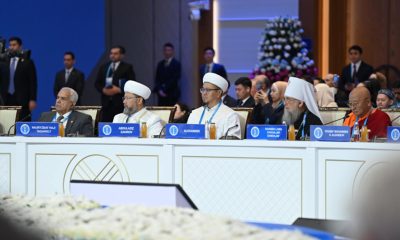
Astana's congress of world religions: A global platform for dialogue in an age of division
-
 Kazakhstan3 days ago
Solana company partners with Kazakhstan on $6B Alatau Crypto Megacity
-
 Iran3 days ago
Will the Gulf monarchies rise above internecine disputes in the interest of collective security?