Ukraine
Ukraine: As fears of all-out war grow, words still matter despite Bulgarian president’s gaffe

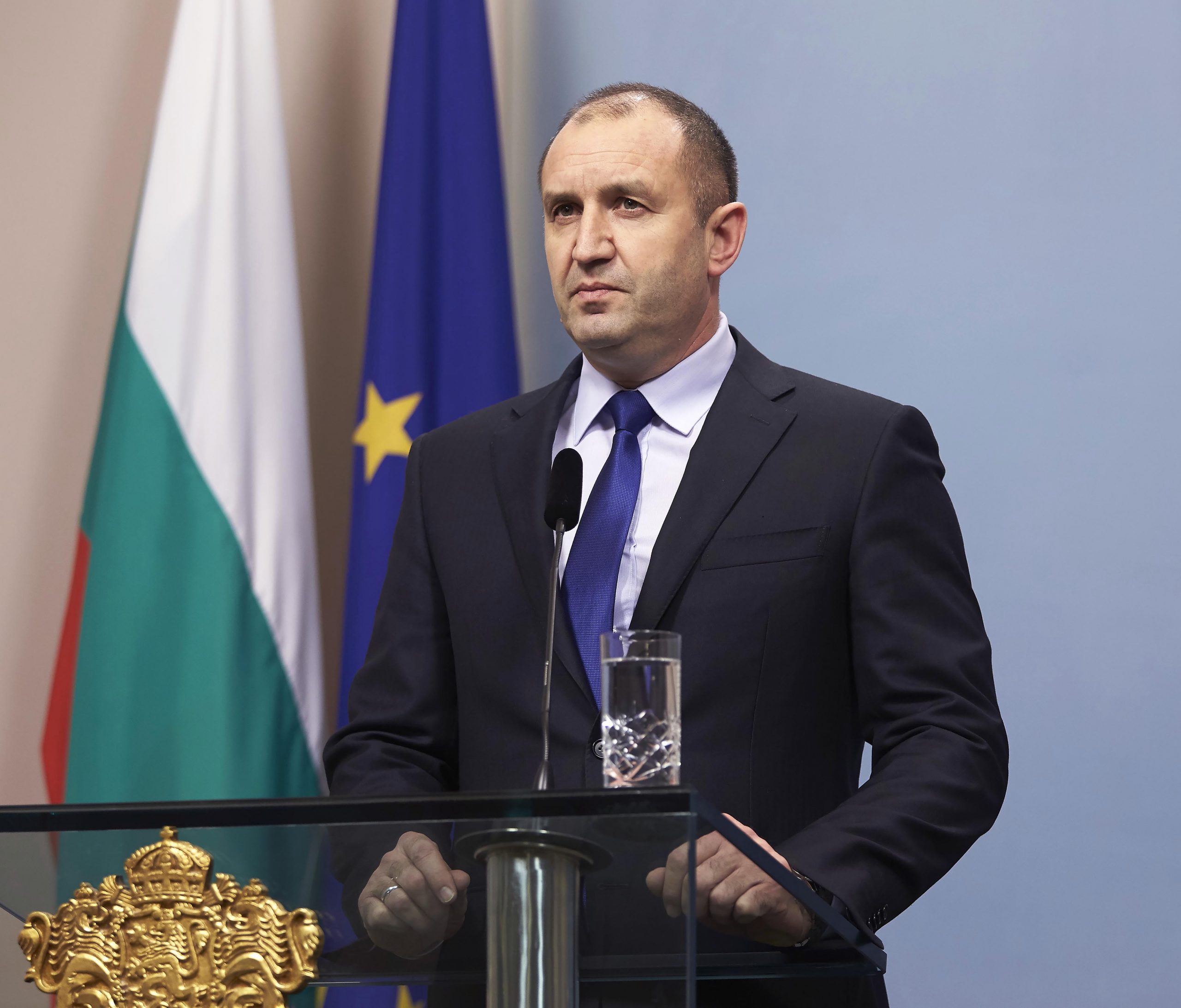
Following his re-election, Bulgarian President Rumen Radev (pictured) has tried to undo the diplomatic damage caused by his comment in a campaign debate that Crimea is “right now, Russian, what else can it be?”, writes Nick Powell, political editor.
His country’s ambassador in Kyiv had been summoned to Ukraine’s foreign ministry and told that the president must disown his words. Meanwhile, the US Embassy in Sofia expressed “deep concern” at the remarks. They appeared to undermine the position of every EU and NATO member, that Russia’s annexation of the Crimean peninsula in 2014 was a grave breach of international law, triggering sanctions against Moscow that remain in force.
Once Radev was re-elected, a statement from the president’s office clarified that “from a legal point of view, Crimea belongs to Ukraine”. It said he had “repeatedly stated that the annexation of Crimea is in violation of international law” and that Bulgaria supported Ukraine’s “sovereignty and territorial integrity”.
That mattered because Russia and Ukraine don’t just have a frozen conflict in Crimea but an active war in Donbas, between Russian sponsored rebels and Ukrainian forces. Recent Russian troop deployments have led to fears in Kyiv -and in Washington and at NATO headquarters- that a full-scale invasion could be imminent. President Radev’s words were badly timed, as well as badly chosen.
Moscow says it would only invade if provoked, whilst making it clear that the supply of lethal weapons to Ukraine’s once ill-equipped armed forces, notably from the United States and Turkey, is indeed regarded as a provocation. Not that Russia itself hasn’t been keen to see just how far it can go before it provokes a response.
The support for the rebellion Russia had fomented in Donbas soon led to an even more extreme breach of international norms. In July 2014 a Russian supplied anti-aircraft missile shot down a Malaysian airliner, killing everyone on board, most of them Dutch citizens on a flight from Amsterdam.
Even if Moscow had expected the missile to hit a Ukrainian military aircraft, it was in effect an act of state-sponsored terrorism and could have been the moment of reckoning. Ukraine’s independence and territorial integrity is guaranteed by the United States and the United Kingdom (and Russia!) under the 1994 Budapest Memorandum, in return for which Ukraine gave up the Soviet nuclear weapons based on its territory.
Despite promises of NATO membership to Ukraine, foolish promises as they were not acted on, the US and UK were never going to respond militarily, Nor were the Dutch asking for such action, although the Americans had asked their NATO allies for military support after the 9/11 attacks. So what could happen now?
Ukrainian Prime Minister Denys Shmyhal has called for a constant NATO naval presence in the Black Sea and more reconnaissance flights along the border with Russia, plus more training exercises on Ukrainian soil. Such a package would of course be viewed by Russia as further provocation but would put into deeds the words of US President Joe Biden, who has promised “unwavering support for the sovereignty and territorial integrity of Ukraine”.
In effect, Biden is gambling that President Putin will stop short of all-out war and the casualties that even a short and successful campaign would bring. Instead Putin will seek to intimidate Ukraine and its allies into accepting that Kyiv must ultimately answer to Moscow and stop deepening its relations with the EU and NATO. In that case a game of bluff will probably continue, with what Russia regards as western provocations in support of Ukraine.
That is of course an extremely dangerous scenario but not alas an unlikely one. Putin has turned down a final request from Angela Merkel for talks aimed at reviving the Minsk agreements, which were meant to end the conflict in Donbas. She is leaving office as German Chancellor with a warning that more EU sanctions against Russia could be needed.
The incoming government in Berlin states in its coalition agreement that a peaceful solution in Ukraine and the lifting of sanctions depends on implementing the Minsk agreements. If that doesn’t happen, we can expect an early test for Annalena Baerbock, the new Green foreign minister who’s expected to take a tough line with Russia.
The coalition agreement demands “an immediate end to the attempts at destabilisation against Ukraine, the violence in eastern Ukraine and the illegal annexation of Crimea”. The EU could soon be using more of its economic might to support Ukraine and pressure Russia. The task is to persuade Putin that it is better to negotiate from a position of strength, as the Minsk agreements would preserve Russian influence in Donbas.
The danger is that military “provocations” will leave him feeling that he’ll look as if he’s negotiating through weakness and instead choose to launch an invasion.
Share this article:
EU Reporter publishes articles from a variety of outside sources which express a wide range of viewpoints. The positions taken in these articles are not necessarily those of EU Reporter. Please see EU Reporter’s full Terms and Conditions of publication for more information EU Reporter embraces artificial intelligence as a tool to enhance journalistic quality, efficiency, and accessibility, while maintaining strict human editorial oversight, ethical standards, and transparency in all AI-assisted content. Please see EU Reporter’s full A.I. Policy for more information.




EU foreign ministers to discuss options for restricting trade with Israeli communities in Judea and Samaria

European operation dismantles €10 million illicit cigarette network in Spain

Srebrenica's lesson is prevention. Why isn't the world applying It to Kashmir?

Energy Union Task Force takes stock of oil and gas security of supply in the EU

ALROSA Re-elects Supervisory Board with Minimal Changes

AIFC to host Astana Finance Days 2026 in September

Joint statement by High Representative/Vice-President Kallas and Commissioner Kos on the 31st anniversary of the Srebrenica genocide

EU launches a Team Gaza Initiative to support early recovery in Gaza with an initial amount of nearly €900 million

Shusha Global Media Forum: Azerbaijan’s Answer to Disinformation

Commission approves French state aid to support offshore wind energy

Natura 2000 Network offers opportunities for sustainable tourism across Europe

Commission adds exemptions to rules on removability of portable batteries

EU steps up international support for Palestinians with major initiative for Gaza's early recovery and stronger international coordination

Kurmuk gold project highlights Africa’s changing investment landscape

Falling in love with the Maldives

Britain’s leadership crisis is a symptom, not the disease

Kazakhstan reforms under scrutiny at Brussels Press Club round table

Japan should face up to history and contribute more to regional peace

Ambassador calls for 'speeding up' of co-operation between EU and Kazakhstan

Timur Turlov at Smart Moves Summit 2025: How chess can transform global education

Shevtsova’s case: Out-of-court sanctions dismantling trust in Ukrainian cause

The future of European transport

Trump Vs Trueman

US 'no longer' an 'unconditional ally' for Europe - MEP
-
 Israel5 days ago
EU foreign ministers to discuss options for restricting trade with Israeli communities in Judea and Samaria
-
 Cigarettes4 days ago
European operation dismantles €10 million illicit cigarette network in Spain
-
 Kashmir4 days ago
Srebrenica's lesson is prevention. Why isn't the world applying It to Kashmir?
-
 Energy market3 days ago
Energy Union Task Force takes stock of oil and gas security of supply in the EU