Ukraine
UNESCO designates Ukraine's Odesa a World Heritage in Danger site


UNESCO, the United Nations cultural agency, announced on Wednesday (25 January) that it had made Odesa, a strategically located port city on Ukraine’s Black Sea coast, a World Heritage in Danger location.
Russia invaded Ukraine 11 month ago and denounced this designation. They claimed that the only threat to Odesa was from the "nationalist regime" in Ukraine.
A Paris-based UNESCO panel awarded Odesa the status. It is intended to protect Odesa’s cultural heritage which was under threat since Russia invaded and to allow for financial and technical assistance.
Since the invasion of Ukraine on February 24, 2022, Russia has bombarded Odesa several times.
Part of Odesa's Museum of Fine Arts' large glass roof and windows, which were inaugurated in 1899, was destroyed by fire on 20 July, 2022.
Audrey Azoulay, Director General of UNESCO, stated that Odesa was a "free city", a "world city", and a "legendary port" that had made a significant impact on literature, cinema, and the arts.
Azoulay stated, "As the war goes on, this inscription reflects my collective determination to save this city from greater destruction."
Volodymyr Zelenskiy, the Ukrainian President, stated that this decision would "help us protect Odesa... Russia is incapable of defending anything but terror and strikes."
UNESCO added the Landmarks of the Ancient Kingdom of Saba and Marib in Yemen to its list of World Heritage in Danger.
Russia's Foreign Ministry stated that it was in agreement with Odesa's decision to preserve and celebrate its legacy.
It stated: "But this requires clarification that the only threat to the city’s rich history stems form Ukraine's nationalist regime, which systematically destroys monuments for the founders and protectors of Odesa."
It specifically cited a monument to Russian Empress Catherine the Great, widely believed to be the city's creator - which was demolished by an order from city authorities last year.
The UNESCO debate on Odesa lasted hours, as Russia unsuccessfully attempted to postpone the vote.
Odesa was founded in the last years of 18th century near the Ottoman fortress. Its position on the Black Sea shores allowed it to be one of the most important ports of the Russian Empire.
Its position as a major trading center brought it significant wealth, making it one of the most cosmopolitan and cosmopolitan places in Eastern Europe.
Its Opera House is one of the city's most iconic historic landmarks. In June 2022 it was reopened and became a symbol for resilience. The giant stairway that leads to the harbour was immortalised in Sergei Eisenstein’s silent 1925 film Battleship Potemkin.
Despite significant damage from World War Two, the city's famous central grid of 19th-century buildings, which is low-rise, survived largely intact.
Odesa was an important tourist destination for Ukraine before Russia invaded. All that changed when the Black Sea became a battlefield. Near the city's coast, sea mines are still present.
Share this article:
EU Reporter publishes articles from a variety of outside sources which express a wide range of viewpoints. The positions taken in these articles are not necessarily those of EU Reporter. Please see EU Reporter’s full Terms and Conditions of publication for more information EU Reporter embraces artificial intelligence as a tool to enhance journalistic quality, efficiency, and accessibility, while maintaining strict human editorial oversight, ethical standards, and transparency in all AI-assisted content. Please see EU Reporter’s full A.I. Policy for more information.






EU foreign ministers to discuss options for restricting trade with Israeli communities in Judea and Samaria

European operation dismantles €10 million illicit cigarette network in Spain

Srebrenica's lesson is prevention. Why isn't the world applying It to Kashmir?

AIFC to host Astana Finance Days 2026 in September

Energy Union Task Force takes stock of oil and gas security of supply in the EU

ALROSA Re-elects Supervisory Board with Minimal Changes

Joint statement by High Representative/Vice-President Kallas and Commissioner Kos on the 31st anniversary of the Srebrenica genocide

EU clarifies rules to allow continued waste recovery shipments to Switzerland

Shusha Global Media Forum: Azerbaijan’s Answer to Disinformation

Commission approves French state aid to support offshore wind energy

Natura 2000 Network offers opportunities for sustainable tourism across Europe

Commission adds exemptions to rules on removability of portable batteries

EU steps up international support for Palestinians with major initiative for Gaza's early recovery and stronger international coordination

Kurmuk gold project highlights Africa’s changing investment landscape

Falling in love with the Maldives

Britain’s leadership crisis is a symptom, not the disease

Kazakhstan reforms under scrutiny at Brussels Press Club round table

Japan should face up to history and contribute more to regional peace

Ambassador calls for 'speeding up' of co-operation between EU and Kazakhstan

Timur Turlov at Smart Moves Summit 2025: How chess can transform global education

Shevtsova’s case: Out-of-court sanctions dismantling trust in Ukrainian cause

The future of European transport

Trump Vs Trueman

US 'no longer' an 'unconditional ally' for Europe - MEP
-
 Israel4 days ago
EU foreign ministers to discuss options for restricting trade with Israeli communities in Judea and Samaria
-
 Cigarettes3 days ago
European operation dismantles €10 million illicit cigarette network in Spain
-
 Kashmir3 days ago
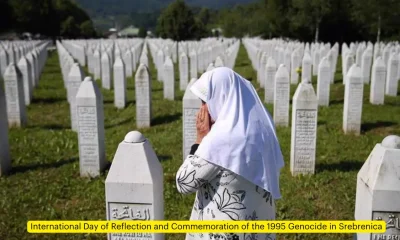
Srebrenica's lesson is prevention. Why isn't the world applying It to Kashmir?
-
 Kazakhstan2 days ago
AIFC to host Astana Finance Days 2026 in September