General
German court sentences ex-SS camp guard, aged 101, to five years in jail

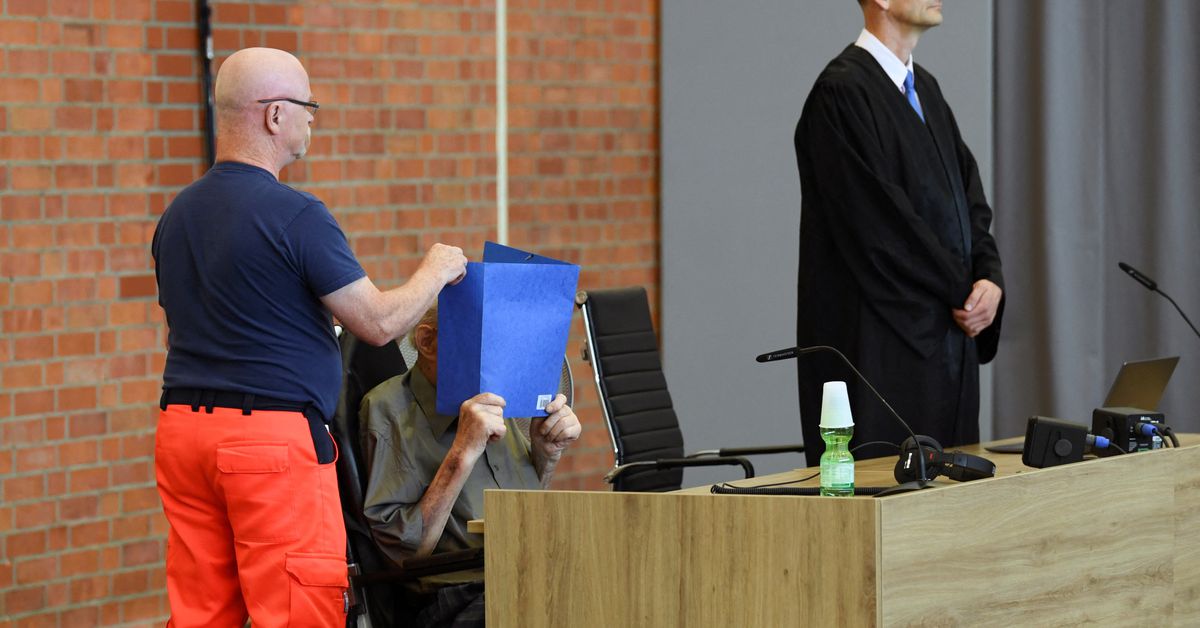
One-hundred-and-one year old former security guard at Sachsenhausen concentration camp is seen in courtroom just before his trial verdict at Landgericht Neuruppin, Brandenburg, Germany, 28 June, 2022.
On Tuesday (28 June), a German court sentenced a former SS Guard to five years imprisonment for helping in the murder of around 3,500 people at Sachsenhausen concentration camp. This brought an end to one of the most recent Nazi trials in Germany.
Josef S. was a paramilitary SS member who, according to the prosecution, contributed to the death of 3,518 people at Sachsenhausen camp north of Berlin by standing guard in the watchtower from 1942 to 1945.
The trial lasted nearly nine months because doctors said that the man, whose full identity was withheld due to German trial reporting rules had not been disclosed, was only partially fit for trial. Sessions were limited to two hours per day.
Some Sachsenhausen internees were executed with Zyklon B, the same poison gas used in other extermination camps in which millions of Jews died during the Holocaust.
Sachsenhausen was home to mainly political prisoners from Europe and Soviet prisoners of war, as well as some Jews.
In recent years, a number of charges have been brought against ex-guards at concentration camps for World War Two crimes versus humanity. A former camp secretary fled the scene on September 2, the day before her trial began, but was captured by police just hours later.
These prosecutions were made possible by a 2011 court ruling that stated that anyone who contributed in indirect ways to wartime murders without triggering a trigger or giving an instruction could be held criminally responsible.
Stefan Waterkamp, a defence lawyer, said that his client would appeal Tuesday’s ruling and that a higher Court would decide if "general guard without concrete participation" was sufficient to warrant such a verdict.
Share this article:
EU Reporter publishes articles from a variety of outside sources which express a wide range of viewpoints. The positions taken in these articles are not necessarily those of EU Reporter. Please see EU Reporter’s full Terms and Conditions of publication for more information EU Reporter embraces artificial intelligence as a tool to enhance journalistic quality, efficiency, and accessibility, while maintaining strict human editorial oversight, ethical standards, and transparency in all AI-assisted content. Please see EU Reporter’s full A.I. Policy for more information.




Kazakhstan cuts water use by 874 mln m³ through new technologies

Inconvenient questions about Andorra and San Marino that Brussels should be asking

Serbia’s business environment is driving its integration into the EU

Record breaking Belgian sailors making more waves

Europe's peripheral and maritime regions 'combine many territorial assets', meeting told

How digital wallets are changing the way Welsh consumers pay for online services

Message to Kemi Badenoch: 'Make a splash by thinking out-of-the-box on UK-Europe relationship'

New EU rules on pay transparency explained

What 'house edge' means in Blackjack and why it varies between games

EU advances zero-emission truck corridors and autonomous vehicle testbeds

Plea for calm in Belfast amid violent disorder

Chinese and European Youth Invited to Showcase Creativity in International Cartoon and Short Video Contest

Commission updates EU Air Safety List: Air Express Algeria added, air carriers from Kyrgyzstan removed

EU increases support to contain Ebola outbreak

European Union and Australia successfully conclude Horizon Europe negotiations

OceanEye initiative places EU at the forefront of ocean observation

Kazakhstan reforms under scrutiny at Brussels Press Club round table

Japan should face up to history and contribute more to regional peace

Ambassador calls for 'speeding up' of co-operation between EU and Kazakhstan

Timur Turlov at Smart Moves Summit 2025: How chess can transform global education

Shevtsova’s case: Out-of-court sanctions dismantling trust in Ukrainian cause

The future of European transport

Trump Vs Trueman

US 'no longer' an 'unconditional ally' for Europe - MEP
-
 Kazakhstan3 days ago
Kazakhstan cuts water use by 874 mln m³ through new technologies
-
 San Marino5 days ago
Inconvenient questions about Andorra and San Marino that Brussels should be asking
-
 General3 days ago
Serbia’s business environment is driving its integration into the EU
-
 Belgium3 days ago
Record breaking Belgian sailors making more waves