Banking
Commission adopts reporting rules on banks' exposure to shadow banking


The European Commission has adopted technical standards to be used by credit institutions when reporting their exposures to shadow banking entities, as required by the Capital Requirements Regulation. These standards set out criteria for the identification of shadow banking entities, ensuring the harmonization and comparability of exposures reported by credit institutions. The standards will also provide supervisors with robust data to assess banks' risks in relation to non-banking financial intermediaries. This will reinforce the prudential framework, allowing for an improved transparency of the material linkages between the traditional banking sector and the shadow banking sector.
Financial Services, Financial Stability and Capital Markets Union Commissioner Mairead McGuinness said: “Non-bank financial institutions have grown during recent years. Some have built up considerable leverage and liquidity mismatches and, as highlighted by the recent losses in the banking sector involving those entities, their activity could pose a risk to the financial system. Today's rules provide EU-active banks with additional clarity on which entities come under shadow banking, ensuring reporting consistency across banks and improving supervisors' capacity to detect the build-up of large exposures to non-bank financial institutions and manage the risks effectively.”
The requirements, adopted in the form of a Delegated Regulation, will now be formally transmitted to the European Parliament and the Council, who will have three months to scrutinise the act. The updated Delegated Regulation is available here.
Share this article:
EU Reporter publishes articles from a variety of outside sources which express a wide range of viewpoints. The positions taken in these articles are not necessarily those of EU Reporter. Please see EU Reporter’s full Terms and Conditions of publication for more information EU Reporter embraces artificial intelligence as a tool to enhance journalistic quality, efficiency, and accessibility, while maintaining strict human editorial oversight, ethical standards, and transparency in all AI-assisted content. Please see EU Reporter’s full A.I. Policy for more information.



Who will win the 2026 World Cup? Data points to Spain

Western investors eye Russian assets again as sanctions discounts persist

EU green jobs: Which activities employ the most people?

Chinese and European Youth Invited to Showcase Creativity in International Cartoon and Short Video Contest

'I don’t think Jews have a place neither in France nor in Belgium’, says Israeli deputy foreign minister

Shaping Europe’s startup future: Commissioner Zaharieva meets young innovators in Sofia

European Union and Australia successfully conclude Horizon Europe negotiations

OceanEye initiative places EU at the forefront of ocean observation

Commission proposes €540 million in financial relief and other supports for farmers facing fertiliser crisis

EU and Republic of Korea bolster strategic partnership with new areas of cooperation

EU finance ministers back EIB Group strategy for a stronger, more secure Europe in a more stable world

The Earth is accumulating heat at an accelerating rate: Global warming reached 1.37°C in 2025

Shoot the messenger: How Europe learned to silence its own warnings

When Brussels messes up: The people always pay

The G7 has a critical minerals plan, but it is missing a development chapter

How European businesses are rethinking customer support in the AI era

Kazakhstan reforms under scrutiny at Brussels Press Club round table

Japan should face up to history and contribute more to regional peace

Ambassador calls for 'speeding up' of co-operation between EU and Kazakhstan

Timur Turlov at Smart Moves Summit 2025: How chess can transform global education

Shevtsova’s case: Out-of-court sanctions dismantling trust in Ukrainian cause

The future of European transport

Trump Vs Trueman

US 'no longer' an 'unconditional ally' for Europe - MEP
-
 Sport3 days ago
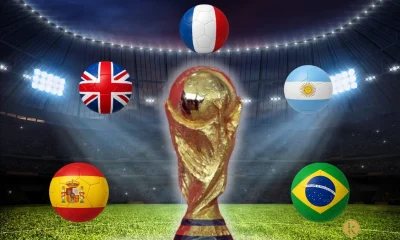
Who will win the 2026 World Cup? Data points to Spain
-
 Russia5 days ago
Western investors eye Russian assets again as sanctions discounts persist
-
 Green Week5 days ago
EU green jobs: Which activities employ the most people?
-
 China-EU4 days ago
Chinese and European Youth Invited to Showcase Creativity in International Cartoon and Short Video Contest