Housing
Housing and renting difficulties: what is the EU’s situation?


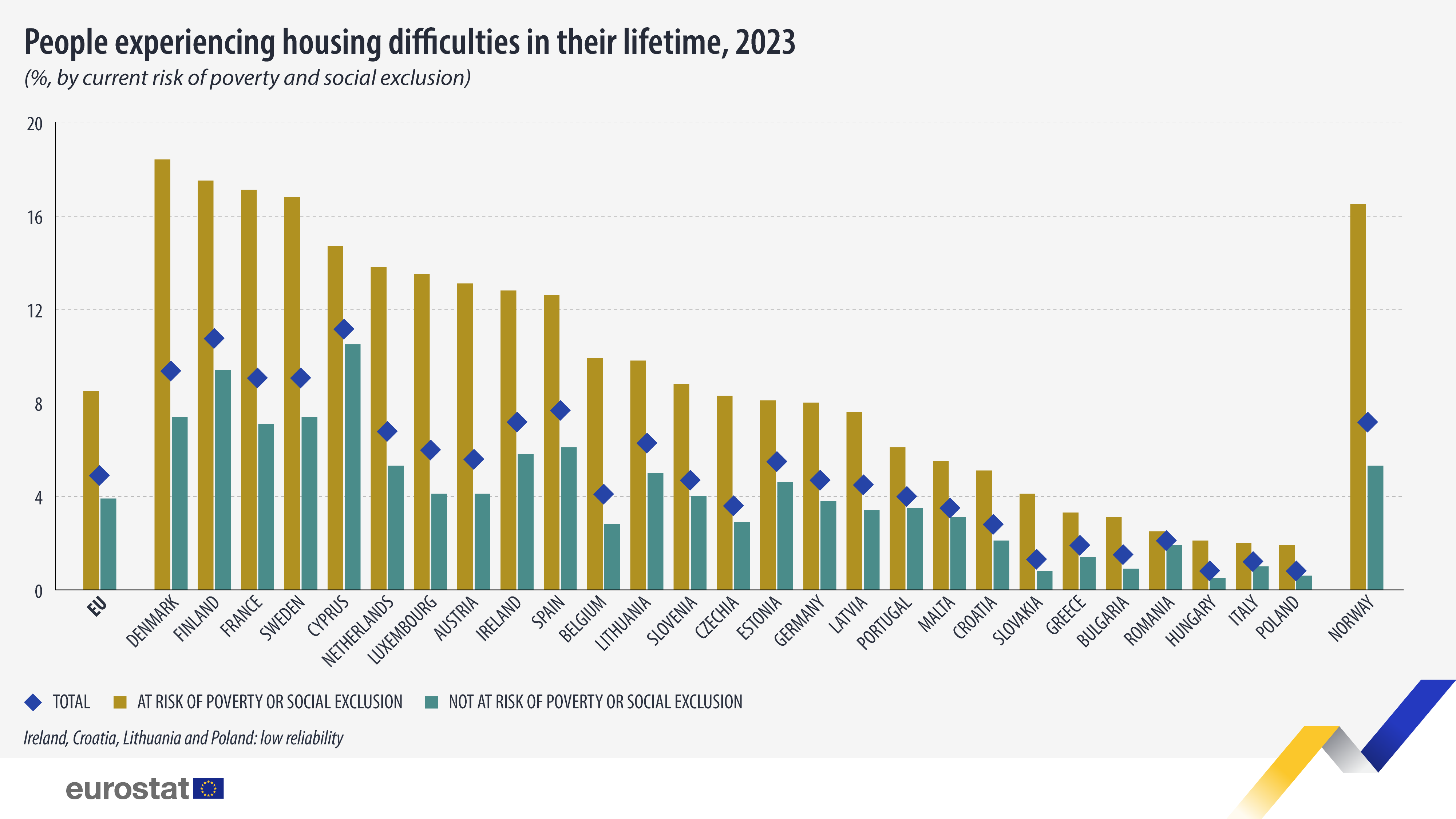
In 2023, across the EU, approximately 4.9% of people aged 16 or over reported experiencing housing difficulties in their lifetime (situation when a person had no place of their own and was forced to stay in a temporary accommodation). This percentage was significantly higher for people at risk of poverty or social exclusion (8.5%). On the other hand, only 3.9% of people not at risk of poverty or social exclusion reported facing housing difficulties in their lifetime.
EU countries with the highest rates of housing difficulties among those at risk of poverty or social exclusion were Denmark (18.4%), Finland (17.5%) and France (17.1%). In contrast, the lowest rates were observed in Poland (1.9%), Italy (2.0%) and Hungary (2.1%).
Source dataset: ilc_lvhd01
People aged 65 and over reported the lowest rates of renting difficulties
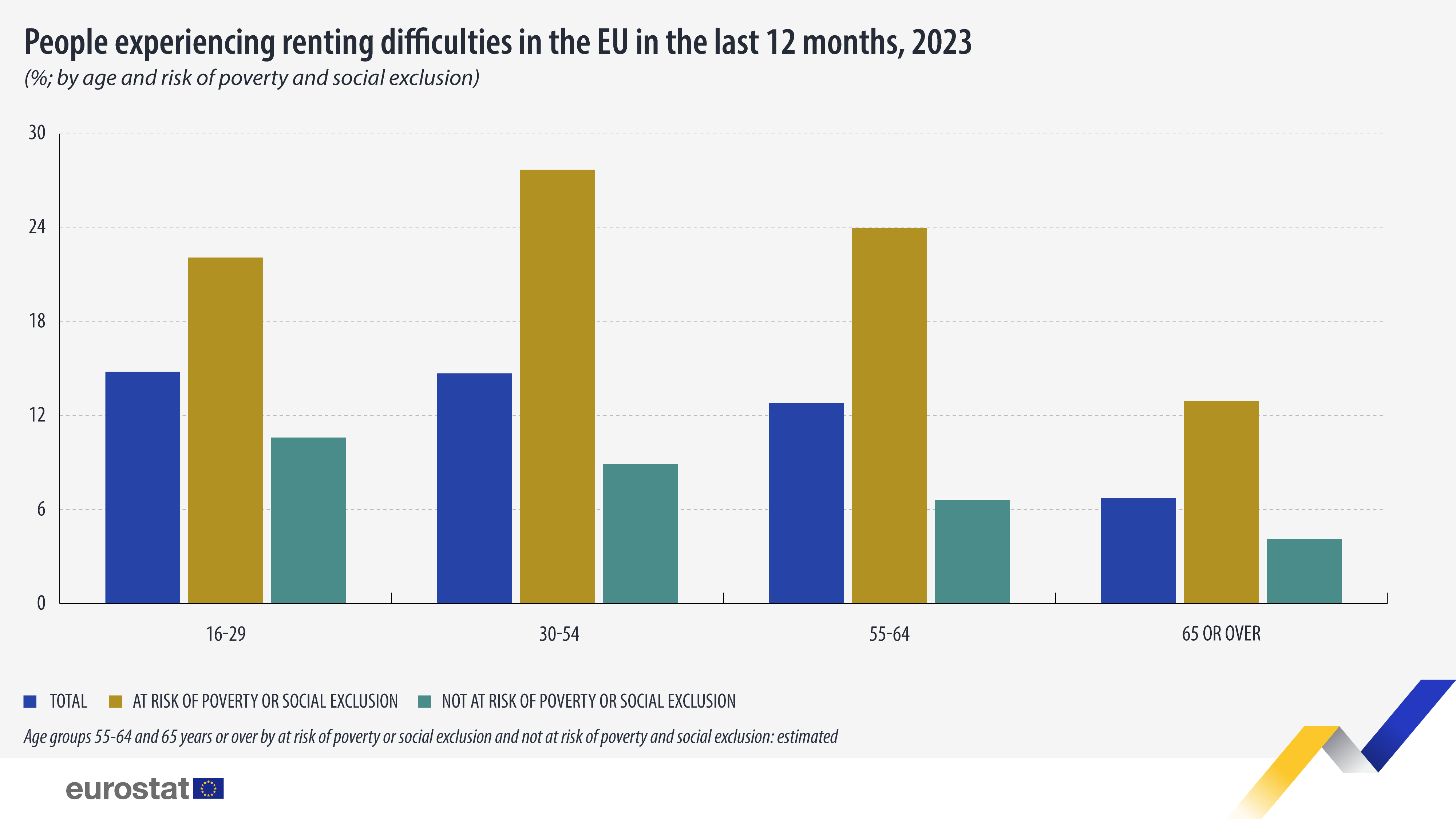
At EU level, people aged 16 to 29 and 30 to 54 reported the highest rates of renting difficulties, 14.8% and 14.7%, respectively, while this rate decreased to 12.8% for those aged 55 to 64 and 6.7% for people aged 65 years or over.
Data show that people at risk of poverty or social exclusion at all ages suffer the most from renting difficulties. However, this pattern decreases with age.
When looking at people at risk of poverty or social exclusion, renting difficulties were higher at 27.7% for people aged 30-54 years, followed by 24.0% for people aged 55 to 64 and 22.1% for those 16 to 29 years. Among those aged 65 years or older, 12.9% of those at risk of poverty or social exclusion reported having renting difficulties, the lowest share.
Source dataset: ilc_lvhd08
For more information
- Statistics Explained article on living conditions in Europe - housing and renting difficulties
- Thematic section on income and living conditions
- Database on income and living conditions
Methodological notes
- Housing difficulties are defined as situations where a person had no place of their own (either owned or rented) and was forced to stay with friends or family, use emergency or temporary accommodation, live in a place not intended as a permanent home, or sleep in a public space. Temporary displacement due to unforeseen events, such as natural disasters or emergencies, is not considered housing difficulties if the person still had a permanent residence (either owned or rented) to return to.
- Renting difficulties occur when an individual is unable to cover the cost of their accommodation, during the last 12 months, using their own resources, without having to borrow money, take out a loan, or resort to other financial means to pay their rent.
- The EU-SILC six yearly module intergenerational transmission of disadvantages and housing difficulties collects information on different aspects of having experienced past housing difficulties in a person’s lifetime, including reasons for such difficulties, duration of the most recent experience, and how individuals overcame these challenges, as well as specific questions on renting difficulties.
Share this article:
EU Reporter publishes articles from a variety of outside sources which express a wide range of viewpoints. The positions taken in these articles are not necessarily those of EU Reporter. Please see EU Reporter’s full Terms and Conditions of publication for more information EU Reporter embraces artificial intelligence as a tool to enhance journalistic quality, efficiency, and accessibility, while maintaining strict human editorial oversight, ethical standards, and transparency in all AI-assisted content. Please see EU Reporter’s full A.I. Policy for more information.



Counterfeit cigarettes drive illicit tobacco trade to highest level in a decade, new study claims

High-speed drama shatters Monaco’s tranquil façade

Libya’s fuel crisis offers lessons for energy security on both sides of the Mediterranean

EU agri-food trade surplus expands in February 2026

Commission disburses €7.2 billion to Poland under NextGenerationEU

Spring semester package: Steering EU economies to increased competitiveness

Africa CDC urges protection for Ebola aid workers

EU and Moldova strengthen cooperation on jobs, skills and social rights

Commission endorses Lithuania’s €884 million Social Climate Plan to support vulnerable households and micro-enterprises in the clean transition

New EU rules on pay transparency explained

Record breaking Belgian sailors making more waves

Message to Kemi Badenoch: 'Make a splash by thinking out-of-the-box on UK-Europe relationship'

Kazakhstan cuts water use by 874 mln m³ through new technologies

Europe's peripheral and maritime regions 'combine many territorial assets', meeting told

Inconvenient questions about Andorra and San Marino that Brussels should be asking

How digital wallets are changing the way Welsh consumers pay for online services

Kazakhstan reforms under scrutiny at Brussels Press Club round table

Japan should face up to history and contribute more to regional peace

Ambassador calls for 'speeding up' of co-operation between EU and Kazakhstan

Timur Turlov at Smart Moves Summit 2025: How chess can transform global education

Shevtsova’s case: Out-of-court sanctions dismantling trust in Ukrainian cause

The future of European transport

Trump Vs Trueman

US 'no longer' an 'unconditional ally' for Europe - MEP
-
 Health3 days ago
Counterfeit cigarettes drive illicit tobacco trade to highest level in a decade, new study claims
-
 France5 days ago
High-speed drama shatters Monaco’s tranquil façade
-
 Libya3 days ago
Libya’s fuel crisis offers lessons for energy security on both sides of the Mediterranean
-
 Agriculture4 days ago
EU agri-food trade surplus expands in February 2026