Brexit
#Brexit: Scotland is Europe’s new Balkans - not wanted on EU voyage


Europe’ most virulent outbreak of tribalism is nowadays evident in Scotland’s determination to quit the United Kingdom and team up with the EU. The problem is that the EU has no intention of participating in this particular version of the Highland Fling, writes Peter Isaac.
Scotland’s main economic dowry of whisky is now almost entirely owned outside Scotland. Its two banks, the Bank of Scotland and the Royal Bank of Scotland are bankrupt and nationalized and controlled from London.
Its oil and oil services industry is badly depleted. That leaves salmon. Here Scotland indeed holds a global trade asset. Its commercial fish farming has added to instead of depleting its tourist value.
Then there is of course tourism itself and here again Scotland possesses a unique asset in that its hospitality is far more competitive and generous than anything south of the border.
The reason that the EU is not courting Scotland is that Scotland is regarded as a potential Greece whose insoluble finances have been mercifully camouflaged by the near-hysterical Project Fear attendant upon Brexit and the subsequent panic-attack entirely generated within London and its elites.
Scotland’s romantic attachment to near-Europe began in Elizabethan times with a focus on France.
It is here one might imagine that Scots in the years since the UK joined the EU might have accomplished something that proved too much for their English neighbours. Namely, to learn French. In the event Scotland put its educational thrust behind reviving Gaelic which is now pronounced as in “garlic”.
So instead of immersion courses concentrating on a living language one encounters in the Western Isles especially eccentric communes devoted to re-instilling a long-forgotten language. At least French president Francois Hollande has stalled in giving the green light to France’s 75 nascent languages.
The failure of Scotland to institute its own engine block–grade production engineering industry began to make itself obvious in the middle of the last century and this concern intensified as Asian ship builders took over from the Clyde.
As recently as 20 years ago there was a strong hope that Silicon Glen would become a fixture in the IT sector. In the event and through lack of scale it too became submerged, as did Finland’s and Canada’s.
All this is not apparent to anyone passing through Scotland. To the question of how exactly Scotland will make its way in the world as a country in its own right one receives the breezy reply that whisky and salmon will do the trick.
The country which provided the New World with its doctors, engineers, and educationalists has become Europe’s current version of such vintage, yet currently quiescent, nationalistic trouble spots as Catalonia, the Balkans, and the Basque region.
Share this article:

EU Reporter publishes articles from a variety of outside sources which express a wide range of viewpoints. The positions taken in these articles are not necessarily those of EU Reporter. Please see EU Reporter’s full Terms and Conditions of publication for more information EU Reporter embraces artificial intelligence as a tool to enhance journalistic quality, efficiency, and accessibility, while maintaining strict human editorial oversight, ethical standards, and transparency in all AI-assisted content. Please see EU Reporter’s full A.I. Policy for more information.




Who will win the 2026 World Cup? Data points to Spain

Western investors eye Russian assets again as sanctions discounts persist

EU green jobs: Which activities employ the most people?

Chinese and European Youth Invited to Showcase Creativity in International Cartoon and Short Video Contest

'I don’t think Jews have a place neither in France nor in Belgium’, says Israeli deputy foreign minister

European Union and Australia successfully conclude Horizon Europe negotiations

EU's labour productivity slightly increased in Q1 2026

OceanEye initiative places EU at the forefront of ocean observation

EU and Republic of Korea bolster strategic partnership with new areas of cooperation

EU finance ministers back EIB Group strategy for a stronger, more secure Europe in a more stable world

The Earth is accumulating heat at an accelerating rate: Global warming reached 1.37°C in 2025

Shoot the messenger: How Europe learned to silence its own warnings

When Brussels messes up: The people always pay

The G7 has a critical minerals plan, but it is missing a development chapter

How European businesses are rethinking customer support in the AI era

Latest financial report by Corinthia Hotel owners, IHI, raises questions over financial stability

Kazakhstan reforms under scrutiny at Brussels Press Club round table

Japan should face up to history and contribute more to regional peace

Ambassador calls for 'speeding up' of co-operation between EU and Kazakhstan

Timur Turlov at Smart Moves Summit 2025: How chess can transform global education

Shevtsova’s case: Out-of-court sanctions dismantling trust in Ukrainian cause

The future of European transport

Trump Vs Trueman

US 'no longer' an 'unconditional ally' for Europe - MEP
-
 Sport3 days ago
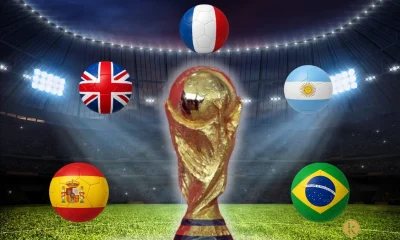
Who will win the 2026 World Cup? Data points to Spain
-
 Russia5 days ago
Western investors eye Russian assets again as sanctions discounts persist
-
 Green Week5 days ago
EU green jobs: Which activities employ the most people?
-
 China-EU4 days ago
Chinese and European Youth Invited to Showcase Creativity in International Cartoon and Short Video Contest