Arts
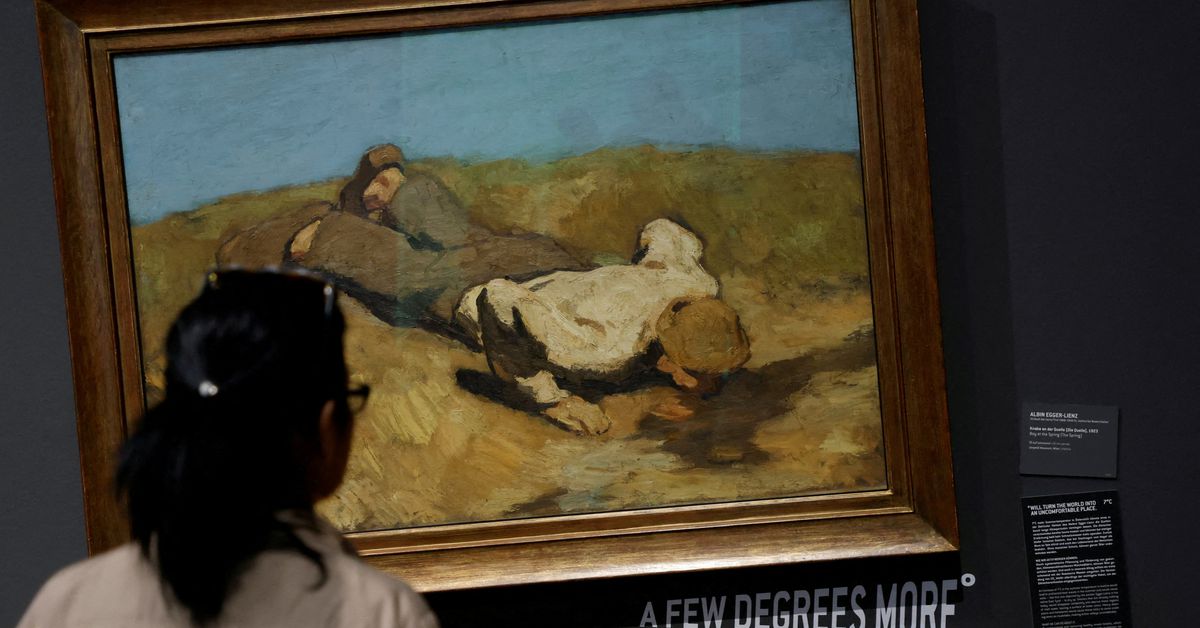
Vienna 'few degrees' exhibit tilts paintings to call for climate action

Activists from the group Last Generation smeared the screen in front of Klimt's "Death and Life" at the Leopold Museum in Vienna and glued one of their hands to it in the November protest calling for an end to drilling for oil.
"We found this way to be absolutely the wrong one," the museum's artistic director, Hans-Peter Wipplinger, said on the opening day of its response: a small exhibition with the full title "A Few Degrees More (Will Turn the World into an Uncomfortable Place)".
It involves hanging 15 works by artists including Klimt and fellow Austrian great Egon Schiele at an angle, with texts calling attention to the effect that global warming of more than 1.5 degrees Celsius (2.7 Fahrenheit) from pre-industrial levels would have on the landscapes depicted in them.
According to the United Nations' Intergovernmental Panel on Climate Change (IPCC), emissions must be halved by the mid-2030s if the world is to have any chance of limiting the temperature rise to 1.5 degrees Celsius above pre-industrial levels - a key target enshrined in the 2015 Paris Agreement.
"We wanted to initiate something productive, something communicative. That means conveying a message and not just in spectacular images (such as the protest) but by helping visitors learn about the situation and the various contexts of this global heating," Wipplinger said.
The exhibition runs until 26 June.
Share this article:
EU Reporter publishes articles from a variety of outside sources which express a wide range of viewpoints. The positions taken in these articles are not necessarily those of EU Reporter. Please see EU Reporter’s full Terms and Conditions of publication for more information EU Reporter embraces artificial intelligence as a tool to enhance journalistic quality, efficiency, and accessibility, while maintaining strict human editorial oversight, ethical standards, and transparency in all AI-assisted content. Please see EU Reporter’s full A.I. Policy for more information.



Setting a new benchmark in premium travel

Survey on an EU Blueprint for intellectual property licensing and spinoff creation

Burnham as PM? 'Wait and see'

Statement by the Ministry of Foreign Affairs of the Republic of Kazakhstan

Rule of law report strengthens EU democracy and fundamental rights

Kazakhstan: Central Election Committee reviews the results of the nomination of candidates for the deputies of Kurultai

Ban on destruction of unsold clothes and shoes enters into application

Kazakhstan and Belgium: Building a Partnership for the Future

The Digital Markets Act Is Hurting Europeans. It’s Time to Put Progress, Free Markets, and Competition First

From Ukraine to Suez: Why the Mediterranean has become the strategic centre of gravity

Commission sends Statements of Objections to several companies and trade associations in suspected construction chemicals cartel

Commission endorses Latvia’s €617 million Social Climate Plan to support vulnerable households and transport users in the clean transition

Commission fines AliExpress €550 million for breaching the Digital Services Act

Astana Hub unveils infrastructure to support AI innovation in health care

The security environment of the South Caucasus amid changing geopolitical realities

Why the US is losing its legitimacy as a global superpower and the trust of the comity of nations

Kazakhstan reforms under scrutiny at Brussels Press Club round table

Japan should face up to history and contribute more to regional peace

Ambassador calls for 'speeding up' of co-operation between EU and Kazakhstan

Timur Turlov at Smart Moves Summit 2025: How chess can transform global education

Shevtsova’s case: Out-of-court sanctions dismantling trust in Ukrainian cause

The future of European transport

Trump Vs Trueman

US 'no longer' an 'unconditional ally' for Europe - MEP
-
 Aviation/airlines4 days ago
Setting a new benchmark in premium travel
-
 Intellectual Property Rights4 days ago
Survey on an EU Blueprint for intellectual property licensing and spinoff creation
-
 Labour4 days ago
Burnham as PM? 'Wait and see'
-
 Kazakhstan4 days ago
Statement by the Ministry of Foreign Affairs of the Republic of Kazakhstan