Research
EU expenditure on R&D reaches €352 billion in 2022


In 2022, the EU spent €352 billion on research & development (R&D), 6.34% more than in the previous year (€331bn) and 48.52% more than in 2012 (€237bn).
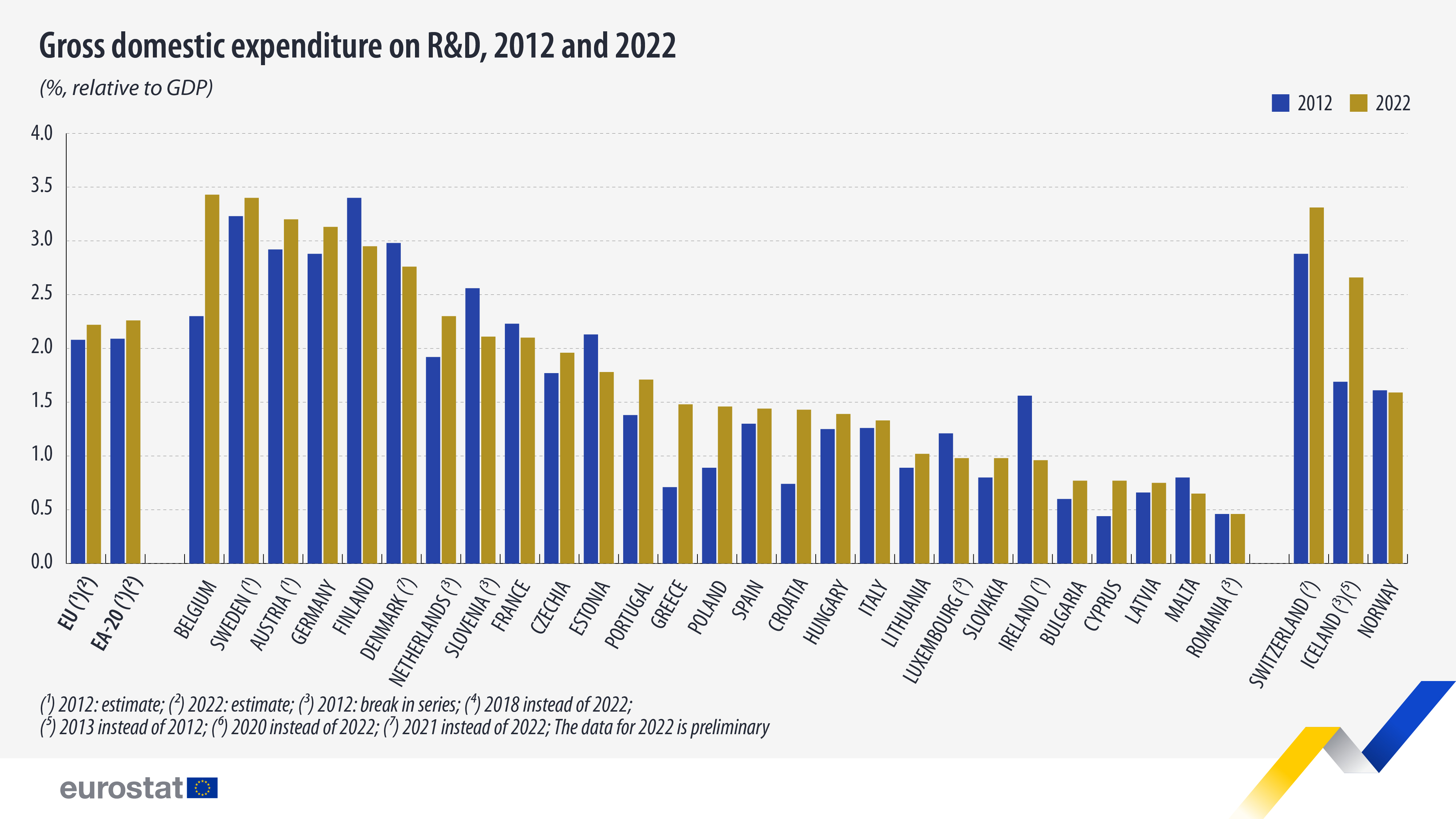
When looking at R&D intensity, i.e. R&D expenditure as a percentage of GDP, data show a slight decrease from 2.27% in 2021 to 2.22% in 2022.
Among the EU members, 4 countries recorded the R&D intensity above 3% in 2022. The highest R&D intensity was recorded in Belgium (3.44%), followed by Sweden (3.40%), Austria (3.20%) and Germany (3.13%).
Source dataset: rd_e_gerdtot
In contrast, 8 EU countries reported R&D intensity below 1%: Romania (0.46%), Malta (0.65%), Latvia (0.75%), Cyprus and Bulgaria (both 0.77%) recorded the lowest shares, followed by Ireland, Slovakia and Luxembourg with shares close to 1%.
Between 2012 and 2022, R&D intensity in the EU increased by 0.14 percentage points (pp). The biggest increases were recorded in Belgium (1.16 pp), Greece (0.77 pp) and Croatia (0.69 pp).
In contrast, R&D intensity decreased in 8 countries. Ireland experienced a decline of -0.6 pp, followed by Finland (-0.45 pp), Estonia (-0.35 pp), Slovenia (-0.30 pp), Luxembourg (-0.23 pp), Denmark (-0.22 pp), Malta (-0.15 pp), and France (-0.13 pp).
Business sector: 66% of the R&D spendings
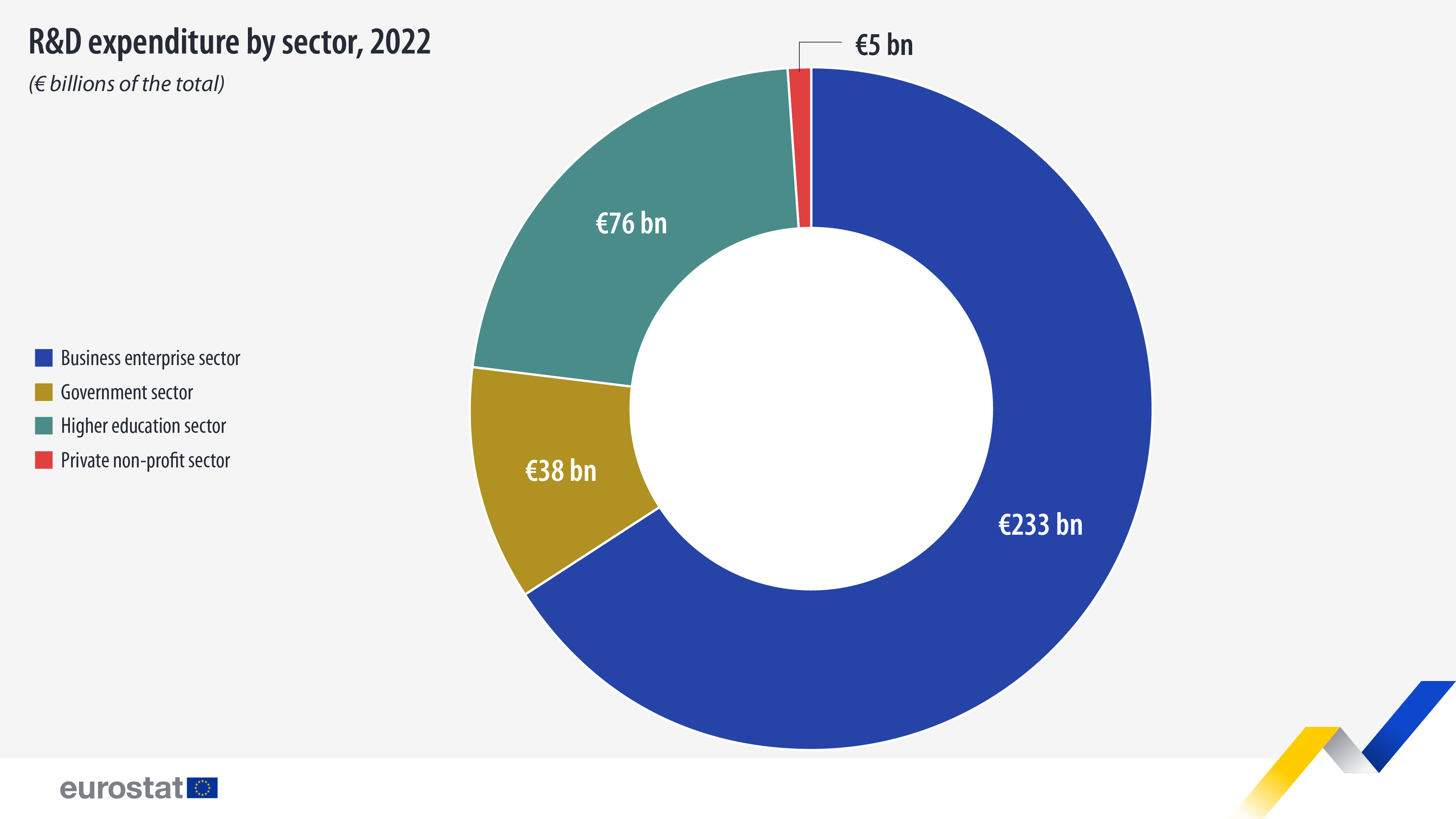
The business enterprise sector continued to account for the largest share of R&D expenditure. In 2022 it represented 66% of EU R&D spending, totalling €233bn. It was followed by the higher education sector (22%; €76bn), the government sector (11%, €37bn), and the private non-profit sector (1%; €5bn).
Source dataset: rd_e_gerdtot
This information comes from provisional data on R&D expenditure published by Eurostat. The article presents a handful of findings from the more detailed Statistics Explained article.
More information
- Statistics Explained article on R&D expenditure
- Thematic section on science, technology and innovation
- Database on science, technology and innovation
Methodological notes
Data for 2022 is missing for Denmark, 2021 data is used instead.
If you have any queries, please visit the contact page.
Share this article:
EU Reporter publishes articles from a variety of outside sources which express a wide range of viewpoints. The positions taken in these articles are not necessarily those of EU Reporter. Please see EU Reporter’s full Terms and Conditions of publication for more information EU Reporter embraces artificial intelligence as a tool to enhance journalistic quality, efficiency, and accessibility, while maintaining strict human editorial oversight, ethical standards, and transparency in all AI-assisted content. Please see EU Reporter’s full A.I. Policy for more information.



ECR MEPs question the European Commission on cardiovascular health and diet promoting the Mediterranean diet as an alternative to ultra-processed foods as key to tackling obesity

Falling in love with the Maldives

Kurmuk gold project highlights Africa’s changing investment landscape

Albania's Vlora airport standoff tests investor confidence as EU accession clock ticks

EU steps up international support for Palestinians with major initiative for Gaza's early recovery and stronger international coordination

Commission adds exemptions to rules on removability of portable batteries

Britain’s leadership crisis is a symptom, not the disease

Iran’s regime in crisis: Negotiations, internal divisions and growing resistance

New court ruling questions 'proportionality' of Mayor Erion Veliaj’s detention

Rome–Washington Axis: Italian Diplomat Zanardi Landi to Help Save Bosnia

Burnham as PM? 'Wait and see'

Ban on destruction of unsold clothes and shoes enters into application

Survey on an EU Blueprint for intellectual property licensing and spinoff creation

Rule of law report strengthens EU democracy and fundamental rights

EU launches Ukraine defence industrial partnership, Drone Deal and disburses €1 billion for drones *

Setting a new benchmark in premium travel

Kazakhstan reforms under scrutiny at Brussels Press Club round table

Japan should face up to history and contribute more to regional peace

Ambassador calls for 'speeding up' of co-operation between EU and Kazakhstan

Timur Turlov at Smart Moves Summit 2025: How chess can transform global education

Shevtsova’s case: Out-of-court sanctions dismantling trust in Ukrainian cause

The future of European transport

Trump Vs Trueman

US 'no longer' an 'unconditional ally' for Europe - MEP
-
 Italy3 days ago
ECR MEPs question the European Commission on cardiovascular health and diet promoting the Mediterranean diet as an alternative to ultra-processed foods as key to tackling obesity
-
 Tourism4 days ago
Falling in love with the Maldives
-
 China4 days ago
Kurmuk gold project highlights Africa’s changing investment landscape
-
 Albania3 days ago
Albania's Vlora airport standoff tests investor confidence as EU accession clock ticks