Economy
Foreign enterprises contribute notably to the EU economy


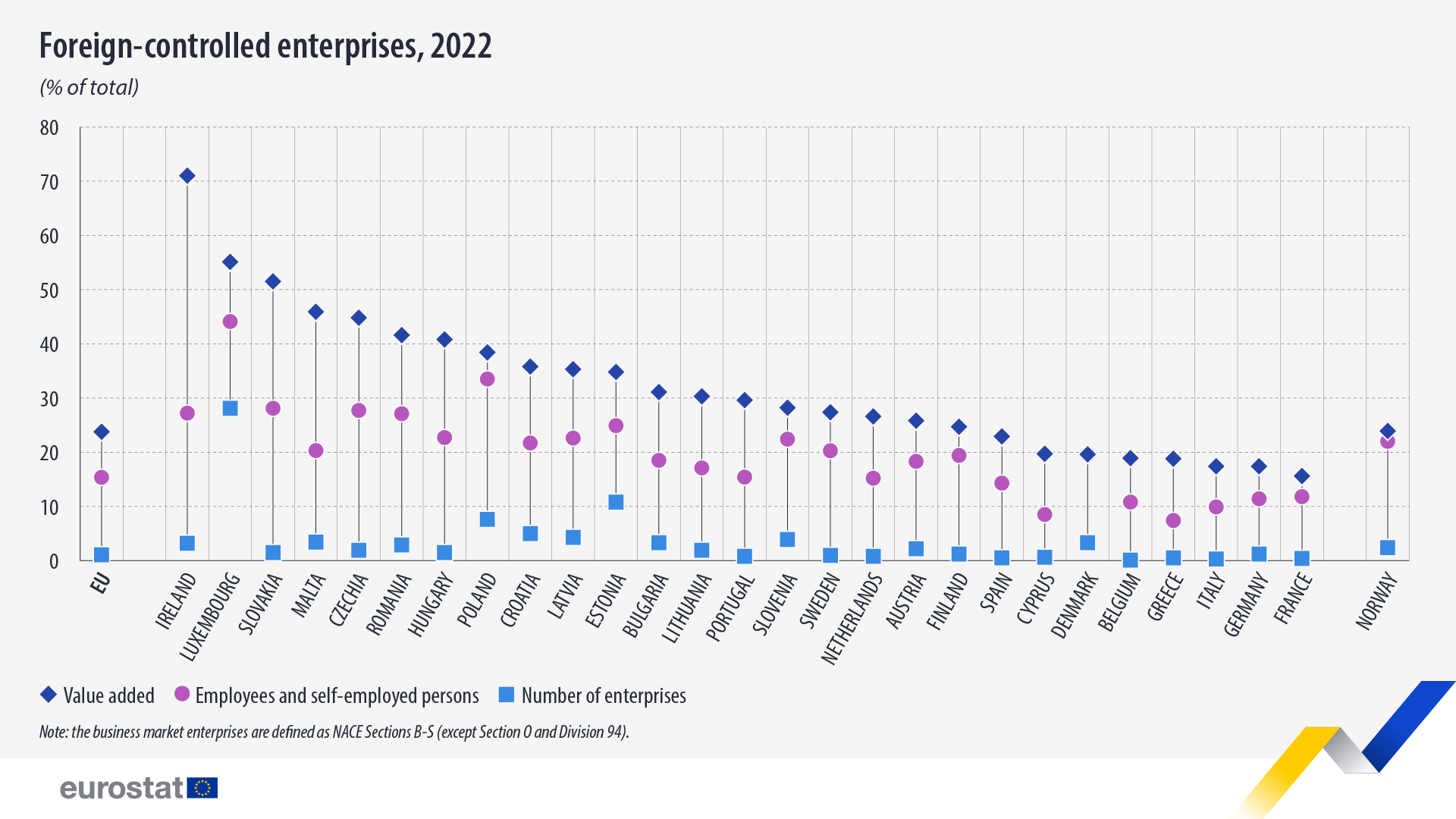
In 2022, 1% of EU market producer enterprises were under foreign control. More than half, 63%, were controlled by institutional units from other EU countries, while 37% were resident outside the EU.
Even if small in numbers, foreign-controlled enterprises contributed significantly to the EU economy, constituting 24% of value added in the business producers’ market in the EU. Value added by foreign-controlled enterprises was the highest in Ireland (71%), Luxembourg (55%) and Slovakia (52%). By contrast, the lowest shares of value added were observed in France (16%), Germany and Italy (both 17%).
Source dataset: fats_activ
Regarding the number of enterprises, the share of foreign-controlled enterprises was the highest in Luxembourg (28%), followed by Estonia (11%) and Poland (8%). At the other end of the scale, Belgium (0.1%), Italy (0.3%) and France (0.4%) had the lowest shares.
In terms of employees and self-employed persons, foreign-controlled enterprises represented 15% of EU jobs. Luxembourg (44%), Poland (34%) and Slovakia (28%) recorded the highest shares. Conversely, foreign-controlled enterprises accounted for 10% of jobs or less in Greece (7%), Cyprus (9%) and Italy (10%).
In 2022, the number of the EU enterprises controlled by institutional units resident in Russia dropped by 11% compared with 2021. That led to a decrease in number of employees and self-employed persons by 30% and a 24% drop in value added of EU enterprises controlled by entities from Russia compared with 2021. On the other hand, in 2022 there was an increase in the number of enterprises (+8%), employees and self-employed persons (+6%) and value added (+12%) of the EU market producers controlled by institutional units resident in Ukraine.
For more information
- Statistics explained on foreign-controlled enterprises statistics - inward FATS
- Thematic section on globalisation of businesses
- Database on globalisation of businesses
Share this article:
EU Reporter publishes articles from a variety of outside sources which express a wide range of viewpoints. The positions taken in these articles are not necessarily those of EU Reporter. Please see EU Reporter’s full Terms and Conditions of publication for more information EU Reporter embraces artificial intelligence as a tool to enhance journalistic quality, efficiency, and accessibility, while maintaining strict human editorial oversight, ethical standards, and transparency in all AI-assisted content. Please see EU Reporter’s full A.I. Policy for more information.



Open letter to president of the European Commission on the Schengen Entry/Exit System (EES)

EU policy toward Azerbaijan: Why Brussels must move beyond political dialogue

The Iran war changed Pakistan's strategic value, not its political trajectory

PMI defends AI consultation tool as scrutiny grows over EU tobacco rules review

Democracy cannot be selective: Why Europe must apply the same standards abroad that it demands at home

Civil society from across the EU gathers in Cork to reinforce Europe’s sustainability agenda

Majority think EU is a 'place of stability in a troubled world'

Rating of American Express casino sites in the UK

Energy Union: New Spain-Portugal electricity interconnection inaugurated

Timing of the publication of the EU ETS auction calendar

Commissioner Šuica travels to Cairo to strengthen euro-mediterranean parliamentary cooperation and youth engagement

Commission seeks feedback on targeted amendment of EMFAF

Commission proposes five joint defence projects to strengthen Europe's industrial capabilities

Study: Europe's defense runs on American servers

The ancient myths that tourism boards (and slot designers) can't stop selling

Europe must double down on nuclear progress to achieve its long-term ambitions

Kazakhstan reforms under scrutiny at Brussels Press Club round table

Japan should face up to history and contribute more to regional peace

Ambassador calls for 'speeding up' of co-operation between EU and Kazakhstan

Timur Turlov at Smart Moves Summit 2025: How chess can transform global education

Shevtsova’s case: Out-of-court sanctions dismantling trust in Ukrainian cause

The future of European transport

Trump Vs Trueman

US 'no longer' an 'unconditional ally' for Europe - MEP
-
 Schengen4 days ago
Open letter to president of the European Commission on the Schengen Entry/Exit System (EES)
-
 Azerbaijan4 days ago
EU policy toward Azerbaijan: Why Brussels must move beyond political dialogue
-
 Iran4 days ago
The Iran war changed Pakistan's strategic value, not its political trajectory
-
 European Commission4 days ago
PMI defends AI consultation tool as scrutiny grows over EU tobacco rules review