Environment
Southern Hemisphere ozone hole surpasses size of Antarctica
SHARE:

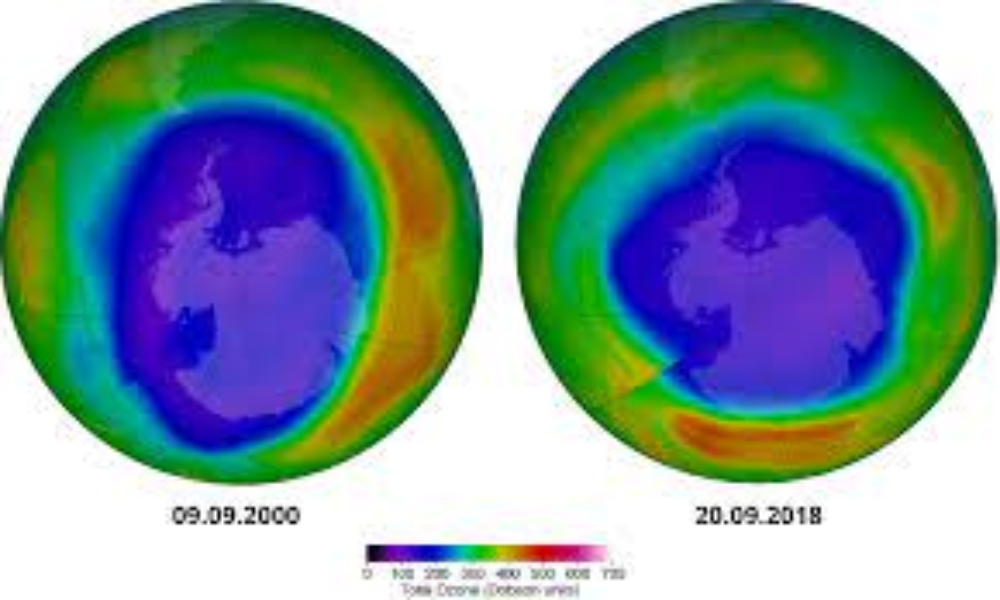
| The Copernicus Atmosphere Monitoring Service is keeping a close eye on the Antarctic region to monitor the development of this year´s ozone hole over the South Pole, which has now reached an extent larger than Antarctica. After a pretty standard start, the 2021 ozone hole has considerably grown in the past week and is now larger than 75 % of ozone holes at that stage in the season since 1979. Scientists from the Copernicus Atmosphere Monitoring Service (CAMS) have been closely monitoring the development of this year´s Antarctic ozone hole. On the International Day for the Preservation of the Ozone Layer (16 September) CAMS is gave a first status update on the stratospheric hole that appears every year during Austral spring, and the ozone layer that protects the Earth from the harmful properties of sunrays. CAMS is implemented by the European Centre for Medium-Range Weather Forecasts on behalf of the European Commission with funding from the EU. Vincent-Henri Peuch, director of the Copernicus Atmosphere Monitoring Service, said: “This year, the ozone hole developed as expected at the start of the season. It seems pretty similar to last year's, which also wasn't really exceptional in September, but then turned into one of the longest-lasting ozone holes in our data record later in the season. Now our forecasts show that this year´s hole has evolved into a rather larger than usual one. The vortex is quite stable and the stratospheric temperatures are even lower than last year. We are looking at a quite big and potentially also deep ozone hole.” CAMS’ operational monitoring of the ozone layer is using computer modelling in combination with satellite observations in a similar way to weather forecasts in order to provide a comprehensive three-dimensional picture of the state of the ozone hole. For that, CAMS effectively combines different pieces of available information. One part of the analysis consists of observations of the total column of ozone from measurements in the ultraviolet-visible part of the solar spectrum. These observations are of very high quality but are not available in the region that is still located in the polar night. A different set of observations is included, which provide crucial information about the vertical structure of the ozone layer, but has limited horizontal coverage. By combining altogether five different sources and bringing them together using its sophisticated numerical model, CAMS can provide a detailed picture of the ozone distribution with consistent total column, profile and dynamics. More information in attached press release. CAMS_Newsflash_Ozone Day_15092021_BEEN.docx |
| Copernicus is a component of the European Union’s space programme, with funding by the EU, and is its flagship Earth observation programme, which operates through six thematic services: Atmosphere, Marine, Land, Climate Change, Security and Emergency. It delivers freely accessible operational data and services providing users with reliable and up-to-date information related to our planet and its environment. The programme is coordinated and managed by the European Commission and implemented in partnership with the member states, the European Space Agency (ESA), the European Organisation for the Exploitation of Meteorological Satellites (EUMETSAT), the European Centre for Medium-Range Weather Forecasts (ECMWF), EU Agencies and Mercator Océan, amongst others. ECMWF operates two services from the EU’s Copernicus Earth observation programme: the Copernicus Atmosphere Monitoring Service (CAMS) and the Copernicus Climate Change Service (C3S). They also contribute to the Copernicus Emergency Management Service (CEMS), which is implemented by the EU Joint Research Council (JRC). The European Centre for Medium-Range Weather Forecasts (ECMWF) is an independent intergovernmental organisation supported by 34 states. It is both a research institute and a 24/7 operational service, producing and disseminating numerical weather predictions to its member states. This data is fully available to the national meteorological services in the member states. The supercomputer facility (and associated data archive) at ECMWF is one of the largest of its type in Europe and member states can use 25% of its capacity for their own purposes. ECMWF is expanding its location across its member states for some activities. In addition to an HQ in the UK and Computing Centre in Italy, new offices with a focus on activities conducted in partnership with the EU, such as Copernicus, will be located in Bonn, Germany from Summer 2021. |
Share this article:

EU Reporter publishes articles from a variety of outside sources which express a wide range of viewpoints. The positions taken in these articles are not necessarily those of EU Reporter. Please see EU Reporter’s full Terms and Conditions of publication for more information EU Reporter embraces artificial intelligence as a tool to enhance journalistic quality, efficiency, and accessibility, while maintaining strict human editorial oversight, ethical standards, and transparency in all AI-assisted content. Please see EU Reporter’s full A.I. Policy for more information.



Islam5 days ago
Friedman Institute and Trends Group at the Italian parliament: Countering the Muslim brotherhood

Competition4 days ago
Competition policy: Enforce without fear

Animal welfare4 days ago
Setting sustainable livestock farming on a strong footing

Portugal4 days ago
Portugal achieves major milestone with permit for offshore aquaculture facility

Artificial intelligence4 days ago
New EU plan to address the risks and opportunities of advanced AI for cybersecurity

General5 days ago
How hair extensions can transform your look naturally

France4 days ago
EU deploys wildfire support to face multiple fires across Portugal and France

Kashmir3 days ago
Kashmir's 9,765 missing women and girls demand international attention

EU waste legislation4 hours ago
EU clarifies rules to allow continued waste recovery shipments to Switzerland

Taxation4 hours ago
European Commission’s Annual Tax Report (ART) provides latest insights into the revenue mix

Digital Services Act5 hours ago
Commission preliminarily finds the addictive design of Instagram and Facebook in breach of the Digital Services Act

Genocide5 hours ago
Joint statement by High Representative/Vice-President Kallas and Commissioner Kos on the 31st anniversary of the Srebrenica genocide

Cigarettes6 hours ago
European operation dismantles €10 million illicit cigarette network in Spain

Kashmir6 hours ago
Srebrenica's lesson is prevention. Why isn't the world applying It to Kashmir?

Israel1 day ago
EU foreign ministers to discuss options for restricting trade with Israeli communities in Judea and Samaria

Transport3 days ago
Safer cars, safer roads: New rules take effect

Kazakhstan3 months ago
Kazakhstan reforms under scrutiny at Brussels Press Club round table

Japan7 months ago
Japan should face up to history and contribute more to regional peace

Kazakhstan8 months ago
Ambassador calls for 'speeding up' of co-operation between EU and Kazakhstan

World11 months ago
Timur Turlov at Smart Moves Summit 2025: How chess can transform global education

Ukraine1 year ago
Shevtsova’s case: Out-of-court sanctions dismantling trust in Ukrainian cause

Transport1 year ago
The future of European transport

Politics1 year ago
Trump Vs Trueman

US1 year ago
US 'no longer' an 'unconditional ally' for Europe - MEP
-
 Islam5 days ago
Friedman Institute and Trends Group at the Italian parliament: Countering the Muslim brotherhood
-
 Competition4 days ago
Competition policy: Enforce without fear
-
 Animal welfare4 days ago
Setting sustainable livestock farming on a strong footing
-
 Portugal4 days ago
Portugal achieves major milestone with permit for offshore aquaculture facility