EU
Clandestine migrants: Civil Liberties Committee backs EU-Turkey readmission agreement


Clandestine migrants from the EU to Turkey or Turkey to the EU would have to be returned under an EU-Turkey “readmission” agreement signed by both parties on 16 December and endorsed by the Civil Liberties Committee on Wednesday. The return rule would apply not only to EU nationals and Turks, but also to third-country nationals who enter either the EU or Turkey via the other.
"The readmission agreement will benefit Turkey as well as the European Union. Now it is up to Turkey to fulfill its obligations to implement the agreement in full", said rapporteur Renate Sommer (EPP, DE). The agreement, which the committee approved by 34 votes to 7 with one abstention, lays down obligations and procedures for taking back “irregular” migrants entering or living clandestinely in Turkey or the EU. It would oblige both sides to readmit their own nationals, third-country nationals without residence documents and stateless persons who entered either the EU or Turkey via the other.
Ms Sommer added that the readmission agreement “would make a significant contribution to curbing irregular immigration into the EU via Turkey, help combat cross-border crime, particularly human trafficking, and relieve the pressure on Greece and hence on the EU as a whole”.
EU funding for border surveillance
Under the agreement, Turkey will get EU financial and technical help to build up its border police and install border surveillance equipment. This should help Turkey to make its borders with neighbouring countries, such as Syria, Iran and Iraq, more secure. To enter into force, the readmission agreement still needs to be approved by Parliament as a whole in a forthcoming plenary session, and then formally ratified by the EU and by Turkey. Its provisions on EU and Turkish nationals would take effect two months after ratification is completed, but those on nationals from third countries with which Turkey has not concluded bilateral arrangements would take effect only three years later. On the day when the readmission agreement was signed, 16 December, the EU and Turkey also launched a “visa liberalisation” dialogue to make progress towards eliminating the visa requirement for Turkish citizens who wish to travel to the Schengen area for short stays.
Share this article:
EU Reporter publishes articles from a variety of outside sources which express a wide range of viewpoints. The positions taken in these articles are not necessarily those of EU Reporter. Please see EU Reporter’s full Terms and Conditions of publication for more information EU Reporter embraces artificial intelligence as a tool to enhance journalistic quality, efficiency, and accessibility, while maintaining strict human editorial oversight, ethical standards, and transparency in all AI-assisted content. Please see EU Reporter’s full A.I. Policy for more information.






EU foreign ministers to discuss options for restricting trade with Israeli communities in Judea and Samaria

European operation dismantles €10 million illicit cigarette network in Spain

Srebrenica's lesson is prevention. Why isn't the world applying It to Kashmir?

AIFC to host Astana Finance Days 2026 in September

ALROSA Re-elects Supervisory Board with Minimal Changes

Energy Union Task Force takes stock of oil and gas security of supply in the EU

Joint statement by High Representative/Vice-President Kallas and Commissioner Kos on the 31st anniversary of the Srebrenica genocide

Commission preliminarily finds the addictive design of Instagram and Facebook in breach of the Digital Services Act

Chinese “leadership and coordination”

Shared commitment to advance EOSC through new EOSC Nodes and EOSC projects

Why young jobseekers struggle to find roles abroad that fit their expertise

Farmers, fair markets and consumers: new report highlights the role of EU competition rules in agriculture

EU and South Africa kick off intergovernmental dialogue on Clean Trade and Investment Partnership

Seveso - 50 years on: EU strengthens its commitment to industrial safety in a changing landscape of risk

Commission opens formal investigation into possible gun jumping in XXXLutz's acquisition of Porta

EU weighs age-13 limit for 'social media plus'

Kazakhstan reforms under scrutiny at Brussels Press Club round table

Japan should face up to history and contribute more to regional peace

Ambassador calls for 'speeding up' of co-operation between EU and Kazakhstan

Timur Turlov at Smart Moves Summit 2025: How chess can transform global education

Shevtsova’s case: Out-of-court sanctions dismantling trust in Ukrainian cause

The future of European transport

Trump Vs Trueman

US 'no longer' an 'unconditional ally' for Europe - MEP
-
 Israel3 days ago
EU foreign ministers to discuss options for restricting trade with Israeli communities in Judea and Samaria
-
 Cigarettes2 days ago
European operation dismantles €10 million illicit cigarette network in Spain
-
 Kashmir2 days ago
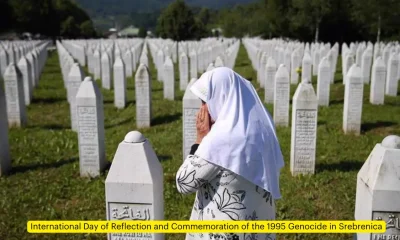
Srebrenica's lesson is prevention. Why isn't the world applying It to Kashmir?
-
 Kazakhstan1 day ago
AIFC to host Astana Finance Days 2026 in September