'From the desk of...'
Why it's OK to question religion


EU Reporter launches a new series of intelligent, incisive opinion columns, beginning with Colin Moors on the thorny subject of religion, and whether it is actually OK to disagree with it. Take it away, Colin...
Provocative title? Maybe. I was going to lead with the Calais refugee crisis for my first (hopefully of many) opinion columns for EU Reporter. I think many of the world's leading commentators have already set the stall out fairly well there, so I'm turning my attention to the other hot topic of the moment - free speech and its role in religious debate. Nothing like getting your hands dirty on the first day, is there?
This article springs from two events that happened this year. The first was Pope Francis talking about the horrors of the Charlie Hebdo massacre, telling the world that freedom of speech is limited when it comes to religion and that "You cannot provoke. You cannot insult the faith of others. You cannot make fun of the faith of others." Charlie Hebdo, you'll remember, was a 'response' by people purporting to be Muslims to the lampooning of the prophet Muhammad in a series of cartoons.
The second event is the news that Saudi Arabia is now pushing hard for new laws that would criminalize insulting behaviour towards prophets, holy books and places and gods. Not only are they calling for this in Saudi but globally.
Abdulmajeed Al-Omari, director for external relations at the Ministry of Islamic Affairs said: "We have made it clear that freedom of expression without limits or restrictions would lead to violation and abuse of religious and ideological rights. This requires everyone to intensify efforts to criminalize insulting heavenly religions, prophets, holy books, religious symbols and places of worship". Let's just pause for a second and enjoy the delightful irony of someone from the Saudi government lecturing the rest of the world on the rights of man, shall we?
I'm going to set my stall out straight away. I respect everyone's right to choose their own belief system. I expect them to be able to practise it freely, provided it causes no harm to others. I have no personal religion but I like to imagine from time to time that I'm capable of good moral behaviour without the need for a written rule book to go by.
I also strongly believe that if your religion or beliefs can't stand up to some pretty stern and harsh scrutiny, you have a poor religion and should probably think about getting a new one. People fight and die over the succession of the prophet Muhammad and whether it should have been his adviser, Ali Bakr (Sunni) or Ali, Muhammad's cousin and son-in-law (Shi'ites). Since Henry VIII of England decided that he was going to be the top man instead of the pope, you don't have to look very far back in history to see what a raw deal Catholics have been getting. So, here we have two sets of people, both trying to kill for the sake of a schism or, when they're not busy with that, trying to kill each other. Here's the kicker - they all agree it's exactly the same god. Would you seriously entrust your moral judgement to such people?
So yes, here I am criticizing religions - Anglicism, Catholicism and Islam. Am I doing something wrong? No. Am I right to want to know why they love the same god but hate each other? Yes - is that not a reasonable question?
Public opinion is possibly the most valid form of criticism (The X Factor and The Voice aside), the vox populi being a potent indicator of the 'word on the street', a force by which governments live or die. The general public of Europe, for now, still has it in its hands to change the status quo, to topple or to elevate politicians. Without a voice, there would be no change, no fresh challengers and no progress, and yet we are expected to take the word of someone's god as a done deal.
This is not at all about bashing religion, I am simply setting the scene for the discussion. Without criticism or scrutiny, "because it's what god wants" would become the de facto response to anything requiring complex thought, or indeed, something that was just simply unpopular with the church, mosque or synagogue.
Banning the use of racist words and phrases hasn't stopped people using them. In most places in Europe, you are free to say whatever you feel, however unpleasant it may be. It's apparently still OK to call homosexual men and women 'an abomination' even though discrimination is forbidden by law. Banning the criticism of religion - any religion - is entirely pointless, as people will simply not acquiesce to it. Being black, Asian or gay isn't a persuasion, it's who you are. Religion is a free choice, although I'm often amazed at the high percentage of people who freely choose the same one their parents had. It is right and proper to protect those who were born into a situation and wholly improper to protect unproven ideas by those exercising their right to choose a religion.
If you accept, let's say Anglicanism as it's the religion I grew up around, as your one true faith and your assured path to the right hand of the lord, that's great. It really is. If you really chose freely, you'd have to accept you also probably shopped around and found out about Shintoism, Buddhism, Jainism or even Wicca if you're into making your own yoghurt and like cats. If you didn't fully research all of them before choosing, it gives you a pretty poor platform from which to evaluate anyone else's. But that's exactly what you would need to do in order to arrive at a satisfactory conclusion. You couldn't simply say "but surely, the Jainist philosophy is unsustainable in modern-day Switzerland" or even "wow, those Sikhs wear some funny hats" without fear of people pointing at you and shouting "religious critic". I know very little of Jainism and quite like the Turban but that's just me.
You see, these opinions are exactly that - opinions. We must be able to base our opinions on the best evidence available and there are times, even for the religious, when the word from the big guy in the sky seems a little far-fetched. How many times have we heard religious leaders and scholars say "ah well, you see, what god meant here was…" basing it on nothing but a vague notion of how he'd like the conversation to turn out. Sorry, but if they're allowed that latitude, I should be allowed to call them on it.
Let's take a few real examples. The Catholic Church doesn't want you to enjoy sex without making more Catholics, so prophylactics are a no-no. There's nothing at all in the Bible about it. Not one thing. The sum total of all Jesus' thoughts on homosexuality? Zero. That doesn't stop the modern-day 'Christians' from hating them though. Both these are examples of human interpretation of the word of god or one of his prophets. The Qur'an can't really make up its mind about booze either, at once praising the grape for being available to make strong drink out of, the next saying it's a bad idea to drink it. So which is it?
All these opinions have no basis in any fact save for the old much-translated works of a few desert-dwelling men hundreds of years ago. We really should be able to criticize any edict based on these tomes without fear of reprisal.
Ultimately, we are responsible for our actions. Whatever we do and whatever we say causes a chain of events, however small that cause a ripple in one life and perhaps a tsunami in another. We cannot simply accept that god's word is the final say on any topic, as it has no basis in fact and worse, removes our culpability. We have to be allowed to make our own moral judgements or be judged by a jury of our peers. If not, we'll be back to burning witches and lynching bread thieves - arguably still more entertaining than The X Factor.
If your brand of religion is right and I've upset your version of the magic sky man, surely you could content yourself in the sure knowledge I'd spend eternity burning in the pit of Hell? Isn't that enough to be going on with, or is your religion that toothless it can't stand one of the followers of the other 4,500 or so world religions calling it stupid?
Share this article:
EU Reporter publishes articles from a variety of outside sources which express a wide range of viewpoints. The positions taken in these articles are not necessarily those of EU Reporter. Please see EU Reporter’s full Terms and Conditions of publication for more information EU Reporter embraces artificial intelligence as a tool to enhance journalistic quality, efficiency, and accessibility, while maintaining strict human editorial oversight, ethical standards, and transparency in all AI-assisted content. Please see EU Reporter’s full A.I. Policy for more information.



EU foreign ministers to discuss options for restricting trade with Israeli communities in Judea and Samaria

Srebrenica's lesson is prevention. Why isn't the world applying It to Kashmir?

European operation dismantles €10 million illicit cigarette network in Spain

AIFC to host Astana Finance Days 2026 in September

Survey of city economic experts: Cities are driving Draghi’s competitiveness agenda, but need EU recognition to scale action

Joint statement by High Representative/Vice-President Kallas and Commissioner Kos on the 31st anniversary of the Srebrenica genocide

Energy Union Task Force takes stock of oil and gas security of supply in the EU

Safer cars, safer roads: New rules take effect

Farmers, fair markets and consumers: new report highlights the role of EU competition rules in agriculture

EU and South Africa kick off intergovernmental dialogue on Clean Trade and Investment Partnership

Seveso - 50 years on: EU strengthens its commitment to industrial safety in a changing landscape of risk

Commission opens formal investigation into possible gun jumping in XXXLutz's acquisition of Porta

EU weighs age-13 limit for 'social media plus'

ALROSA Re-elects Supervisory Board with Minimal Changes

Public consultation on Joint Undertakings, Art. 185 initiatives, and thematic priorities for European Partnerships under Horizon Europe 28-34

Poland sees new research and changes to policies on migrant integration

Kazakhstan reforms under scrutiny at Brussels Press Club round table

Japan should face up to history and contribute more to regional peace

Ambassador calls for 'speeding up' of co-operation between EU and Kazakhstan

Timur Turlov at Smart Moves Summit 2025: How chess can transform global education

Shevtsova’s case: Out-of-court sanctions dismantling trust in Ukrainian cause

The future of European transport

Trump Vs Trueman

US 'no longer' an 'unconditional ally' for Europe - MEP
-
 Israel3 days ago
EU foreign ministers to discuss options for restricting trade with Israeli communities in Judea and Samaria
-
 Kashmir2 days ago
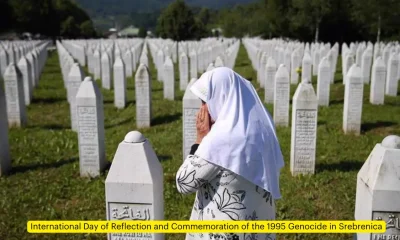
Srebrenica's lesson is prevention. Why isn't the world applying It to Kashmir?
-
 Cigarettes2 days ago
European operation dismantles €10 million illicit cigarette network in Spain
-
 Kazakhstan1 day ago
AIFC to host Astana Finance Days 2026 in September