EU
#Russia: Oleg Deripaska hits back at AP over Paul Manafort connections


The most recent installment in the Russiagate controversy engulfing the United States revolves around a recent story published by the AP earlier in March. The report claimed to prove that Paul Manafort, a long-time lobbyist and short-lived chairman of Donald Trump’s presidential run, had sought in 2005 to sign a PR contract with Oleg Deripaska, one of Russia’s richest men and owner of aluminium company UC Rusal. Quoting a string of unverified reports and confidential sources, the AP alleged that Manafort had offered to promote and “re-focus” the policies of “the Putin Government” in several Western countries as part of a communications campaign approved by Deripaska, writes James Drew.
The incendiary allegations led to a virulent response from Deripaska, who hit back at the AP by taking out ad space in the Wall Street Journal and the Washington Post. Calling the report “character assassination”, the aluminium tycoon has offered to testify before Congress to refute the claims made by the news organization. Deripaska denied signing the contract and called on the news organization to produce evidence of the work Manafort allegedly did on his behalf.
“I have never made any commitments or contracts with the obligation or purpose to covertly promote or advance 'Putin's government' interests anywhere in the world,” Deripaska wrote. What’s more, “an actual $10 million plus campaign to lobby Russian interests worldwide would leave some trace, a slew of at least unnamed sources, subcontractors and work output”. Otherwise, “ a supposed blue sky proposal (if it even exists) from a consultant is not the factual basis for anything”. All the AP could produce was to say that “the work actually performed is unclear”.
While Manafort and Deripaska have both confirmed working together, they insisted that their business relationship was focused only on providing investment consulting services. Instead, Deripaska argues he got swept up as “collateral damage” in the “increasingly shrill and controversial theatre of US-Russia relations” and that the claim the Russian government turned to him to run a media campaign is scurrilous. Interestingly, Anders Aslund, a well respected resident senior fellow at the Atlantic Council, has sided with Deripaska in the controversy, stating “there is a number of people suspected of being middle men for Putin, of holding assets for Putin but nobody thinks Deripaska is among them.”
The crux of the letter signed by Deripaska tells the story of how Rusal was founded, in response to the AP’s claims that he is “a Russian billionaire close to President Vladimir Putin” who made his fortune thanks to the Kremlin. The tycoon points out that he participated in the wave of privatizations that occurred in the early 1990s by buying shares in an aluminium smelter in Eastern Siberia – back when the future president was still working in the office of the mayor of Saint Petersburg. The head of Rusal also disagreed with the AP’s claim that he “bought assets abroad in ways perceived to benefit the Kremlin interests”, pointing to the fact that smelting aluminium requires bauxite, of which Russia has few reserves. Solving the issue, Deripaska wrote, meant investing in Guinea, an African nation that boasts a third of the world’s bauxite reserves.
It remains to be seen how the story will unfold, but as this latest episode in the Russiagate controversy proves, events should be taken with a grain of salt.
Share this article:
EU Reporter publishes articles from a variety of outside sources which express a wide range of viewpoints. The positions taken in these articles are not necessarily those of EU Reporter. Please see EU Reporter’s full Terms and Conditions of publication for more information EU Reporter embraces artificial intelligence as a tool to enhance journalistic quality, efficiency, and accessibility, while maintaining strict human editorial oversight, ethical standards, and transparency in all AI-assisted content. Please see EU Reporter’s full A.I. Policy for more information.




The South Caucasus at a historic turning point: Between lasting peace and renewed confrontation
The security environment of the South Caucasus amid changing geopolitical realities

Commission registers two European Citizens' Initiatives on education and housing

Kazakhstan and Belgium: Building a Partnership for the Future

Why the US is losing its legitimacy as a global superpower and the trust of the comity of nations

Commission sends Statements of Objections to several companies and trade associations in suspected construction chemicals cartel

Commission endorses Latvia’s €617 million Social Climate Plan to support vulnerable households and transport users in the clean transition

Rome–Washington Axis: Italian Diplomat Zanardi Landi to Help Save Bosnia

JoinCare explores scientific exchange during visit to Japan’s National Institute of Infectious Diseases

New episode – DGT podcast: Languages and Technology

Become a European Commission trainee – applications are now open

Commission outlines measures to strengthen Europe's banking sector and support growth

British political shifts and the future of UK-China ties
The South Caucasus at a historic turning point: Between lasting peace and renewed confrontation

As Ireland chairs the EU Presidency, what impact has over fifty years of EU membership had on Ireland

The Digital Markets Act Is Hurting Europeans. It’s Time to Put Progress, Free Markets, and Competition First

Kazakhstan reforms under scrutiny at Brussels Press Club round table

Japan should face up to history and contribute more to regional peace

Ambassador calls for 'speeding up' of co-operation between EU and Kazakhstan

Timur Turlov at Smart Moves Summit 2025: How chess can transform global education

Shevtsova’s case: Out-of-court sanctions dismantling trust in Ukrainian cause

The future of European transport

Trump Vs Trueman

US 'no longer' an 'unconditional ally' for Europe - MEP
-
 South Caucasus1 day ago
The South Caucasus at a historic turning point: Between lasting peace and renewed confrontation
-
South Caucasus2 days ago
The security environment of the South Caucasus amid changing geopolitical realities
-
 European Citizens' Initiative4 days ago
Commission registers two European Citizens' Initiatives on education and housing
-
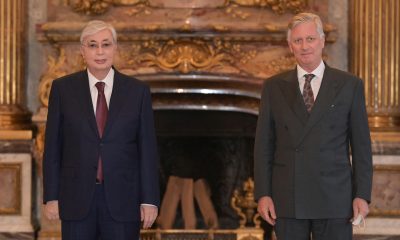 Belgium5 days ago
Kazakhstan and Belgium: Building a Partnership for the Future