General
Just nine fashion companies do even the bare minimum on unsustainable cotton

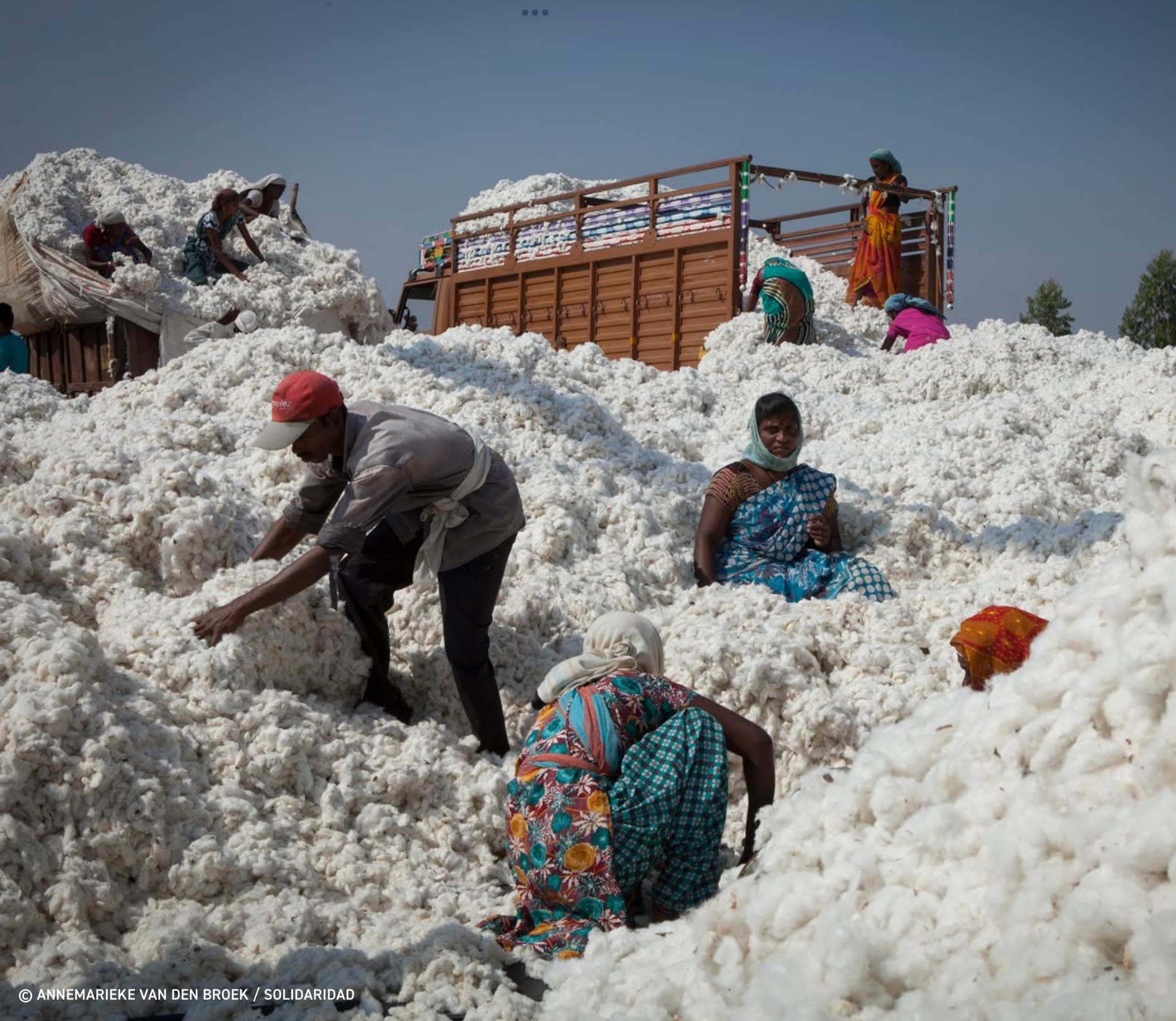
When it comes to their use of cotton, the vast majority of international brands (89%) are non-transparent, unsustainable and show little progress towards improving labour conditions. Those are the findings of the 2023 Cotton Ranking, published by Solidaridad Europe and the Pesticide Action Network UK, writes Political Editor Nick Powell.
One of the report’s main messages is that unsustainable cotton is a choice. It maintains that a wide range of possible actions are available to corporations to help them mitigate, address or even reverse the worst environmental and social impacts of cotton production. They are set out in a paper ‘Cotton and Corporate Responsibility’, published simultaneously with the 2023 Cotton Ranking.
Much of the cotton purchased by major companies does not meet even the requirements of basic certification, meaning that its source cannot be verified as meeting minimum standards. Only nine of the 82 largest cotton-sourcing companies in the world are found to be sourcing at least 99% of their cotton from certified sources. They are Decathlon, H&M, Ikea, Adidas, Columbia, Marks & Spencer, C&A, Lojas Renner and Puma.
All other companies fell short, with 30 of them receiving a zero score in the ranking. Many brands cite complex trade realities as a barrier to progress but the authors see the issue as one of corporate social responsibility. Recommendations include investing in smallholder climate adaptation, updating purchasing practices to ensure better pay for cotton producers, and becoming transparent on cotton sourcing, as just a start.
“In reality, given the resources available to big brands, unsustainable cotton is a choice. A bad one. But it doesn’t have to be one we live with. Brands and retailers can make new decisions. They can choose to be more transparent in their operations, and about their suppliers. They can choose to take on the complex question of fair pay, rather than use it as an excuse. And they can choose to engage with all actors along their supply chain, rather than hiding behind intermediaries.” says Tamar Hoek of Solidaridad Europe.
Currently smallholder cotton farmers, who make up the majority of the world’s cotton producers, live on the edge of poverty as they do not receive a fair income. They also have no access to training and no support for climate adaptation.
With the impending impact of climate change likely to reduce or destroy yields across every cotton growing region, smallholder farmers will not be able to ensure reliable production and will be pushed even further into poverty. That would come on top of the negative impacts of the current corporate practices on cotton workers and the environment, with low margins pushing farmers to work for less money and to gamble on hazardous agrochemicals in an effort to stay above the poverty line.
"Nearly half of smallholder cotton farmers are poisoned by pesticides every year. Zero pesticide poisoning is possible today if textile & apparel companies choose to take responsibility for their supply chains and deepen investment in supporting a transition to agroecological cotton production" says Rajan Bhopal, of the Pesticide Action Network UK.
The 2023 Cotton Ranking and the ‘Cotton and Corporate Responsibility’paper mark the first publications of the newly launched Sustainable Cotton Hub. It will bring together experts from organisations working in and around the cotton sector. The aim is to expose the sustainability challenges of cotton production, and explore the host of contributing economic, labour and environmental factors.
The hub will provide concrete recommendations on how major stakeholders can address these critical issues.Future papers will cover topics including climate change, nature and inequality.
Share this article:
EU Reporter publishes articles from a variety of outside sources which express a wide range of viewpoints. The positions taken in these articles are not necessarily those of EU Reporter. Please see EU Reporter’s full Terms and Conditions of publication for more information EU Reporter embraces artificial intelligence as a tool to enhance journalistic quality, efficiency, and accessibility, while maintaining strict human editorial oversight, ethical standards, and transparency in all AI-assisted content. Please see EU Reporter’s full A.I. Policy for more information.



Astana's congress of world religions: A global platform for dialogue in an age of division

Protect children from online sexual abuse: Call for urgent negotiations and permanent solution

Solana company partners with Kazakhstan on $6B Alatau Crypto Megacity

Will the Gulf monarchies rise above internecine disputes in the interest of collective security?

Europe must double down on nuclear progress to achieve its long-term ambitions

International Plastic Bag Free Day – from single use to reuse

Study: Europe's defense runs on American servers

Commission proposes five joint defence projects to strengthen Europe's industrial capabilities

Safer cars, safer roads: New rules take effect

Survey of city economic experts: Cities are driving Draghi’s competitiveness agenda, but need EU recognition to scale action

Europe's Cloud moment: The DMA must now deliver

EU-Mexico: While others build walls, Europe builds bridges

New EU strategy must help farmers move toward a more humane food system

Kashmir's 9,765 missing women and girls demand international attention

Quarterly reports show a surge in solar energy and e-vehicles, with record highs in 2025

EU deploys wildfire support to face multiple fires across Portugal and France

Kazakhstan reforms under scrutiny at Brussels Press Club round table

Japan should face up to history and contribute more to regional peace

Ambassador calls for 'speeding up' of co-operation between EU and Kazakhstan

Timur Turlov at Smart Moves Summit 2025: How chess can transform global education

Shevtsova’s case: Out-of-court sanctions dismantling trust in Ukrainian cause

The future of European transport

Trump Vs Trueman

US 'no longer' an 'unconditional ally' for Europe - MEP
-
 Kazakhstan4 days ago
Astana's congress of world religions: A global platform for dialogue in an age of division
-
 Child sexual abuse4 days ago
Protect children from online sexual abuse: Call for urgent negotiations and permanent solution
-
 Kazakhstan4 days ago
Solana company partners with Kazakhstan on $6B Alatau Crypto Megacity
-
 Iran4 days ago
Will the Gulf monarchies rise above internecine disputes in the interest of collective security?