EU
#Health Speedy introduction of new, efficacious drugs saves lives


Less than a month ago, (17 February) the European parliament’s ENVI committee took a step towards changing the way medicines are approved at European level. This it did by voting in favour of a report and amendments to the EU’s Regulation No 726/2004, writes European Alliance for Personalised Medicine (EAPM) Executive Director Denis Horgan.
This is an important shift in view of how the European Medicines Agency (EMA) operates and approves new drugs.
The EMA is now responsible for the centralized authorization procedure for medicines in all European Union and European Economic Area countries (that’s the 28 EU member states plus Iceland, Liechtenstein and Norway). This is important given that all member states traditionally have competence for their own health service and guard that competence jealously.
Most EU countries see the ‘value’ of new drugs decided by how much better a new drug is, compared to those already available, as well as by the depth of their own resources. This ‘relative effectiveness’ reckoning uses the same data that the EMA does to check drug safety, efficiency and how well a drug works works in order to allow it to gain authorisation to go on the market.
Harmonising this evaluation EU-wide should give patients faster access to life-saving medicines and should also cut down on wasteful duplications and inefficiencies in individual Member States.
All European Union countries are obliged to adopt and make available a new drug within 180 days from the moment the EMA rubber-stamps its market authorization, but quite often this availability is significantly delayed, resulting in less quality of life for patients and, quite often, death.
The bottom line is that, despite the 180-day rule, some Member States drag their feet.
For example, the breast cancer drug transtuzumab was immediately available and reimbursed to patients in Germany, The Netherlands and Spain. In the UK, however, the timescale was 564 days. In Belgium it was 1,160 days while the Danes had to wait 1,891 days.
And that’s just western Europe. In the east, it was mostly worse; Hungarian patients had to wait 2,713 days without access to the drug, Romanians 2,878 days, Slovakians 3,686 days and Latvians a massive 4,660 days. The latter is an astonishing 12 years and nine months.
So why does access matter so much and what are the arguments regarding what constitutes ‘value’?
The answer to the first part is simple: without access to certain drugs, people die. The second part is somewhat more complex and is not necessarily always about only drugs.
For example, patients are overwhelmingly in favour of the use of cutting-edge companion diagnostics that can tell them what diseases they have and may get in the future, and the best way to treat them, while payers and lawmakers are much more cautious when weighing cost against ‘value’.
It’s been said before but will benefit being said again that to understand ‘value’ one must first understand a product and consider what it can provide, weighed against cost and other considerations.
So what do we mean by ‘value’? How do we define it? How do we measure a human life – or quality of life – against the cost of a treatment?
Patients, when they understand their options, will have their own views on what constitutes value, depending on their circumstances – “Will I get better? Will I live longer? Will my quality of life improve? What are the side effects?”
Of course payers, not surprisingly, when they weigh the benefits against cost and other considerations, may take a different approach.
Meanwhile, manufacturers and innovators are obliged to operate within limits of ‘value’ that are as yet unclear in this exciting new age of personalised medicine.
But there is a solid argument that value should always be defined in respect of the customer. Value in health care depends on results and outcomes – vital to the patient –regardless of the volume of services delivered, yet the value is always going to be seen as relative to cost.
Statistics show us that up-to-the-minute cancer treatments can now treat some of the most severe or rarest diseases known on this planet. Over the past two-and-a-half decades, patient life expectancy has risen by some three years, with four-fifths of that figure directly down to new treatments and medicines.
Yet these drugs and treatments are expensive. But, given huge improvements as ongoing but very costly developments bring us these new pharmaceuticals, are they worth it? Patients may have one view but, as it stands, that’s for the EMA and national healthcare systems to quantify and decide.
Preferably they will do this quickly when innovative and potentially life-saving drugs are concerned.
Share this article:
EU Reporter publishes articles from a variety of outside sources which express a wide range of viewpoints. The positions taken in these articles are not necessarily those of EU Reporter. Please see EU Reporter’s full Terms and Conditions of publication for more information EU Reporter embraces artificial intelligence as a tool to enhance journalistic quality, efficiency, and accessibility, while maintaining strict human editorial oversight, ethical standards, and transparency in all AI-assisted content. Please see EU Reporter’s full A.I. Policy for more information.








Study: Europe's defense runs on American servers

Commission proposes five joint defence projects to strengthen Europe's industrial capabilities

Can digital sovereignty survive an open trading system?

Friedman Institute and Trends Group at the Italian parliament: Countering the Muslim brotherhood

Commissioner Šuica travels to Cairo to strengthen euro-mediterranean parliamentary cooperation and youth engagement

From a remote island to shelves around the world: The story of Azorean canned fish

Commission seeks feedback on targeted amendment of EMFAF

Can the EU resist US pressure on medicine prices?

Safer cars, safer roads: New rules take effect

Survey of city economic experts: Cities are driving Draghi’s competitiveness agenda, but need EU recognition to scale action

Europe's Cloud moment: The DMA must now deliver

EU-Mexico: While others build walls, Europe builds bridges

New EU strategy must help farmers move toward a more humane food system

Kashmir's 9,765 missing women and girls demand international attention

Quarterly reports show a surge in solar energy and e-vehicles, with record highs in 2025

EU deploys wildfire support to face multiple fires across Portugal and France

Kazakhstan reforms under scrutiny at Brussels Press Club round table

Japan should face up to history and contribute more to regional peace

Ambassador calls for 'speeding up' of co-operation between EU and Kazakhstan

Timur Turlov at Smart Moves Summit 2025: How chess can transform global education

Shevtsova’s case: Out-of-court sanctions dismantling trust in Ukrainian cause

The future of European transport

Trump Vs Trueman

US 'no longer' an 'unconditional ally' for Europe - MEP
-
 Defence5 days ago
Study: Europe's defense runs on American servers
-
 Industry5 days ago
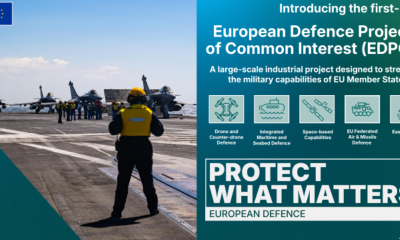
Commission proposes five joint defence projects to strengthen Europe's industrial capabilities
-
 Digital economy4 days ago
Can digital sovereignty survive an open trading system?
-
 Islam3 days ago
Friedman Institute and Trends Group at the Italian parliament: Countering the Muslim brotherhood