Entertainment
Half a million arts and entertainment enterprises in the EU


It is estimated that in 2021, there were half a million active enterprises in creative, arts and entertainment activities in the EU, with an additional 12 000 involved in library, archive and museum activities. These add to the 1.2 million enterprises in other culture-related economic activities (2020 data).
This information comes from preliminary data on Structural Business Statistics (SBS), which now offers wider and more complete coverage of the services sector.
Source dataset: sbs_sc_ovw
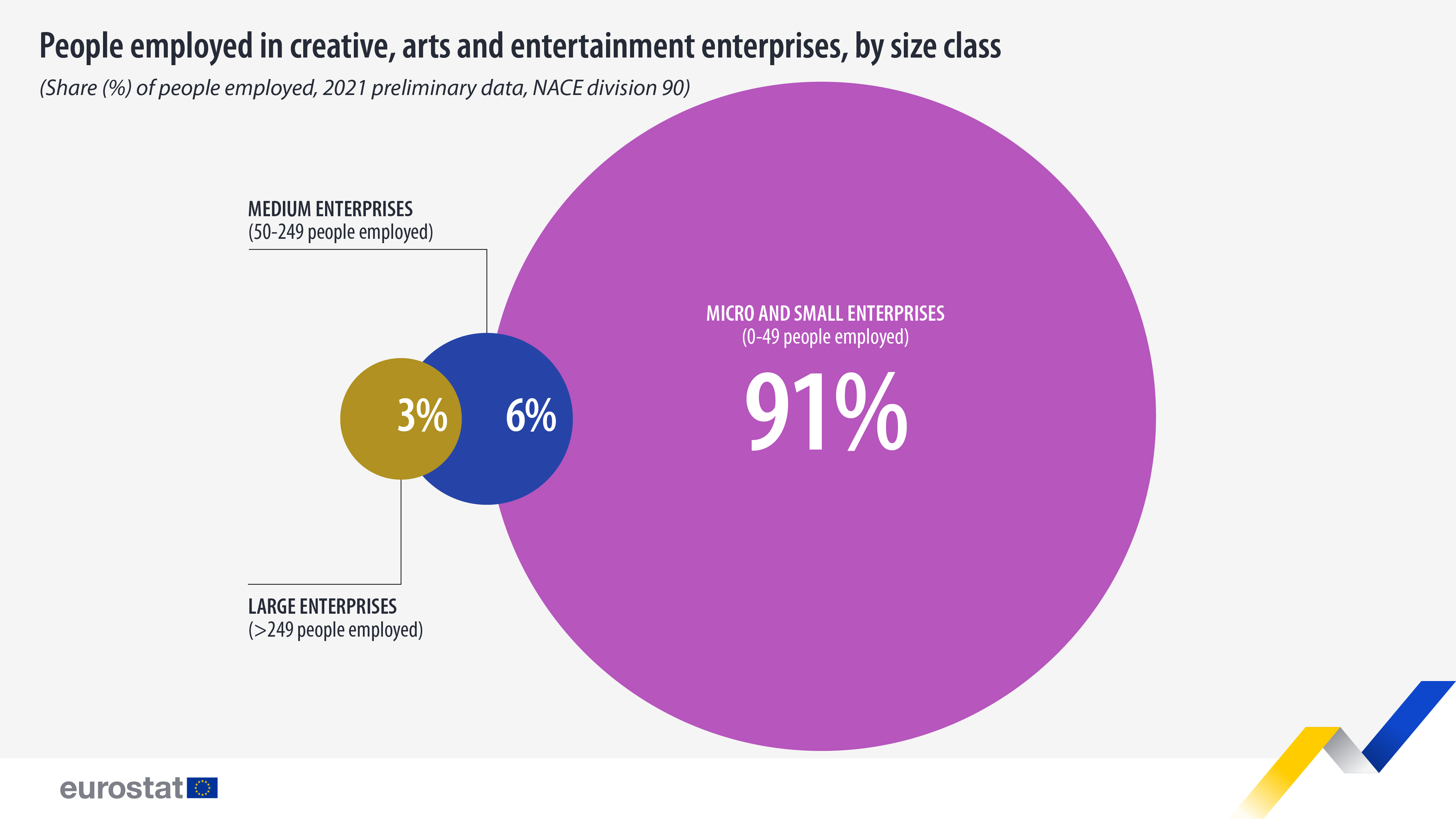
Enterprises in creative, arts and entertainment activities employed 582 000 people in 2021. The vast majority (91 %) were employed in micro or small enterprises (0 to 49 employees), 6% in medium enterprises (50 to 249 employees) and 3% in large enterprises (250 or more employees).
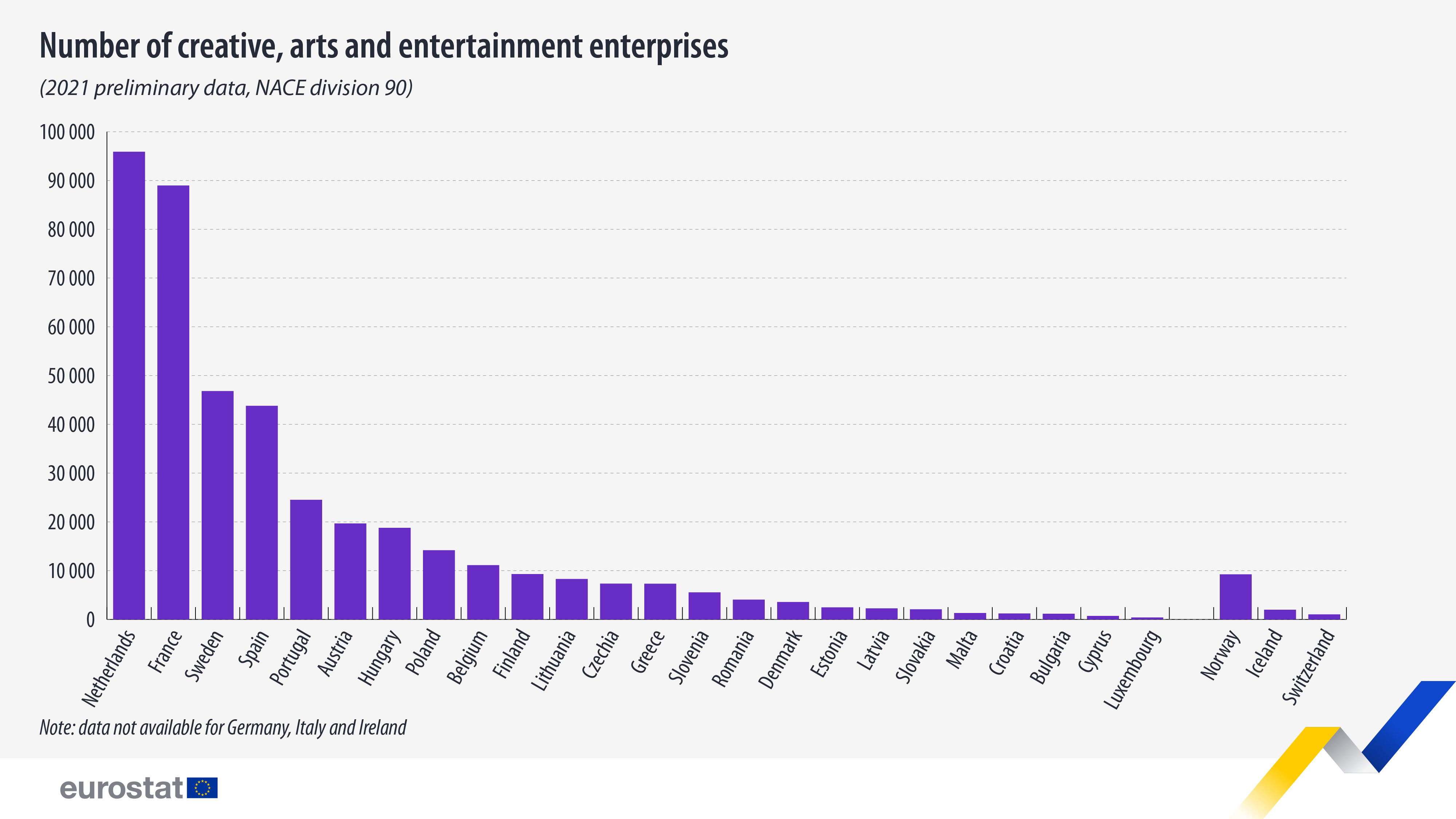
Looking at EU countries, the Netherlands had the highest number of creative, arts and entertainment enterprises, 95 902, followed by France (88 981), Sweden (46 825), Spain (43 796) and Portugal (24 533). The lowest numbers were registered in Luxembourg (398), Cyprus (711), Bulgaria (1 154), Croatia (1 217) and Malta (1 304).
Source dataset: sbs_sc_ovw
Advancing Structural Business Statistics
Structural Business Statistics already gave a comprehensive insight into the structure of the business sector, but this was improved by the introduction of new regulations on European Business Statistics, which includes new economic activities. Thanks to this, business statistics now cover two NACE divisions: division 90 for “creative, arts and entertainment activities” and 91 for “libraries, archives, museums and other cultural activities”.
Furthermore, preliminary Structural Business Statistics on three key variables (number of enterprises, employment, turnover) are published about a year after the end of the reference period. The preliminary release also includes the breakdown by enterprise size class, allowing users to carry out analysis for different kinds of enterprises and, in particular, for Small and Medium-Sized Enterprises (SMEs).
With the final release, about 20 months following the end of the reference year, the detailed economic activities at 4 digits of the NACE classification are published, including the newly available class 8552 on cultural education.
More information
Methodological notes
- The final release of 2021 data, including the total aggregate for the cultural sector, will be available in October.
- New regulation: European Business Statistics Regulation 2019/2152 and the General Implementing Regulation (EU) 2020/1197.
If you have any queries, please visit the contact us page.
Share this article:
EU Reporter publishes articles from a variety of outside sources which express a wide range of viewpoints. The positions taken in these articles are not necessarily those of EU Reporter. Please see EU Reporter’s full Terms and Conditions of publication for more information EU Reporter embraces artificial intelligence as a tool to enhance journalistic quality, efficiency, and accessibility, while maintaining strict human editorial oversight, ethical standards, and transparency in all AI-assisted content. Please see EU Reporter’s full A.I. Policy for more information.



ECR MEPs question the European Commission on cardiovascular health and diet promoting the Mediterranean diet as an alternative to ultra-processed foods as key to tackling obesity

Albania's Vlora airport standoff tests investor confidence as EU accession clock ticks

Commission adds exemptions to rules on removability of portable batteries

Iran’s regime in crisis: Negotiations, internal divisions and growing resistance

EU steps up international support for Palestinians with major initiative for Gaza's early recovery and stronger international coordination

Natura 2000 Network offers opportunities for sustainable tourism across Europe

Commission approves French state aid to support offshore wind energy

Shusha Global Media Forum: Azerbaijan’s Answer to Disinformation

Kazakhstan's fixed capital investment tops 9.5 trillion tenge in H1 2026

Commission registers two European Citizens' Initiatives on education and housing

Kazakhstan and Belgium: Building a Partnership for the Future

New court ruling questions 'proportionality' of Mayor Erion Veliaj’s detention

Rome–Washington Axis: Italian Diplomat Zanardi Landi to Help Save Bosnia

Burnham as PM? 'Wait and see'

Ban on destruction of unsold clothes and shoes enters into application

Survey on an EU Blueprint for intellectual property licensing and spinoff creation

Kazakhstan reforms under scrutiny at Brussels Press Club round table

Japan should face up to history and contribute more to regional peace

Ambassador calls for 'speeding up' of co-operation between EU and Kazakhstan

Timur Turlov at Smart Moves Summit 2025: How chess can transform global education

Shevtsova’s case: Out-of-court sanctions dismantling trust in Ukrainian cause

The future of European transport

Trump Vs Trueman

US 'no longer' an 'unconditional ally' for Europe - MEP
-
 Italy4 days ago
ECR MEPs question the European Commission on cardiovascular health and diet promoting the Mediterranean diet as an alternative to ultra-processed foods as key to tackling obesity
-
 Albania4 days ago
Albania's Vlora airport standoff tests investor confidence as EU accession clock ticks
-
 European Commission5 days ago
Commission adds exemptions to rules on removability of portable batteries
-
 Iran4 days ago
Iran’s regime in crisis: Negotiations, internal divisions and growing resistance