France
Switzerland’s Jacqueline de Quattro on the Muslim Brotherhood: 'We must not be naive'


This summer has seen the French government release a significant report facing up to the Muslim Brotherhood’s reported deep roots in French education, culture, and society.
Other countries such as Belgium are also confronting the organisation’s presence and influence within their borders and at a pan-European level.
In a recent interview with Dominik Feusi, the leading Swiss politician Jacqueline de Quattro has warned of the danger that she believes the Muslim Brotherhood poses for Switzerland and called for resolute political action.
During a Swiss parliamentary session, de Quattro also asked the country’s Federal Council what it intends to do to combat infiltration by the Muslim Brotherhood in Switzerland.
Additionally, she also filed, along with fellow senior Swiss politicians, a request that the government publish a report on the Islamist political movement in Switzerland, similar to that recently conducted by the French government.
In an interview with the respected Swiss publication Nebelspalter, De Quattro explains: “The Muslim Brotherhood represents a real threat. If we want to prevent them from establishing themselves in our country as they have in France, we must act quickly. In France, the Muslim Brotherhood has been building a strong network for years aimed at establishing Sharia law. They have infiltrated schools, social and humanitarian circles, as well as the cultural world. Their influence extends to all areas of government. Such a situation must never occur in Switzerland.”
De Quattro told the publication that she has asked Switzerland’s Federal Council to document the presence of these networks, their structure, their ideological and social influence, as well as their compatibility - or incompatibility - with Swiss constitutional principles. For her, an objective and in-depth report would provide a valuable basis for the adoption of coherent and proportionate measures, while respecting fundamental freedoms and the rule of law, she told the publication.
In her interview with Feusi, she mentioned the Brotherhood’s influence in areas such as education, religion, and social affairs. She is especially concerned about schools, explaining that the French report highlighted that threat. She went on in her interview to say: “Three young people aged 15, 16, and 18 were arrested in German-speaking Switzerland on suspicion of terrorist activities. In French-speaking Switzerland, three minors were arrested in the cantons of Geneva and Vaud. They were active on a social network where extremist and radical content was disseminated. Fedpol reports a worrying increase in the threat of online radicalisation among increasingly younger people. The youngest radicalised person to have committed a crime is only 11 years old. Fedpol also points out that violent actions by extremist groups are likely in the context of the Middle East conflict,” she told the interviewer.
De Quattro also told Feusi that she is clear on the role politicians can play in preventing confrontation of the influence of the Muslim Brotherhood in Switzerland, explaining, “Schools have become the preferred target of these movements, which pursue political objectives that are often contrary to our democratic principles. However, our young people are vulnerable and easily influenced. Education is therefore a priority.
“We must be attentive to radicalisation via social media, but also have the courage to take an interest in what is happening in certain mosques. Many preachers are invited there to propagate an Islamist ideology. This is fertile ground for terrorist acts. The situation in Switzerland is not as harmonious as one might think. The danger is very real here too,” she said to Feusi in the interview.
When asked by Dominik Feusi about Nebelspalter’s report on an Islamist school programme in the canton of Thurgau, de Quattro responded by saying: “All efforts that contribute to integration are welcome. But we must remain vigilant and not be naive. The Muslim Brotherhood constantly strives to conceal its activities and hides behind fictitious associations. Politicians must take a close look at this. We must take stock of the Islamic networks that exist in our country, including their international ramifications. Our internal security depends on it."
Dominik Feusi went on to ask de Quattro if there are any indications that Islamist organisations in Switzerland are part of a larger network such as the Muslim Brotherhood, for example through financial flows or training abroad. De Quattro responded to the journalist by saying: “I'll give you an example: the French report highlights the role of Geneva, where Said Ramadan, the founder's son-in-law, founded the Islamic Centre of Geneva in 1961. This centre has become a hub for the development of the Muslim Brotherhood in Europe. This demonstrates the transnational influence of the Muslim Brotherhood,” she said in the interview.
At the time of going to press, no-one from the Muslim Brotherhood was available for comment but it has previously said it is misrepresented and that is officially condemns violence and terrorism. Its supporters argue that the organization has a right to participate in the political process and pursue its goals through democratic means and emphasize its role in providing social services, advocating for social justice, and promoting Islamic values.
Share this article:
EU Reporter publishes articles from a variety of outside sources which express a wide range of viewpoints. The positions taken in these articles are not necessarily those of EU Reporter. Please see EU Reporter’s full Terms and Conditions of publication for more information EU Reporter embraces artificial intelligence as a tool to enhance journalistic quality, efficiency, and accessibility, while maintaining strict human editorial oversight, ethical standards, and transparency in all AI-assisted content. Please see EU Reporter’s full A.I. Policy for more information.



Can digital sovereignty survive an open trading system?

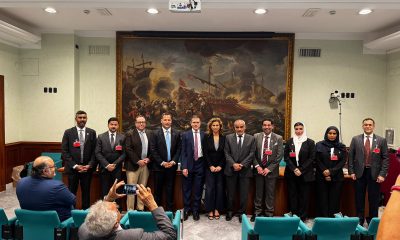
Friedman Institute and Trends Group at the Italian parliament: Countering the Muslim brotherhood

From a remote island to shelves around the world: The story of Azorean canned fish

EU deploys wildfire support to face multiple fires across Portugal and France

Europe’s job market is shifting, and EURES is ready to lead the way into 2030

EU agricultural markets remain robust despite uncertainties and rising input costs

Commission report highlights achievements of EU rules on animal health

Deposits to Swiss banks from Bangladeshi nationals nearly tops all time peak

EU foreign ministers to discuss options for restricting trade with Israeli communities in Judea and Samaria

Safer cars, safer roads: New rules take effect

Survey of city economic experts: Cities are driving Draghi’s competitiveness agenda, but need EU recognition to scale action

Europe's Cloud moment: The DMA must now deliver

EU-Mexico: While others build walls, Europe builds bridges

New EU strategy must help farmers move toward a more humane food system

Kashmir's 9,765 missing women and girls demand international attention

Quarterly reports show a surge in solar energy and e-vehicles, with record highs in 2025

Kazakhstan reforms under scrutiny at Brussels Press Club round table

Japan should face up to history and contribute more to regional peace

Ambassador calls for 'speeding up' of co-operation between EU and Kazakhstan

Timur Turlov at Smart Moves Summit 2025: How chess can transform global education

Shevtsova’s case: Out-of-court sanctions dismantling trust in Ukrainian cause

The future of European transport

Trump Vs Trueman

US 'no longer' an 'unconditional ally' for Europe - MEP
-
 Digital economy4 days ago
Can digital sovereignty survive an open trading system?
-
 Islam4 days ago
Friedman Institute and Trends Group at the Italian parliament: Countering the Muslim brotherhood
-
 Maritime4 days ago
From a remote island to shelves around the world: The story of Azorean canned fish
-
 Wildfires4 days ago
EU deploys wildfire support to face multiple fires across Portugal and France