EU
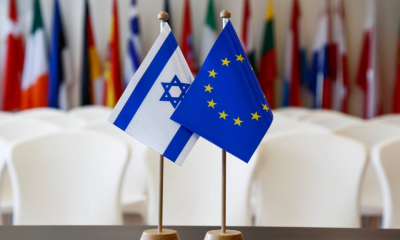
EU foreign ministers agree to hold long-awaited EU-Israel Association Council


An official removes Israel's flag at the European Commission (EC) headquarters, after the meeting between Israel's Prime Minister Benjamin Netanyahu and EC President Jean-Claude Juncker was cancelled in Brussels, Belgium, 11 December 2017.
No date has been set yet as the 27 member states must first agree an a common position and agenda. EU foreign affairs chief Josep Borrell said he hopes that the meeting could be held before Israel enters in election mode on November 1st. "Member states almost unanimously agreed that if they are able to agree on a common position and agenda, there is no necessity to wait after November 1st," he said, writes Yossi Lempkowicz.
The EU-Israel Association Council is the highest body at ministerial level that discusses bilateral relations. It has not met since 2012 because of disagreements on the Israeli-Palestinian issue. European Union Foreign Ministers agreed Monday to hold a meeting of the EU-Israel Association Council, the highest body at ministerial level that discusses bilateral relations and that has not met since 2012.
EU’s foreign affairs chief Josep Borrell announced the agreement at a press conference following the Foreign Ministers’ meeting in Brussels. He didn’t mention a specific date for such a meeting but said the 27 EU Foreign Ministers need first to agree on a "common position" before setting a date with Israel for convening the Association Council.
"This is the rule with each Association Council,” he explained. Borrell said he hopes that the meeting could be held before Israel enters in elections on 1 November. "Member states almost unanimously agreed that if they are able to agree on a common position and agenda, there is no necessity to wait after November 1st," Borrell added.
He said that if this is not possible "we will have to wait for a new (Israeli) government to be formed." If the meeting of the EU-Israel Association Council takes place before the November elections, Israel would be represented by its Foreign Minister, Yair Lapid, who is also interim Prime Minister. Borrell said that the EU position in supporting the two-state solution "has not changed".
He added that as the situation in the Palestinian territories "is deteriorating", it would be a good occasion to discuss it with Israel.
"It will be a good opportunity to rethink the Middle East peace process," he said. The last meeting of the EU-Israel Association Council was held in 2012. Since then, political disagreements on the Israel-Palestinian peace process, in particular on the settlements issue, has prevented a new meeting which is normally due to be held every year.
It was created in the framework of the 2000 EU-Israel Association Agreement. C-operation between the EU and Israel on bilateral issues such as trade, technology, science, security, culture, education is very intense. European Commission President Ursula von der Leyen visited Israel in June in order to deepen EU-Israel relations and partnership in particular on energy co-operation as Israel is working hard to be able to export some of its offshore gas resources to Europe, which is looking to replace Russian fossil fuel purchases since the invasion of Ukraine and sanctions against Vladimir Putin’s regime.
As foreign minister, Yair Lapid met his EU colleagues in Brussels in July 2021. The Czech Republic, a country with a very long and friendly relationship with Israel, took over this month the rotating EU presidency of the Council of Ministers.
Share this article:
EU Reporter publishes articles from a variety of outside sources which express a wide range of viewpoints. The positions taken in these articles are not necessarily those of EU Reporter. Please see EU Reporter’s full Terms and Conditions of publication for more information EU Reporter embraces artificial intelligence as a tool to enhance journalistic quality, efficiency, and accessibility, while maintaining strict human editorial oversight, ethical standards, and transparency in all AI-assisted content. Please see EU Reporter’s full A.I. Policy for more information.




Astana's congress of world religions: A global platform for dialogue in an age of division

Protect children from online sexual abuse: Call for urgent negotiations and permanent solution

Solana company partners with Kazakhstan on $6B Alatau Crypto Megacity

Will the Gulf monarchies rise above internecine disputes in the interest of collective security?

Europe must double down on nuclear progress to achieve its long-term ambitions

International Plastic Bag Free Day – from single use to reuse

Study: Europe's defense runs on American servers

Commission proposes five joint defence projects to strengthen Europe's industrial capabilities

Safer cars, safer roads: New rules take effect

Survey of city economic experts: Cities are driving Draghi’s competitiveness agenda, but need EU recognition to scale action

Europe's Cloud moment: The DMA must now deliver

EU-Mexico: While others build walls, Europe builds bridges

New EU strategy must help farmers move toward a more humane food system

Kashmir's 9,765 missing women and girls demand international attention

Quarterly reports show a surge in solar energy and e-vehicles, with record highs in 2025

EU deploys wildfire support to face multiple fires across Portugal and France

Kazakhstan reforms under scrutiny at Brussels Press Club round table

Japan should face up to history and contribute more to regional peace

Ambassador calls for 'speeding up' of co-operation between EU and Kazakhstan

Timur Turlov at Smart Moves Summit 2025: How chess can transform global education

Shevtsova’s case: Out-of-court sanctions dismantling trust in Ukrainian cause

The future of European transport

Trump Vs Trueman

US 'no longer' an 'unconditional ally' for Europe - MEP
-
 Kazakhstan4 days ago
Astana's congress of world religions: A global platform for dialogue in an age of division
-
 Child sexual abuse4 days ago
Protect children from online sexual abuse: Call for urgent negotiations and permanent solution
-
 Kazakhstan4 days ago
Solana company partners with Kazakhstan on $6B Alatau Crypto Megacity
-
 Iran4 days ago
Will the Gulf monarchies rise above internecine disputes in the interest of collective security?