
Corporate tax rules
EU delays digital levy to focus on global minimum tax agreement

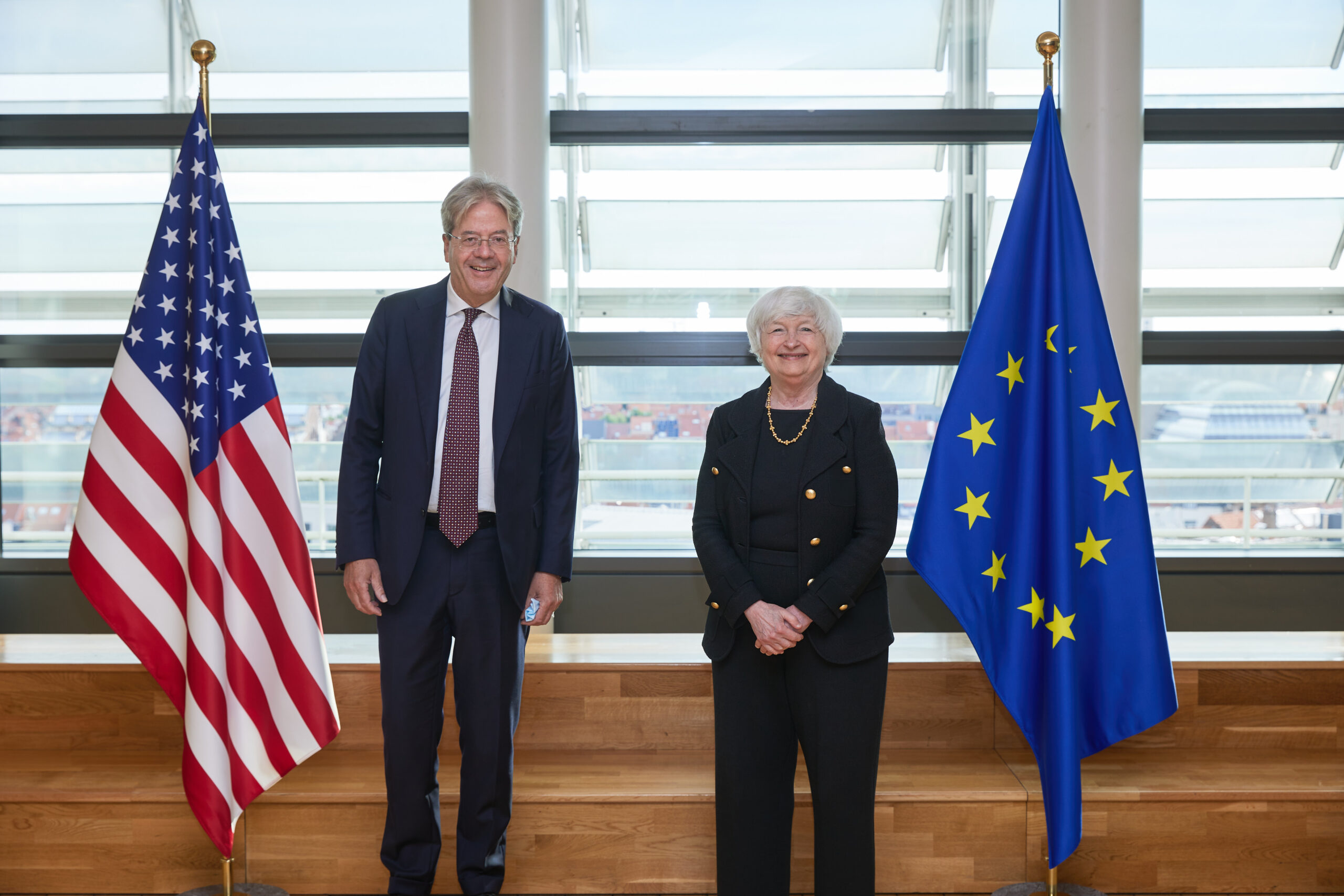
The EU has decided to postpone its digital levy until the autumn after a two-day meeting of G20 finance ministers in Venice, where a historic agreement was reached on building a more stable and fairer international tax architecture, writes Catherine Feore.
Much of the renewed impetus for progress in this area has come from the new Biden administration. Today (12 July) the US Secretary of State for the Treasury Janet Yellen (pictured) met with the president and executive vice president of the European Commission for the economy, as well as with Economy Commissioner Paolo Gentiloni and European Central Bank President Christine Lagarde, before participating in today’s Eurogroup meeting of finance ministers.
The new proposal will build on the ‘base erosion and profit shifting’ (BEPS) work of the OECD and address the two components of this work, namely the allocation of profits of multinational companies (MNEs) and an effective global minimum corporate tax rate. The US initially suggested that a minimum corporate tax rate should be set at 21%, but swiftly moved to 15%.
Going into today’s Eurogroup meeting, Economy Commissioner Paolo Gentiloni said he had had an excellent meeting with the US Secretary of the Treasury Janet Yellen. Gentiloni said the main achievement of the weekend - the global agreement on taxation - would put an end to the “race to the bottom” to relocate taxes. He said: “In this framework, I informed Secretary Yellen of our decision to put on hold the proposal of an EU digital levy to allow us to concentrate on the last mile of this historic agreement.”
The European Commission’s spokesperson Daniel Ferrie said that the Commission would have to swiftly address the outstanding issues and finalize “various design elements”, together with a detailed implementation plan by October. The idea is that this would be approved by G20 heads of government at a summit in Rome. Ferrie said: “For this reason we have decided to put on hold our work on a proposal for a digital levy as a new ‘own resource’ during this period.”
The European Commission had tabled an announcement on a new EU digital levy for 14 July, then delayed to 22 July, it has now been delayed until after this agreement. The digital levy was envisaged as a new own resource which would help the EU in the repayment of the NextGenerationEU borrowing. New own resources need to be put in place by 1 January 2023.
Share this article:



ECR MEPs question the European Commission on cardiovascular health and diet promoting the Mediterranean diet as an alternative to ultra-processed foods as key to tackling obesity

Falling in love with the Maldives

Kurmuk gold project highlights Africa’s changing investment landscape

Albania's Vlora airport standoff tests investor confidence as EU accession clock ticks

EU steps up international support for Palestinians with major initiative for Gaza's early recovery and stronger international coordination

Commission adds exemptions to rules on removability of portable batteries

Iran’s regime in crisis: Negotiations, internal divisions and growing resistance

Natura 2000 Network offers opportunities for sustainable tourism across Europe

Kazakhstan and Belgium: Building a Partnership for the Future

New court ruling questions 'proportionality' of Mayor Erion Veliaj’s detention

Rome–Washington Axis: Italian Diplomat Zanardi Landi to Help Save Bosnia

Burnham as PM? 'Wait and see'

Ban on destruction of unsold clothes and shoes enters into application

Survey on an EU Blueprint for intellectual property licensing and spinoff creation

Rule of law report strengthens EU democracy and fundamental rights

EU launches Ukraine defence industrial partnership, Drone Deal and disburses €1 billion for drones *

Kazakhstan reforms under scrutiny at Brussels Press Club round table

Japan should face up to history and contribute more to regional peace

Ambassador calls for 'speeding up' of co-operation between EU and Kazakhstan

Timur Turlov at Smart Moves Summit 2025: How chess can transform global education

Shevtsova’s case: Out-of-court sanctions dismantling trust in Ukrainian cause

The future of European transport

Trump Vs Trueman

US 'no longer' an 'unconditional ally' for Europe - MEP
-
 Italy3 days ago
ECR MEPs question the European Commission on cardiovascular health and diet promoting the Mediterranean diet as an alternative to ultra-processed foods as key to tackling obesity
-
 Tourism5 days ago
Falling in love with the Maldives
-
 China5 days ago
Kurmuk gold project highlights Africa’s changing investment landscape
-
 Albania3 days ago
Albania's Vlora airport standoff tests investor confidence as EU accession clock ticks