European Commission
EU takes aim at trafficking of illicit firearms


Illicit firearms pose a grave risk to public safety, fuelling terrorism, organized crime, gang violence and other serious offences. In the EU, it is currently difficult to combat firearms trafficking, given that current EU rules only cover the legal ownership and transfer of firearms. There are also significant differences in how firearms related offences are defined and punished across countries. That is why the Commission has proposed new EU-wide rules to effectively tackle trafficking and other firearms-related offences.
The proposal will help to harmonise rules and efforts across EU countries and improve the effectiveness of law enforcement against firearms-related crimes by
- introducing EU-wide common definitions of firearms offences and penalties – covering everything from trafficking, to falsifying mandatory markings, to the illicit use of blueprints for 3D printing of firearms
- supporting stronger cooperation between EU countries – each country will have to establish a National Firearms Focal Point to coordinate this cross-border cooperation
- improving the collection and use of data – including establishing a dataset to register seized firearms, and requiring EU countries to gather and share data related to firearms offences every five years.
This new proposal is the first to be adopted under the European internal security strategy, ProtectEU. It will make investigations and prosecutions more effective and reinforce law enforcement's ability to respond to emerging threats, which will in turn help to better protect citizens.
For more information
Press release – Commission proposes EU-wide rules against the trafficking of illicit firearms
Share this article:
EU Reporter publishes articles from a variety of outside sources which express a wide range of viewpoints. The positions taken in these articles are not necessarily those of EU Reporter. Please see EU Reporter’s full Terms and Conditions of publication for more information EU Reporter embraces artificial intelligence as a tool to enhance journalistic quality, efficiency, and accessibility, while maintaining strict human editorial oversight, ethical standards, and transparency in all AI-assisted content. Please see EU Reporter’s full A.I. Policy for more information.



Astana's congress of world religions: A global platform for dialogue in an age of division

Protect children from online sexual abuse: Call for urgent negotiations and permanent solution

Solana company partners with Kazakhstan on $6B Alatau Crypto Megacity

Will the Gulf monarchies rise above internecine disputes in the interest of collective security?

Europe must double down on nuclear progress to achieve its long-term ambitions

International Plastic Bag Free Day – from single use to reuse

Study: Europe's defense runs on American servers

MEPs supportive of draft Biotech report, but divisions over incentives remain

Kashmir's 9,765 missing women and girls demand international attention

Quarterly reports show a surge in solar energy and e-vehicles, with record highs in 2025

EU deploys wildfire support to face multiple fires across Portugal and France

New EU plan to address the risks and opportunities of advanced AI for cybersecurity

Portugal achieves major milestone with permit for offshore aquaculture facility

Setting sustainable livestock farming on a strong footing

Competition policy: Enforce without fear

Friedman Institute and Trends Group at the Italian parliament: Countering the Muslim brotherhood

Kazakhstan reforms under scrutiny at Brussels Press Club round table

Japan should face up to history and contribute more to regional peace

Ambassador calls for 'speeding up' of co-operation between EU and Kazakhstan

Timur Turlov at Smart Moves Summit 2025: How chess can transform global education

Shevtsova’s case: Out-of-court sanctions dismantling trust in Ukrainian cause

The future of European transport

Trump Vs Trueman

US 'no longer' an 'unconditional ally' for Europe - MEP
-
 Kazakhstan4 days ago
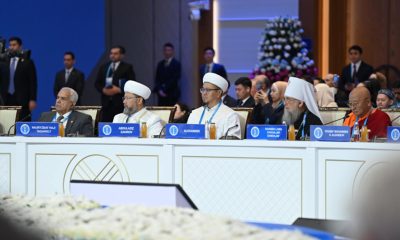
Astana's congress of world religions: A global platform for dialogue in an age of division
-
 Child sexual abuse4 days ago
Protect children from online sexual abuse: Call for urgent negotiations and permanent solution
-
 Kazakhstan4 days ago
Solana company partners with Kazakhstan on $6B Alatau Crypto Megacity
-
 Iran4 days ago
Will the Gulf monarchies rise above internecine disputes in the interest of collective security?