Conflicts
EU announces increased humanitarian assistance to Iraqis fleeing from violence


The European Commission will increase its humanitarian assistance to Iraq by €5 million following the displacement of hundreds of thousands of people as a result of the recent attacks perpetrated by the Islamic State of Iraq and the Levant (ISIL) and other armed groups. This additional funding will bring the total 2014 humanitarian funding for Iraq to €12m.
International Cooperation, Humanitarian Aid and Civil Protection Commissioner Kristalina Georgieva said: "This fresh wave of violence has terrible consequences for vulnerable children, women and men. Our new funding comes on top of €3m I announced in March during my visit to Baghdad and the Kurdish region of Iraq in anticipation of a further deterioration in the country's security. It will help relieve suffering by providing basic services and assistance. I appeal to all parties to the fighting to ensure the safety of civilians and to respect the role of humanitarians working in dangerous conditions."
The recent spate of displacement was precipitated by the capture of the city of Mosul by ISIL and attacks by armed opposition groups targeting the governorates of Ninewah, Salah Al-Din, Diyala and Al Anbar. Up to half a million people have been displaced from Ninewah so far, adding to the more than 400 000 persons already displaced in the last six months.
The full scale of the humanitarian disaster is as yet unclear, as many displaced families are currently being hosted by relatives and communities of origin. The number of displaced people is expected to rise due to the severity of the fighting. The European Commission's Humanitarian Aid and Civil Protection department (ECHO) has been preparing its response to new waves of displacement and this additional funding is a further step in that process.
Background
The city of Mosul (Ninewah governorate) fell under the control of armed opposition groups (AOGs), including the Islamic State of Iraq and the Levant (ISIL). All hospitals in Mosul, with a population close to two million people, are reported to be closed. Humanitarian organizations have also relocated from Mosul.
A large-scale humanitarian crisis is developing. The UN has reported casualties in the hundreds and massive displacement of the population. Violence continues to cause displacement across central and north Iraq, causing the numbers of internally displaced people (IDPs) to rise. Current estimates suggest that up to 500 000 people have been displaced since January. An estimated 300 000 IDPs have arrived in Erbil and Dohuk in recent days.
Humanitarian agencies continue to organise assistance for internally displaced families. Although conditions for IDPs hosted by local communities are stable for the moment, there are concerns about the capacities of Kurdish communities who already host a large number of IDPs from Al-Anbar as well as Syrian refugees.
On the disputed borders between Ninewa and the Kurdish governorates, food shortages on the local markets as well as the disruption of electricity and water services are being reported. Humanitarian agencies continue working on the establishment of temporary sheltering in Shikan and Khabat, and the distribution of food and emergency items. The restoration and strengthening of health services in the areas where IDPs are gathering is a priority.
The European Commission's total humanitarian support to Iraq since 2007 amounts to almost €145m, including support to Syrian refugees in Iraq. Its humanitarian programme responds to the needs of internally displaced Iraqis in the country and Iraqi refugees in Jordan and Lebanon with €7m in 2013 and €12m in 2014.
More information
The European Commission's humanitarian aid and civil protection
Commissioner Georgieva's website
Emergency Response Coordination Centre
Share this article:
EU Reporter publishes articles from a variety of outside sources which express a wide range of viewpoints. The positions taken in these articles are not necessarily those of EU Reporter. Please see EU Reporter’s full Terms and Conditions of publication for more information EU Reporter embraces artificial intelligence as a tool to enhance journalistic quality, efficiency, and accessibility, while maintaining strict human editorial oversight, ethical standards, and transparency in all AI-assisted content. Please see EU Reporter’s full A.I. Policy for more information.



European operation dismantles €10 million illicit cigarette network in Spain

Energy Union Task Force takes stock of oil and gas security of supply in the EU

Srebrenica's lesson is prevention. Why isn't the world applying It to Kashmir?

AIFC to host Astana Finance Days 2026 in September

ALROSA Re-elects Supervisory Board with Minimal Changes

EU clarifies rules to allow continued waste recovery shipments to Switzerland

EU launches a Team Gaza Initiative to support early recovery in Gaza with an initial amount of nearly €900 million

Joint statement by High Representative/Vice-President Kallas and Commissioner Kos on the 31st anniversary of the Srebrenica genocide

Starmer’s problem? 'He is not a politician'

Why a Brussels–Nicosia–Eastern Mediterranean strategic affairs platform would benefit the European Union

Albania's Vlora airport standoff tests investor confidence as EU accession clock ticks

ECR MEPs question the European Commission on cardiovascular health and diet promoting the Mediterranean diet as an alternative to ultra-processed foods as key to tackling obesity

Kazakhstan's fixed capital investment tops 9.5 trillion tenge in H1 2026

Commission adopts simpler rules for EU agri-food promotion policy

Commission approves €659 million German state aid for four new semiconductor facilities

EU law on nitrates pollution remains effective, with scope for smarter implementation

Kazakhstan reforms under scrutiny at Brussels Press Club round table

Japan should face up to history and contribute more to regional peace

Ambassador calls for 'speeding up' of co-operation between EU and Kazakhstan

Timur Turlov at Smart Moves Summit 2025: How chess can transform global education

Shevtsova’s case: Out-of-court sanctions dismantling trust in Ukrainian cause

The future of European transport

Trump Vs Trueman

US 'no longer' an 'unconditional ally' for Europe - MEP
-
 Cigarettes4 days ago
European operation dismantles €10 million illicit cigarette network in Spain
-
 Energy market3 days ago
Energy Union Task Force takes stock of oil and gas security of supply in the EU
-
 Kashmir4 days ago
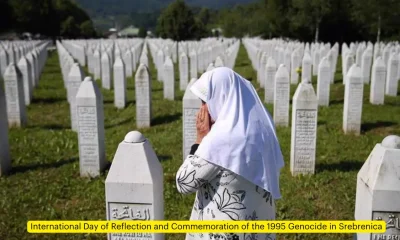
Srebrenica's lesson is prevention. Why isn't the world applying It to Kashmir?
-
 Kazakhstan3 days ago
AIFC to host Astana Finance Days 2026 in September