EU
Commission assesses progress by Turkey in visa dialogue

Today (20 October) the Commission presented its first report on progress by Turkey in fulfilling the requirements set in its visa liberalization road map.
"This first report shows that Turkey is doing effective efforts to meet the criteria identified in its visa liberalization road map and I welcome in particular the progress achieved in the fields of migration and international protection, as well as in document security. Work is still needed in areas like, among others, border management, and police and judicial cooperation. I am convinced that Turkey will keep a steady pace towards the fulfilment of the benchmarks by bringing forward several essential legislative and administrative reforms," said Home Affairs Commissioner Cecilia Malmström.
The Commission report assesses the situation of the legislation, administrative capacities and practices of Turkey in the areas addressed by the benchmarks of the road map, and makes a set of recommendations for the Government of Turkey to fulfil these benchmarks.
It acknowledges the progress made regarding the Turkish passport and civil registry systems, the importance of the reforms recently adopted in the field of migration and international protection, some positive developments in border cooperation with the member states and FRONTEX, as well as the encouraging initiatives taken to reform anti-terror legislation.
At the same time, further steps remain necessary to fully comply with the requirements of the visa road map. The report recommends inter alia that:
-
On document security, Turkey will need to start issuing new passports that include biometric data, in line with the EU acquis, and develop cooperation with member states in detecting forged and fraudulent travel documents.
-
On migration management, Turkey will need to ensure the effective implementation of the new Law on Foreigners and International Protection, and will need to complete the setting up of the General Directorate for Migration Management.
-
Measures should be taken in Turkey to set up a more modern, effective and integrated border management system, to strengthen the visa system, as well as to develop stronger border cooperation with EU Member States.
-
The EU expects full and effective implementation vis-à-vis all Member States of the EU-Turkey readmission agreement that has entered into force on 1 October 2014. Meanwhile, the bilateral readmission obligations already in place between Turkey and the EU Member States should be more effectively fulfilled.
-
On public order and security, the Turkish authorities need to sign, ratify, and start implementing several international conventions, to adopt national legislation in line with European and international standards, and to continue the reform of Turkey's justice system, in view of safeguarding its independence and efficiency. These actions will help support Turkey’s law enforcement agencies in the fight against organized crime, and foster police and judicial co-operation with their counterparts in the member states and with the relevant EU agencies.
-
In the area of fundamental rights, Turkey should continue to revise anti-terrorism legislation and work on ensuring that this legislation is implemented in line with ECHR provisions and the case-law of the European Court of Human Rights.
-
Turkey will also need to adopt and implement a comprehensive strategy and action plan to improve the situation for people with Roma heritage living in Turkey, as well as legislation to prevent discrimination and facilitate social inclusion.
Background
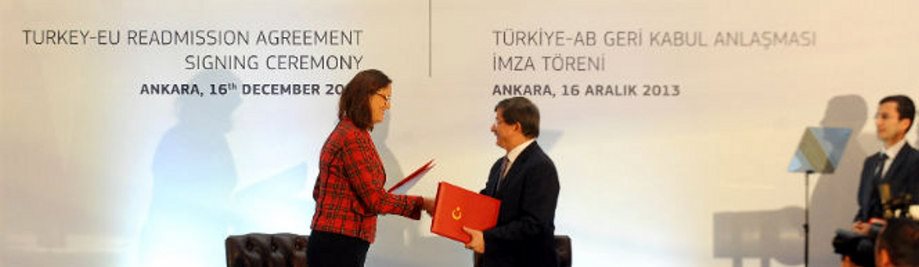
The European Commission launched a visa liberalization dialogue with Turkey on 16 December 2013, in parallel with the signature of the EU-Turkey readmission agreement (IP/13/1259).
On that occasion a visa road map was handed over to Turkish authorities. It sets out a comprehensive list of areas, divided in 5 chapters (called "blocks") on which Turkey was requested to develop legislation and administrative capacities and practices, as well as adequate cooperation with the EU.
The requirements listed in the road map aim:
-
At enhancing the quality of Turkey's travel and identity documents, as well as the cooperation with the EU in detecting false documents and impostors (block 1 of the road map);
-
at improving the quality of Turkey's migration, international protection, borders and visa policy as well its border co-operation with the EU (block 2);
-
at strengthening Turkey's capacity to prevent and combat against organized crime, and to co-operate with the EU in police and judicial matters (block 3), and;
-
at protecting the fundamental rights of citizens, with a specific attention to the rights and needs of minorities (block 4).
The visa roadmap also includes a separate block listing requirements related to the need for Turkey to fully and effectively implement the readmission agreement signed with the EU (STATEMENT/14/285), as well as the readmission obligations taken by Turkey at bilateral level with the EU Member States.
Today's first report was prepared by the Commission on the basis of information provided by Turkish authorities, as well as through field visits and technical missions, which took place in Turkey between March and June 2014 and included experts from the Commission, the EU delegation in Turkey, Turkey, the EU member states and the relevant EU agencies (FRONTEX, EASO, EUROPOL).
The visa liberalization dialogue is a merit-based process. Turkey should meet all the requirements set out in the visa roadmap and demonstrate that there is no substantial migratory and security risk associated with lifting the visa obligation. Once this process is successfully completed, the Commission can recommend to the European Parliament and the Council lifting the visa obligation for Turkish citizens.
More information
First report on Turkey
Cecilia Malmström's website
Follow Commissioner Malmström on Twitter
DG Home Affairs website
Follow DG Home Affairs on Twitter
Share this article:
EU Reporter publishes articles from a variety of outside sources which express a wide range of viewpoints. The positions taken in these articles are not necessarily those of EU Reporter. Please see EU Reporter’s full Terms and Conditions of publication for more information EU Reporter embraces artificial intelligence as a tool to enhance journalistic quality, efficiency, and accessibility, while maintaining strict human editorial oversight, ethical standards, and transparency in all AI-assisted content. Please see EU Reporter’s full A.I. Policy for more information.




European operation dismantles €10 million illicit cigarette network in Spain

EU foreign ministers to discuss options for restricting trade with Israeli communities in Judea and Samaria

Srebrenica's lesson is prevention. Why isn't the world applying It to Kashmir?

Energy Union Task Force takes stock of oil and gas security of supply in the EU

ALROSA Re-elects Supervisory Board with Minimal Changes

AIFC to host Astana Finance Days 2026 in September

Joint statement by High Representative/Vice-President Kallas and Commissioner Kos on the 31st anniversary of the Srebrenica genocide

EU launches a Team Gaza Initiative to support early recovery in Gaza with an initial amount of nearly €900 million

Shusha Global Media Forum: Azerbaijan’s Answer to Disinformation

Commission approves French state aid to support offshore wind energy

Natura 2000 Network offers opportunities for sustainable tourism across Europe

Commission adds exemptions to rules on removability of portable batteries

EU steps up international support for Palestinians with major initiative for Gaza's early recovery and stronger international coordination

Kurmuk gold project highlights Africa’s changing investment landscape

Falling in love with the Maldives

Britain’s leadership crisis is a symptom, not the disease

Kazakhstan reforms under scrutiny at Brussels Press Club round table

Japan should face up to history and contribute more to regional peace

Ambassador calls for 'speeding up' of co-operation between EU and Kazakhstan

Timur Turlov at Smart Moves Summit 2025: How chess can transform global education

Shevtsova’s case: Out-of-court sanctions dismantling trust in Ukrainian cause

The future of European transport

Trump Vs Trueman

US 'no longer' an 'unconditional ally' for Europe - MEP
-
 Cigarettes4 days ago
European operation dismantles €10 million illicit cigarette network in Spain
-
 Israel5 days ago
EU foreign ministers to discuss options for restricting trade with Israeli communities in Judea and Samaria
-
 Kashmir4 days ago
Srebrenica's lesson is prevention. Why isn't the world applying It to Kashmir?
-
 Energy market3 days ago
Energy Union Task Force takes stock of oil and gas security of supply in the EU