Holocaust
Holocaust survivors join families of hostages at Tel Aviv rally, urge swift action: 'Bring Them All Home'

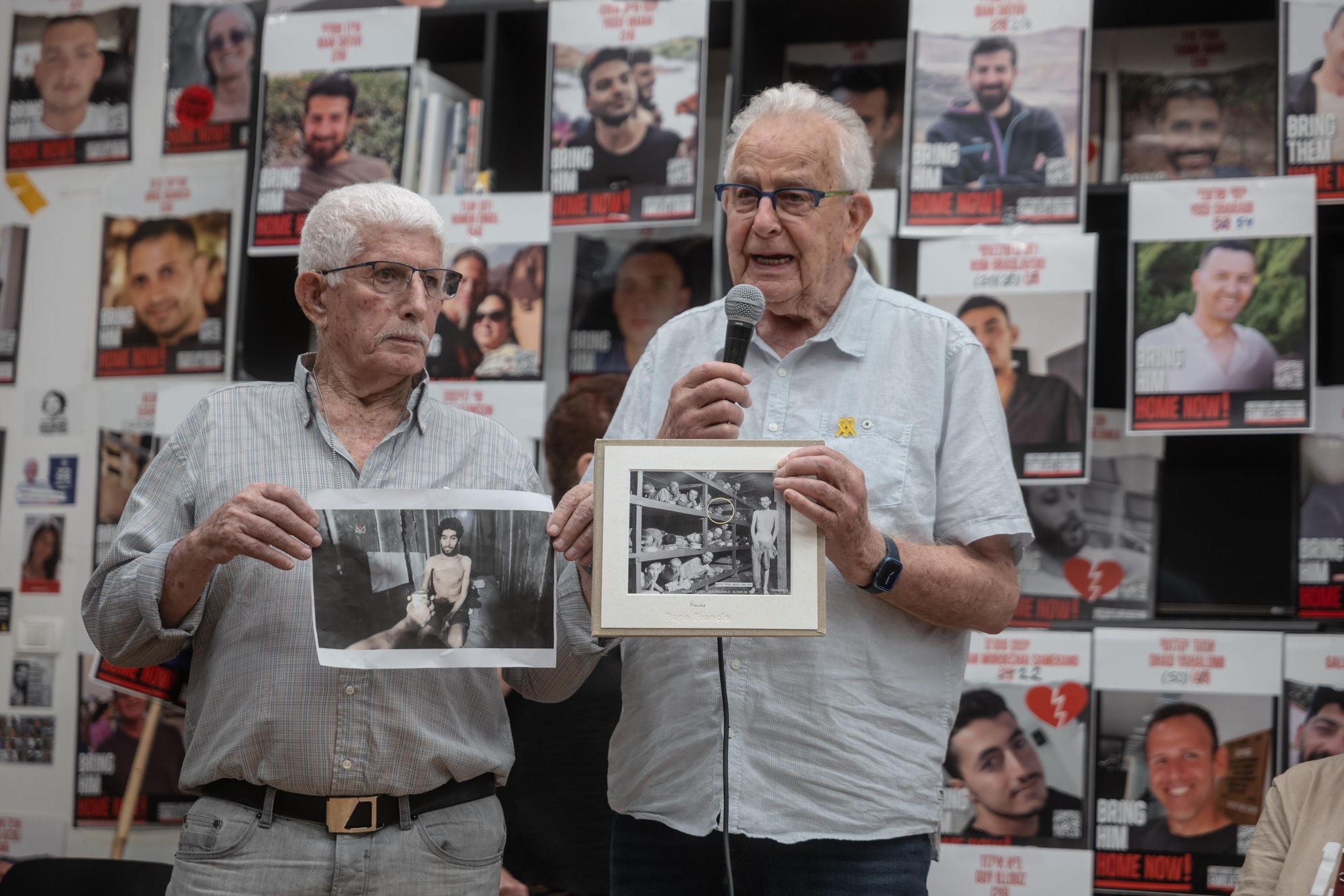
In a powerful show of solidarity, a group of Holocaust survivors gathered today at Hostages Square in Tel Aviv, meeting with freed hostages and families of those still held captive in Gaza. The visit, which was held yesterday evening and organized by the International March of the Living, came just days after the release of disturbing footage showing hostages Rom Braslavski and Evyatar David in a state of severe malnourishment and distress.
The images, widely circulated over the weekend, have deeply shaken many Holocaust survivors, reviving traumatic memories of hunger, imprisonment, and helplessness. Survivors from across Israel who previously took part in the March of the Living came together to express their support, lend strength to the families, and urge Israeli and international leaders to act swiftly.
Among the participants were freed hostages Yocheved Lifshitz and Danielle Aloni, as well as several families of current and former hostages. They included Gilad and Nitza Korengold, parents of released hostage Tal Shoham, joined by other members of the Shoham family; Danny and Naama Miran, the father and sister of hostage Omri Miran; Doron Zaxer, adoptive father of hostage Idan Alexander; and Michel Illouz, father of fallen hostage Guy Illouz.
In a public statement read aloud at the gathering, Holocaust survivor Arne Rabuchin gave voice to the survivors’ collective anguish and moral urgency: “When we, Holocaust survivors, saw the images of Rom Braslavski and Evyatar David, emaciated, frightened, barely clinging to life, we felt as if the air had been pulled from our lungs,” he said. “It transported us back 80 years to the moment we were liberated from Nazi tyranny.”
The statement continued with a direct appeal to Israeli leadership, global powers, and the wider public: “Do not rest. Do not wait. Do not allow hesitation to cost more lives. Bring the hostages home, every single one, with the same urgency you would demand for your own child, your own brother, your own mother. They are human beings. And their time is running out.”
Yocheved Lifshitz, who was held by Hamas in Gaza for over two weeks and has spoken publicly about her experience in the tunnels, addressed the crowd with a mix of pain and resilience: “I am a survivor of the tunnels, and I came back from there,” she said. “On Friday, when I saw the images of those children who haven’t eaten, I felt myself being pulled back into the tunnels. I feel what they are feeling. I am proud to see you all here. I thank everyone who came.”
Other survivors echoed her sentiments. Naftali Fürst, 94, who survived four concentration camps, including Auschwitz, said his presence was meant to convey strength and hope to the families: “Without hope, we would not have survived,” he said. “I came here with strength to support the families whose children are still in the horror of Gaza’s underground.”
The emotional visit underscored the ongoing psychological toll of the hostage crisis, not only on the families but on a generation of Holocaust survivors who see parallels between past atrocities and present suffering.
Revital Yakin Krakovsky, Deputy CEO of March of the Living, noted the deep emotional impact the recent hostage images have had on survivors: “Since the release of the images of Rom and Evyatar, Holocaust survivors have been deeply distressed. The trauma they endured as terrified, hungry, and helpless children has come rushing back in an instant,” she said. “They are heartbroken and outraged that not everything is being done to bring the hostages home. The survivors came today to offer strength and to remind the families: you are not alone.”
The March of the Living, which annually brings Holocaust survivors and youth to the sites of former Nazi camps in Poland, has continued to serve as a platform for memory and moral action. Today’s gathering extended that mission to the present-day crisis, calling on decision-makers to remember the lessons of history and act with urgency.
As the war in Gaza enters its tenth month, over 100 hostages are believed to remain in captivity. For the families and their supporters, time is a critical factor. The voices of Holocaust survivors at Hostages Square added a weight of historical perspective, and a plea not to look away.
Picture caption: Holocaust survivors Naftali Furst and Haim Gar Or
Photo credit: Chen Schimmel
Share this article:
EU Reporter publishes articles from a variety of outside sources which express a wide range of viewpoints. The positions taken in these articles are not necessarily those of EU Reporter. Please see EU Reporter’s full Terms and Conditions of publication for more information EU Reporter embraces artificial intelligence as a tool to enhance journalistic quality, efficiency, and accessibility, while maintaining strict human editorial oversight, ethical standards, and transparency in all AI-assisted content. Please see EU Reporter’s full A.I. Policy for more information.



ECR MEPs question the European Commission on cardiovascular health and diet promoting the Mediterranean diet as an alternative to ultra-processed foods as key to tackling obesity

Falling in love with the Maldives

Kurmuk gold project highlights Africa’s changing investment landscape

Albania's Vlora airport standoff tests investor confidence as EU accession clock ticks

EU steps up international support for Palestinians with major initiative for Gaza's early recovery and stronger international coordination

Commission adds exemptions to rules on removability of portable batteries

Iran’s regime in crisis: Negotiations, internal divisions and growing resistance

Britain’s leadership crisis is a symptom, not the disease

New court ruling questions 'proportionality' of Mayor Erion Veliaj’s detention

Rome–Washington Axis: Italian Diplomat Zanardi Landi to Help Save Bosnia

Burnham as PM? 'Wait and see'

Ban on destruction of unsold clothes and shoes enters into application

Survey on an EU Blueprint for intellectual property licensing and spinoff creation

Rule of law report strengthens EU democracy and fundamental rights

EU launches Ukraine defence industrial partnership, Drone Deal and disburses €1 billion for drones *

Setting a new benchmark in premium travel

Kazakhstan reforms under scrutiny at Brussels Press Club round table

Japan should face up to history and contribute more to regional peace

Ambassador calls for 'speeding up' of co-operation between EU and Kazakhstan

Timur Turlov at Smart Moves Summit 2025: How chess can transform global education

Shevtsova’s case: Out-of-court sanctions dismantling trust in Ukrainian cause

The future of European transport

Trump Vs Trueman

US 'no longer' an 'unconditional ally' for Europe - MEP
-
 Italy3 days ago
ECR MEPs question the European Commission on cardiovascular health and diet promoting the Mediterranean diet as an alternative to ultra-processed foods as key to tackling obesity
-
 Tourism4 days ago
Falling in love with the Maldives
-
 China4 days ago
Kurmuk gold project highlights Africa’s changing investment landscape
-
 Albania3 days ago
Albania's Vlora airport standoff tests investor confidence as EU accession clock ticks