Kazakhstan
Slight majority favours construction of nuclear power plant in Kazakhstan, survey finds


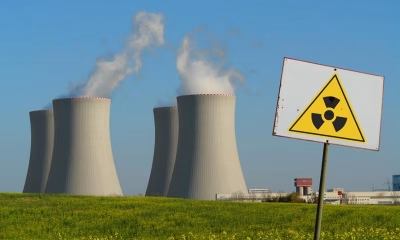
Photo credit: inform.kz. A slight majority of respondents (53.1%) support building a nuclear power plant, hoping it will help resolve electricity shortages by 2030, according to survey results published on Aug. 22 by the Kazakhstan Institute for Strategic Studies (KazISS). The telephone survey, which included 1,200 citizens aged 18 and over, was conducted from Aug. 7 to 18, writes Dana Omirgazy in Editor’s Picks, Nation.
Respondents (32.5%) who oppose the idea of building a nuclear power plant are mainly concerned about possible accidents and their consequences for the environment.
Every tenth respondent (14.4%) has yet to decide.
Also, half of the respondents (51.0%) believe that they have sufficient information and level of knowledge to vote “for” or “against” the construction of a nuclear power plant in the referendum.
Another 12.2% of respondents admit that they have incomplete information, 31.6% do not have it, and 5.2% found it difficult to answer. During the survey, 42.6% of respondents expressed a firm intention to participate in the referendum on constructing a nuclear power plant if it is held.
Another 16.4% answered that they would rather take part. Some 25.3% of respondents plan to refrain from participating in the referendum, 8.9% are unlikely to go, and 6.8% find it difficult to answer.
Kazakhstan plans to hold a national referendum to determine whether to construct a nuclear power plant, which has sparked intense public debate. President Kassym-Jomart Tokayev announced it during his September state-of-the-nation address last year.
Share this article:

EU Reporter publishes articles from a variety of outside sources which express a wide range of viewpoints. The positions taken in these articles are not necessarily those of EU Reporter. Please see EU Reporter’s full Terms and Conditions of publication for more information EU Reporter embraces artificial intelligence as a tool to enhance journalistic quality, efficiency, and accessibility, while maintaining strict human editorial oversight, ethical standards, and transparency in all AI-assisted content. Please see EU Reporter’s full A.I. Policy for more information.






EU policy toward Azerbaijan: Why Brussels must move beyond political dialogue

The Iran war changed Pakistan's strategic value, not its political trajectory

PMI defends AI consultation tool as scrutiny grows over EU tobacco rules review

Democracy cannot be selective: Why Europe must apply the same standards abroad that it demands at home

Civil society from across the EU gathers in Cork to reinforce Europe’s sustainability agenda

How Schuman lost Its way

Rating of American Express casino sites in the UK

Astana's congress of world religions: A global platform for dialogue in an age of division

From a remote island to shelves around the world: The story of Azorean canned fish

Can digital sovereignty survive an open trading system?

Can the EU resist US pressure on medicine prices?

Energy Union: New Spain-Portugal electricity interconnection inaugurated

Timing of the publication of the EU ETS auction calendar

Commissioner Šuica travels to Cairo to strengthen euro-mediterranean parliamentary cooperation and youth engagement

Commission seeks feedback on targeted amendment of EMFAF

Commission proposes five joint defence projects to strengthen Europe's industrial capabilities

Kazakhstan reforms under scrutiny at Brussels Press Club round table

Japan should face up to history and contribute more to regional peace

Ambassador calls for 'speeding up' of co-operation between EU and Kazakhstan

Timur Turlov at Smart Moves Summit 2025: How chess can transform global education

Shevtsova’s case: Out-of-court sanctions dismantling trust in Ukrainian cause

The future of European transport

Trump Vs Trueman

US 'no longer' an 'unconditional ally' for Europe - MEP
-
 Azerbaijan5 days ago
EU policy toward Azerbaijan: Why Brussels must move beyond political dialogue
-
 Iran5 days ago
The Iran war changed Pakistan's strategic value, not its political trajectory
-
 European Commission5 days ago
PMI defends AI consultation tool as scrutiny grows over EU tobacco rules review
-
 Democracy5 days ago
Democracy cannot be selective: Why Europe must apply the same standards abroad that it demands at home