Uzbekistan
Uzbekistan and UNESCO: Transforming dialogue into systemic partnership


When Uzbekistan initiated a new stage in engagement with UNESCO in 2017, few expected that within such a short period of time the country would become an active participant in shaping the global cultural and educational agenda. Today, Uzbekistan is a member of the Intergovernmental Committee for the Safeguarding of Intangible Heritage, a participant in science and digital technology programs, and an initiator of major international forums under UNESCO's auspices.
This transformation is the direct result of the systemic government policy. Over the past eight years, co-operation with UNESCO has evolved from a symbolic to a strategic dimension: from the restoration of monuments to the creation of institutions, from isolated festivals to the development of a cultural ecosystem.
During this period, 16 elements of rich Uzbek culture have been inscribed on UNESCO's Representative List of the Intangible Cultural Heritage of Humanity: from the Boysun cultural space and Shashmaqom to the magic of Lazgi, Bakhshi art, traditional arts and crafts.
At the initiative of Uzbekistan, a number of resolutions have been adopted, including "The Khiva Process: Promoting International Collaboration in Central Asia" (2021), " Follow-up of the Tashkent Declaration and Commitments to Action for Transforming Early Childhood Care and Education," and "The Tashkent Declaration on the Occasion of the International Day for Universal Access to Information" (2023).
"Uzbekistan has proven that cultural diplomacy can be a tool for modernization. This is an example of how heritage becomes the foundation of innovation," UNESCO representatives note.
Cooperation extends beyond culture. UNESCO departments have been opened at the universities of Samarkand and Tashkent, and the UNESCO-Uzbekistan Beruniy Prize for Scientific Research on the Ethics of AI has been established.
Programs in climate research, education, science and digital transformation are being implemented jointly with the organization. A UNESCO Regional Centre for Preschool Education Development will soon be opened in Samarkand, and a joint methodology for assessing readiness for the implementation of artificial intelligence will be presented.
The 43rd session of the General conference will become a natural continuation of this journey. For the first time Uzbekistan isn’t only participating in the global dialogue but is forming its content – from humanitarian values to digital standards.
For the country, this is not a result, but a new stage. Cooperation with UNESCO has evolved from an external symbol into a systemic policy—a policy centered on people, knowledge, and culture.
Share this article:
EU Reporter publishes articles from a variety of outside sources which express a wide range of viewpoints. The positions taken in these articles are not necessarily those of EU Reporter. Please see EU Reporter’s full Terms and Conditions of publication for more information EU Reporter embraces artificial intelligence as a tool to enhance journalistic quality, efficiency, and accessibility, while maintaining strict human editorial oversight, ethical standards, and transparency in all AI-assisted content. Please see EU Reporter’s full A.I. Policy for more information.



EU foreign ministers to discuss options for restricting trade with Israeli communities in Judea and Samaria

European operation dismantles €10 million illicit cigarette network in Spain

Srebrenica's lesson is prevention. Why isn't the world applying It to Kashmir?

Energy Union Task Force takes stock of oil and gas security of supply in the EU

ALROSA Re-elects Supervisory Board with Minimal Changes

AIFC to host Astana Finance Days 2026 in September

EU launches a Team Gaza Initiative to support early recovery in Gaza with an initial amount of nearly €900 million

Joint statement by High Representative/Vice-President Kallas and Commissioner Kos on the 31st anniversary of the Srebrenica genocide

Commission approves €659 million German state aid for four new semiconductor facilities

EU law on nitrates pollution remains effective, with scope for smarter implementation

European Commission rewards spurious PA textbook reforms

Iran’s regime in crisis: Negotiations, internal divisions and growing resistance

Top EU official speaks of 'very special feeling' over new deal with UK

Shusha Global Media Forum: Azerbaijan’s Answer to Disinformation

Commission approves French state aid to support offshore wind energy

Natura 2000 Network offers opportunities for sustainable tourism across Europe

Kazakhstan reforms under scrutiny at Brussels Press Club round table

Japan should face up to history and contribute more to regional peace

Ambassador calls for 'speeding up' of co-operation between EU and Kazakhstan

Timur Turlov at Smart Moves Summit 2025: How chess can transform global education

Shevtsova’s case: Out-of-court sanctions dismantling trust in Ukrainian cause

The future of European transport

Trump Vs Trueman

US 'no longer' an 'unconditional ally' for Europe - MEP
-
 Israel5 days ago
EU foreign ministers to discuss options for restricting trade with Israeli communities in Judea and Samaria
-
 Cigarettes4 days ago
European operation dismantles €10 million illicit cigarette network in Spain
-
 Kashmir4 days ago
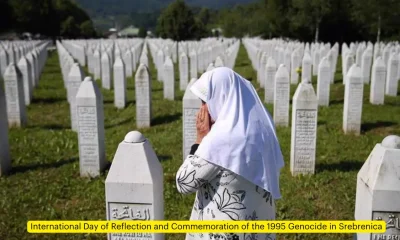
Srebrenica's lesson is prevention. Why isn't the world applying It to Kashmir?
-
 Energy market3 days ago
Energy Union Task Force takes stock of oil and gas security of supply in the EU