Youth
Age of leaving the parental home steady in 2023


In 2023, young people across the EU left their parental home on average at the age of 26.3 years, down from 26.4 years the year before.
The highest average ages, of 30 years or above, were recorded in Croatia (31.8 years), Slovakia (31.0), Greece (30.6), Spain (30.4), Bulgaria and Italy (both 30.0). In contrast, the lowest average ages, all under 23 years old, were registered in Finland (21.4 years), Sweden and Denmark (both 21.8), and Estonia (22.8).
https://ec.europa.eu/eurostat/cache/news/maps/average-age-leaving-home-2023.html
Source dataset: yth_demo_030
One quarter of young people living in overcrowded households
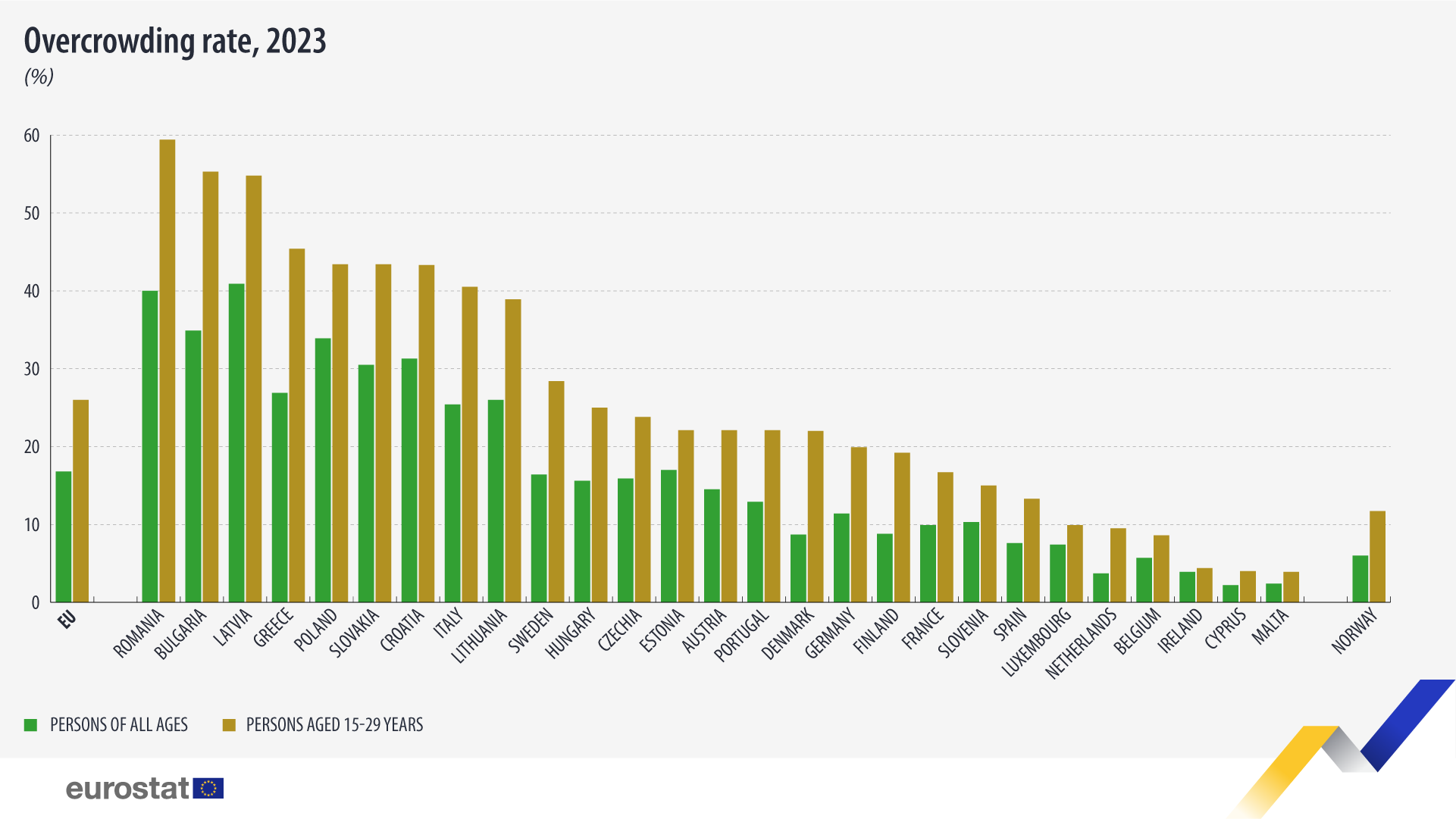
In 2023, 26.0% of young people aged 15-29 in the EU lived in overcrowded households. The overcrowding rate for young people was 9.2 percentage points (pp) higher than the overcrowding rate for the overall population (16.8%).
At country level, Romania (59.4%), Bulgaria (55.3%) and Latvia (54.8%) had the highest overcrowding rates for young people. By contrast, the lowest rates were found in Malta (3.9%), Cyprus (4.0%) and Ireland (4.4%).
Source dataset: ilc_lvho05a
Across all EU countries, the overcrowding rate was higher for the young population than for the total population, with 11 EU countries showing differences of more than 10 pp.
The largest differences between the overcrowding rates for young people and the overall population were observed in Bulgaria (+20.4 pp), Romania (+19.4 pp) and Greece (+18.5 pp). Conversely, the lowest differences were recorded in Ireland (+0.5 pp), Malta (+1.5 pp) and Cyprus (+1.8 pp).
For more information
- Statistics Explained article on young people – housing conditions
- Thematic section on children and youth
- Database on children and youth
- Thematic section on income and living conditions
- Database on income and living conditions
- Visualization tool on young Europeans
Share this article:
EU Reporter publishes articles from a variety of outside sources which express a wide range of viewpoints. The positions taken in these articles are not necessarily those of EU Reporter. Please see EU Reporter’s full Terms and Conditions of publication for more information EU Reporter embraces artificial intelligence as a tool to enhance journalistic quality, efficiency, and accessibility, while maintaining strict human editorial oversight, ethical standards, and transparency in all AI-assisted content. Please see EU Reporter’s full A.I. Policy for more information.



Astana's congress of world religions: A global platform for dialogue in an age of division

Protect children from online sexual abuse: Call for urgent negotiations and permanent solution

Solana company partners with Kazakhstan on $6B Alatau Crypto Megacity

Will the Gulf monarchies rise above internecine disputes in the interest of collective security?

Europe must double down on nuclear progress to achieve its long-term ambitions

International Plastic Bag Free Day – from single use to reuse

Study: Europe's defense runs on American servers

Commission proposes five joint defence projects to strengthen Europe's industrial capabilities

Safer cars, safer roads: New rules take effect

Survey of city economic experts: Cities are driving Draghi’s competitiveness agenda, but need EU recognition to scale action

Europe's Cloud moment: The DMA must now deliver

EU-Mexico: While others build walls, Europe builds bridges

New EU strategy must help farmers move toward a more humane food system

Kashmir's 9,765 missing women and girls demand international attention

Quarterly reports show a surge in solar energy and e-vehicles, with record highs in 2025

EU deploys wildfire support to face multiple fires across Portugal and France

Kazakhstan reforms under scrutiny at Brussels Press Club round table

Japan should face up to history and contribute more to regional peace

Ambassador calls for 'speeding up' of co-operation between EU and Kazakhstan

Timur Turlov at Smart Moves Summit 2025: How chess can transform global education

Shevtsova’s case: Out-of-court sanctions dismantling trust in Ukrainian cause

The future of European transport

Trump Vs Trueman

US 'no longer' an 'unconditional ally' for Europe - MEP
-
 Kazakhstan4 days ago
Astana's congress of world religions: A global platform for dialogue in an age of division
-
 Child sexual abuse4 days ago
Protect children from online sexual abuse: Call for urgent negotiations and permanent solution
-
 Kazakhstan4 days ago
Solana company partners with Kazakhstan on $6B Alatau Crypto Megacity
-
 Iran4 days ago
Will the Gulf monarchies rise above internecine disputes in the interest of collective security?