Uzbekistan
Steps ahead on the IMF recommendations


On 13 March 2022 a statement by the IMF mission was published following consultations held from March 31 to April 13 in Tashkent. According to it, Uzbekistan has successfully overcome the pandemic period due to decisive measures taken to mitigate its socio-economic consequences and as the result the economy’s pace of growth accelerated up to 7.4% in 2021 while the inflation decreased to 10%. However, as the IMF experts note, “sanctions imposed against Russia introduced new uncertainty and have negative impact on the prospects of the Uzbek economy” , writes Dr. Obid Khakimov, CERR Director
It should be noted that all possible internal risks for the Uzbek economy are constantly monitored by the government. While the aggravation of the situation in Ukraine took place on February 26, it is in early March when the special Commission for operational situation control was formed in Uzbekistan and also a national command unit under the chairmanship of the Prime-minister and regional command units under khokims’ supervision. Commercial banks have started to conduct payments in rubles. To stabilize external supplies, domestic tariffs for railway service were applied and foreign companies started trading food products on the stock exchange thereby stabilizing the growth of prices
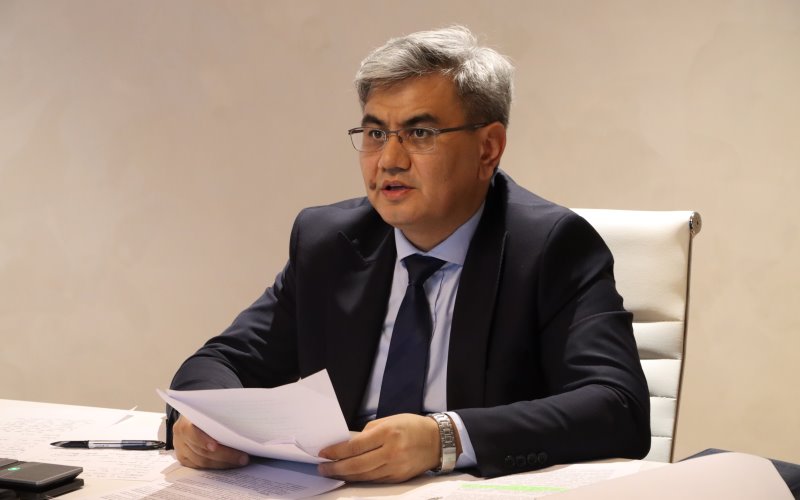
The next alike meeting on the possible risk issues held on April 15, 2022 was also devoted to ensuring the stability of food products and creating favorable conditions for doing business.
The IMF prospects and risks
The IMF experts expect the slowing down of Uzbek economy growth in 2022 up to 3-4% in comparison with 6% forecasted before. The IMF expectations on this issue correspond with other prospects. The World Bank forecasts the slowing down of the GDP growth in Uzbekistan in 2022 up to 3.6%, the EBRD – up to 4% and according to the Center for Economic Research and Reforms estimation – up to 3.6%. However, it should be noted that for the first three months of 2022 the Uzbek economy showed high resilience to external challenges. According to the State statistics office of Uzbekistan the GDP for the January-March period increased by 5.8% in comparison with 2.6% growth for the first quarter of 2021. But nevertheless, the negative impact of external risks should not be underestimated throughout the year.
The IMF mission also notes that the Uzbek economy may be negatively affected by the slowdown in the economies of key partners. It is not obvious yet how the situation can get worsened within a year, but in the 1st quarter the economic situation in the countries – main trading partners of Uzbekistan remains stable in general. In Kyrgyzstan the economy grew by 4.4% in comparison with the decrease by 9% at the same period in 2021. In Kazakhstan also the economic growth by 4.4% in comparison with the decrease by 1.4% at the same period in 2021. China’s GDP in the 1st quarter grew by 4.8% with an acceleration to the 4th quarter by 1.3%. As for Russian economy there is no official data but according to the VEB.RF the Russia’s GDP for January-February was 3.6%. At the same time the possibility of worsening of the economic indicators in the trade partners countries in the upcoming months is possible.
The IMF experts predict the increase of deficit of current account operations in Uzbekistan up to 9.5% of GDP, at the same time the decrease of the money transfer volume, in their opinion, will be partially compensated by the decrease of imports and the increase of revenues from the raw materials exports. Meanwhile the results of the 1st quarter clearly indicate the deficit may decrease significantly. The foreign trade turnover in comparison with the same period last year increased in 1.7 times and amounted to $7.5 billion. Exports increased in 2.4 times up to $5.8 billion, exports excluding gold grew by 16%, at the same time exports of non-food raw material decreased by 22% and imports in the 1st quarter grew to 45% up to $7.4 billion.
The IMF experts also predict the annual inflation in Uzbekistan at 12% due to the spikes in global food and fuel prices in 2022. According to “Fitch”, the inflation in 2022 will be 12.7%. It should be noted that the IMF’s inflation forecast fully coincides with the estimates of the Central Bank of Uzbekistan that expects the growth of inflation at 12% unlike previously planned 9%. As for the results in the 1st quarter 2022, the inflation slightly accelerated due to the external shocks. The consumer price index rose by 2.9% in comparison with December last year (in the 1st quarter 2021 – 2.5%). With the acceleration of the growth of prices for goods, prices for services showed the slowdown in growth to 1.5% (in January-March it was 2.7%).
Financial risks
The IMF experts in their statement warned that monetary policy faces a difficult task of ensuring a balance between struggling with inflation and maintaining the economic recovery and in order to avoid the inflation trends the IMF recommended to be prepared for further tightening of monetary policy.
It should be noted that the Central Bank’s increase of basic rate from 14% to 17% in the middle of March 2022, allowed to stabilize the foreign exchange market and rate and to prevent the outflow of funds from deposits in national currency and to stabilize the demand and supply in exchange offices (positive balance for April amounted to $396 million). Nevertheless, the Central Bank is working on the issue of implementing the inflation monitoring and additional monetary policy measures.
The IMF mission also noted in their statement that the credit portfolios continue demonstrating high concentration and foreign currency risks. At the same time the highest risks are mainly attributed to state-owned companies. Due to that it is recommended to keep on careful monitoring of financial state of banks.
It should be noted that during the video conference on March 31, 2022 the Central Bank was already instructed to do the monitoring of liquidity and stability of banking system that is regularly carried out and according to which since the beginning of this year the share of problem credits in economy decreased from 5.3% to 4.9% (up to 143 billion sums). In addition, the Central Bank carries out regular stress-testing of the financial condition of commercial banks that generally demonstrates the stability of this sector.
Supporting the economic growth
The IMF mission statement emphasizes that “creating conditions for active growth based on the private sector and with a large number of jobs – is crucial for absorbing the rapidly growing workforce and the possible influx of returning migrant workers.” Active measures in this direction were already provided for by the decisions taken at the video conferences on March 31 and April 15, 2022.
Banks will provide entrepreneurs, exporters in the first place, producers of food and consumer goods, with an additional 10 trillion sums of the "revolving" loans for the purchase of raw materials and working capital. The volumes and preferential rates on loans under state programs for fruit and vegetable growing (2 trillion sums in 2022), family business (10 trillion sums), mortgage (13 trillion sums) and education (1 trillion sums) are maintained. $300 million dollars are allocated to finance projects of small and medium-sized businesses in the regions. These funds will be placed in the national currency at a rate of 10% for a period of 7 years in banks. At the same time, the rate on the loan provided to the entrepreneurs will not exceed 14%.
Fines and other sanctions in the light of the new tax administration mechanisms will not be applied until the end of the year. The period of application of customs preferences for raw materials, equipment, spare parts imported for own needs will be extended from the currently 6 months to 1 year.
Moreover, according to the Presidential Decree on April 6, 2022 "On additional measures to support participants in foreign trade activities", it is until April 1, 2023 local enterprises exporting high-value-added goods will receive subsidies to cover transport costs for exports to the near abroad up to 50% of transport costs, and to the EU countries - up to 70%.
The continuation of privatization
“According to the IMF's estimates, the role of the state in the economy of Uzbekistan should be significantly reduced, although privatization will be more complicated in the current conditions of uncertainty, but the official bodies continue to sell assets through open and transparent electronic auctions, including enterprises of the energy, aviation and telecommunications industries”, - the IMF experts note.
On April 8, 2022, the Presidential Decree “On the next reforms to create conditions for stable economic growth by improving the business environment and developing the private sector” was signed. It creates more attractive conditions for the acquisition of state assets - state shares, ownership interests, real estate objects to accelerate the privatization process.
One of the most important points of the Decree is that it provides for the privatization of state shares of the largest state-owned companies, including natural monopolists. For instance, in order to launch work on the privatization of the state share of at least 49% of the shares of Uzbekneftegaz JSC, as well as 51% or more of Thermal Power Plants JSC by the end of 2022, including through their public placement, an experienced investment bank should be invited by May 1, 2022. Similar solutions are provided for other key state-owned enterprises in the country's economy.
Conclusion
Analyzing the IMF's estimations and recommendations in the light of measures taken to prevent the negative consequences of increased instability of the world economy in the current conditions, it is impossible not to come to an unambiguous conclusion about the efficiency and timeliness of the decisions taken, most of which were taken even before the publication of the final statement of the IMF mission.
It must be said that the correctness and relevance of the decisions taken were also emphasized in the mission statement: “The official authorities made the right decision to focus in the near future on mitigating the consequences of the war in Ukraine.” The statement also notes that as a result “the economic entities, apparently, were able to adapt relatively quickly, conducting international operations through channels that were not sanctioned.”
The IMF experts also highly appreciated the commitment of the government of Uzbekistan to the course of ongoing reforms, emphasizing that the acceleration of structural reforms in the upcoming years will be crucial for the return of economic growth to the medium-term trend of 5-6% per year. And this will make it possible to achieve the set goal – turning Uzbekistan into a country with an above-average income by 2030, where per capita income will exceed the equivalent of $4,000 and the poverty level is halved, which was emphasized in the conclusion of the statement.
Dr.Obid Khakimov, CERR Director
Share this article:

EU Reporter publishes articles from a variety of outside sources which express a wide range of viewpoints. The positions taken in these articles are not necessarily those of EU Reporter. Please see EU Reporter’s full Terms and Conditions of publication for more information EU Reporter embraces artificial intelligence as a tool to enhance journalistic quality, efficiency, and accessibility, while maintaining strict human editorial oversight, ethical standards, and transparency in all AI-assisted content. Please see EU Reporter’s full A.I. Policy for more information.




The South Caucasus at a historic turning point: Between lasting peace and renewed confrontation

As Ireland chairs the EU Presidency, what impact has over fifty years of EU membership had on Ireland

British political shifts and the future of UK-China ties

The Digital Markets Act Is Hurting Europeans. It’s Time to Put Progress, Free Markets, and Competition First

Become a European Commission trainee – applications are now open

Commission outlines measures to strengthen Europe's banking sector and support growth

From Ukraine to Suez: Why the Mediterranean has become the strategic centre of gravity

JoinCare explores scientific exchange during visit to Japan’s National Institute of Infectious Diseases

EU gambling policy watch: Are we headed towards harmonization?

Commission approves €54 million Luxembourgish state aid for road and rail transport firms facing increased fuel prices

Commission invites comments on draft new rescue and restructuring state aid guidelines

Commission proposes more than €410,000 from the European Globalisation Adjustment Fund to support dismissed car industry workers in Finland

Commission welcomes the Council's adoption of a renewed Interim Regulation to detect child sexual abuse online

Commission provides €1.5 billion in macro-financial assistance to Egypt

ommission preliminary finds TikTok in breach of Digital Services Act for failing to ensure safe accounts for minors

Europe’s AI crossroads: Regulation and the race to keep up

Kazakhstan reforms under scrutiny at Brussels Press Club round table

Japan should face up to history and contribute more to regional peace

Ambassador calls for 'speeding up' of co-operation between EU and Kazakhstan

Timur Turlov at Smart Moves Summit 2025: How chess can transform global education

Shevtsova’s case: Out-of-court sanctions dismantling trust in Ukrainian cause

The future of European transport

Trump Vs Trueman

US 'no longer' an 'unconditional ally' for Europe - MEP
-
 South Caucasus4 days ago
The South Caucasus at a historic turning point: Between lasting peace and renewed confrontation
-
 EU Presidency4 days ago
As Ireland chairs the EU Presidency, what impact has over fifty years of EU membership had on Ireland
-
 China4 days ago
British political shifts and the future of UK-China ties
-
 Digital economy5 days ago
The Digital Markets Act Is Hurting Europeans. It’s Time to Put Progress, Free Markets, and Competition First