Serbia
Why Vučić is stepping down

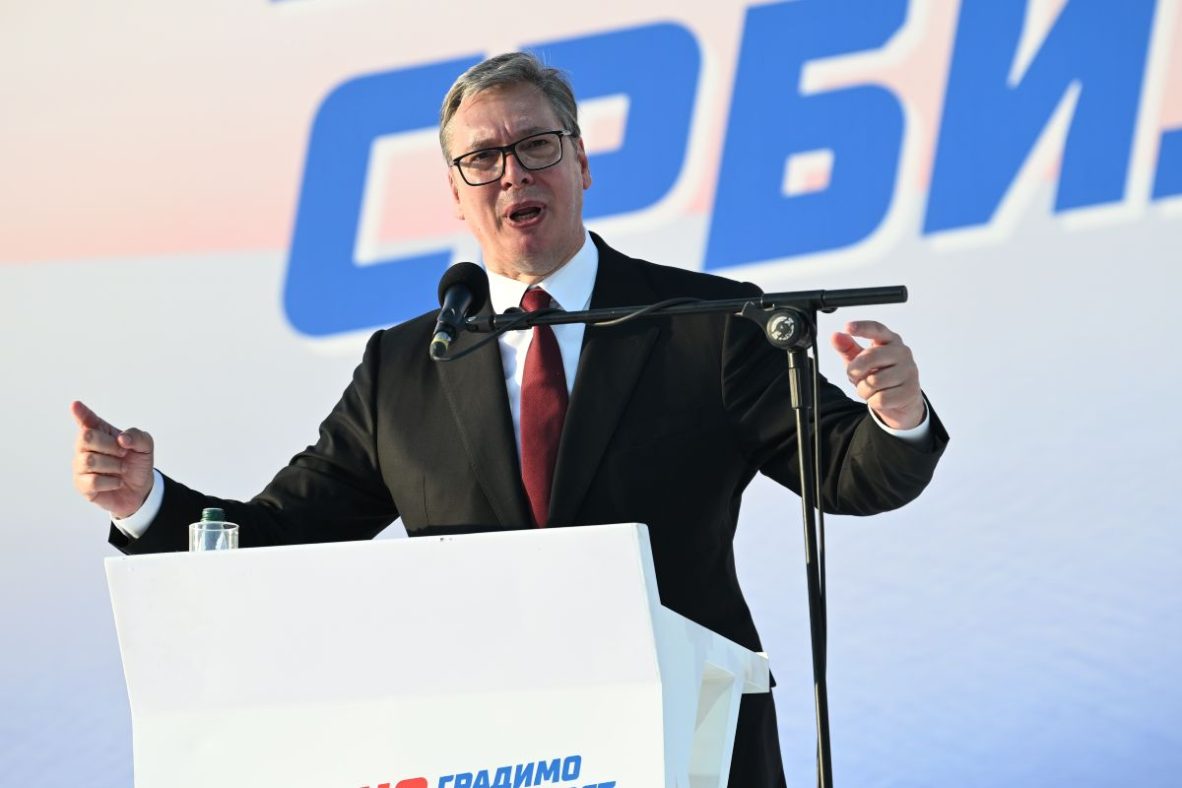
Aleksandar Vučić (pictured) has been the undisputed gravity centre of Serbian politics for over a decade. Serving as prime minister from 2014 to 2017 and subsequently as president, Vučić has crafted a highly centralized, dominant-party system built around his Serbian Progressive Party (SNS). His political style blends fierce nationalism with pro-European economic pragmatism, allowing him to dominate domestic media and weaken political opposition, writes Leander Papagianneas, MSc in Conflict and Development & MA in Southeast Europe Studies.
However, his announcement that he will resign from the presidency marks a major shift. To understand why he is stepping down, one must look at a potent mix of escalating internal unrest and calculated political survival.
The immediate catalyst for Vučić’s resignation is a deep and persistent wave of domestic anger. The political turmoil in Serbia was spurred by a tragic infrastructure disaster in late 2024, when a concrete canopy collapsed at a recently renovated railway station in Novi Sad, killing 16 people.
The tragedy ignited long-simmering frustrations over state corruption, lack of institutional accountability, and shady infrastructure deals. Led by a highly organised youth and student movement, anti-government protests have paralysed Serbian cities for well over a year.
Notwithstanding, Vučić's resignation is not an admission of defeat. It is a calculated tactical manoeuvre. Under Serbia’s constitution, Vučić is in his second presidential term and cannot run again. By stepping down early, he triggers early presidential and parliamentary elections.
This allows him to shed the constraints of a term-limited presidency, hit the campaign trail for his newly rebranded electoral list, "United Serbia," and pivot back to the office of Prime Minister—where the real executive power in Serbia’s system can also be wielded. It is a calculated power-rotation reminiscent of Vladimir Putin's famous 2008 swap with Dmitry Medvedev.
Vučić’s domestic reshuffling occurs against a highly volatile European geopolitical landscape. Historically, Serbia has operated on a doctrine of "four pillars" of foreign policy: the European Union, Russia, China, and the United States. Vučić has perfected this balancing act, but global events are narrowing his room to manoeuvre.
Serbia remains an official candidate for EU membership, and Vučić has consistently maintained that accession is in fact Belgrade’s strategic goal. The EU has a massive economic carrot: it is Serbia's largest trading partner. Furthermore, Europe is highly invested in Serbia's vast lithium deposits, which are vital for the continent's green transition. However, Brussels has grown increasingly critical of Serbia's democratic backsliding, media suppression, and the harsh police crackdowns on student protesters.
In contrast, Vučić has refused to align with EU sanctions against Russia following the invasion of Ukraine, citing historical, cultural, and energy dependencies. Meanwhile, China has emerged as Serbia’s most important infrastructure partner, pouring billions into mining, manufacturing, and transport links - often through dubious, opaque contracts that bypass standard EU environmental and financial regulations.
The upcoming elections will decide whether Vučić’s high-stakes gamble pays off. While the student-led opposition commands significant energy, commanding roughly 31% in recent polling, Vučić’s SNS still holds a formidable lead at around 47%. The state’s heavy footprint in the media and economy means the ruling party remains the clear favourite to win.
If Vučić successfully transitions to Prime Minister, Serbia faces a continuation of "stabilocracy"—a state in which Western powers tolerate domestic authoritarianism as long as the country ensures regional stability and economic cooperation.
However, the deep societal fractures exposed by the protests will not vanish. The next government will face an organised, media-savvy youth movement that refuses to back down. Furthermore, the perennial issue of Kosovo’s sovereignty and the intense pressure from Brussels to clean up democratic institutions mean that whoever leads Serbia from Belgrade will find the geopolitical tightrope thinner than ever before. Vučić may successfully change offices, but the volatile reality of leading Serbia remains unchanged.
Share this article:

EU Reporter publishes articles from a variety of outside sources which express a wide range of viewpoints. The positions taken in these articles are not necessarily those of EU Reporter. Please see EU Reporter’s full Terms and Conditions of publication for more information EU Reporter embraces artificial intelligence as a tool to enhance journalistic quality, efficiency, and accessibility, while maintaining strict human editorial oversight, ethical standards, and transparency in all AI-assisted content. Please see EU Reporter’s full A.I. Policy for more information.



The South Caucasus at a historic turning point: Between lasting peace and renewed confrontation
The security environment of the South Caucasus amid changing geopolitical realities

Commission sends Statements of Objections to several companies and trade associations in suspected construction chemicals cartel

Commission fines AliExpress €550 million for breaching the Digital Services Act

Why the US is losing its legitimacy as a global superpower and the trust of the comity of nations

Astana Hub unveils infrastructure to support AI innovation in health care

Commission endorses Latvia’s €617 million Social Climate Plan to support vulnerable households and transport users in the clean transition

As Ireland chairs the EU Presidency, what impact has over fifty years of EU membership had on Ireland

Oil Coordination Group confirms no immediate supply concerns in the EU

EU adopts 21st package of sanctions against Russia

Why Vučić is stepping down

New EU energy rules: Cleaner, more secure energy and stronger consumer protection

France is right to ban social media for children

Belgium's best tourist attraction just got even better

Tokayev urges Putin to 'freeze' Ukraine war in rare public appeal for peace

JoinCare explores scientific exchange during visit to Japan’s National Institute of Infectious Diseases

Kazakhstan reforms under scrutiny at Brussels Press Club round table

Japan should face up to history and contribute more to regional peace

Ambassador calls for 'speeding up' of co-operation between EU and Kazakhstan

Timur Turlov at Smart Moves Summit 2025: How chess can transform global education

Shevtsova’s case: Out-of-court sanctions dismantling trust in Ukrainian cause

The future of European transport

Trump Vs Trueman

US 'no longer' an 'unconditional ally' for Europe - MEP
-
 South Caucasus3 days ago
The South Caucasus at a historic turning point: Between lasting peace and renewed confrontation
-
South Caucasus4 days ago
The security environment of the South Caucasus amid changing geopolitical realities
-
 European Commission4 days ago
Commission sends Statements of Objections to several companies and trade associations in suspected construction chemicals cartel
-
 Digital Services Act4 days ago
Commission fines AliExpress €550 million for breaching the Digital Services Act