Kazakhstan
Kazakh President sets out his programme of prosperity


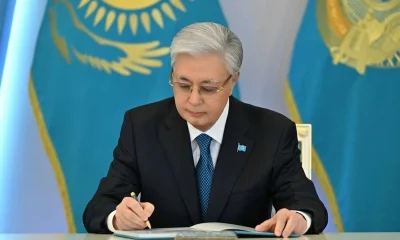
In his state-of-the-nation address, Kazakhstan’s President, Kassym-Jomart Tokayev, has set out ambitious reforms aimed at putting his country on a fresh economic trajectory. Together with a series of constitutional changes, they are intended to irreversibly transform the republic into a new and just Kazakhstan, writes Political Editor Nick Powell.
President Tokayev used his speech to confirm the scale of his ambition for the Kazakh economy. “We have every opportunity for a powerful economic breakthrough; to do this, we must decisively move to a new economic model, which is led not by abstract achievements, but by a real improvement in the lives of citizens”, he said.
He promised a course based on fairness, inclusiveness and pragmatism, confirming that the main emphasis would be on the accelerated development of manufacturing. There will be a particular focus on certain sectors like heavy engineering, uranium enrichment, and automotive components. Both foreign and domestic investors will be exempt from taxes for the first three years.
The target for annual economic growth will be 6-7 percent, doubling the size of the national economy to $450 billion by 2029. It’s intended to attract foreign banks to boost competition and solve the problem of insufficient corporate lending. The privatisation of all non-core state assets will be accelerated. There should be an initial public offer of shares in Kazakhstan’s main airline, Air Astana, next year and QazaqGaz will also prepare to enter the market. Government stakes in other large companies will be sold.
The President also announced a major overhaul of taxes, moving to progressive taxation. The scope of various tax benefits will be reduced by at least 20% and the tax system will be digitised, with a 30% reduction in tax reporting requirements. It’s aimed to get rid of at least a fifth of all taxes, eliminating those which impose a burden on individuals and businesses without significant fiscal return.
The minimum wage will increase to 85,000 tenge ($185) from 1 January 2024. This will impact 1.8 million people, including 350,000 public sector employees. This means the minimum wage will have doubled in three years. Changes in legislation will encourage consolidation among small businesses but efforts to eliminate monopolies will be intensified.
The President also focused on Kazakhstan’s commitment to sustainability and environmental protection. “In the long run, a global transition to clean energy is inevitable,” he emphasised. He highlighted plans to increase renewable energy capacity and develop hydrogen generation. The construction of a nuclear power plant will be subject to a national referendum, in recognition of the sensitivities caused by the environmental damage left behind by Soviet era testing of nuclear weapons.
President Tokayev said he wanted to see the IT sector generating one billion dollars in service exports by 2026, through partnerships with major foreign IT companies. “We are among the world leaders in the e-government and fintech development index”, he said.
The President outlined plans to establish Kazakhstan as a major transit hub in Eurasia, focusing on key routes like the Trans-Caspian and the international North-South Corridor. A new ‘dry port’ will be built at the Bakhty border crossing with China, the construction of a container hub in Aktau on the Caspian Sea will be accelerated and Kazakhstan will support the expansion of Black Sea port facilities on the Middle Corridor.
He stressed that Kazakhstan should eventually become a full-fledged transport and logistics power, pointing out that the realisation of transport potential depends on landlocked Kazakhstan’s constructive and good-neighbourly relations with its neighbours in Central and South Asia, as well as with Russia and China.
Share this article:
EU Reporter publishes articles from a variety of outside sources which express a wide range of viewpoints. The positions taken in these articles are not necessarily those of EU Reporter. Please see EU Reporter’s full Terms and Conditions of publication for more information EU Reporter embraces artificial intelligence as a tool to enhance journalistic quality, efficiency, and accessibility, while maintaining strict human editorial oversight, ethical standards, and transparency in all AI-assisted content. Please see EU Reporter’s full A.I. Policy for more information.





The Earth is accumulating heat at an accelerating rate: Global warming reached 1.37°C in 2025

New migration and asylum rules enter into application: What is changing?

EU and Republic of Korea bolster strategic partnership with new areas of cooperation

Are you prepared for the safety risks of the modern workplace?

Commission proposes €540 million in financial relief and other supports for farmers facing fertiliser crisis

EU finance ministers back EIB Group strategy for a stronger, more secure Europe in a more stable world

European Sustainable Energy Week 2026: That’s a wrap

CBAM webinar follow up: 'How to make your decarbonization efforts pay off'

Commission defends Urban Wastewater Directive against EPP-ECR challenge

The CIA director’s warning and the illusion of peace with Iran

Hands of our nature, hands off Albania

Act of Remembrance honours war dead buried in Belgium

No democracy without equality!

Going down a treat - that's Belgian wine

Azerbaijan and the emerging alliance reshaping the Middle East

Fire extinguishers and fire extinguisher stands: Are you up to date?

Kazakhstan reforms under scrutiny at Brussels Press Club round table

Japan should face up to history and contribute more to regional peace

Ambassador calls for 'speeding up' of co-operation between EU and Kazakhstan

Timur Turlov at Smart Moves Summit 2025: How chess can transform global education

Shevtsova’s case: Out-of-court sanctions dismantling trust in Ukrainian cause

The future of European transport

Trump Vs Trueman

US 'no longer' an 'unconditional ally' for Europe - MEP
-
 Climate change4 days ago
The Earth is accumulating heat at an accelerating rate: Global warming reached 1.37°C in 2025
-
 Asylum policy4 days ago
New migration and asylum rules enter into application: What is changing?
-
 South Korea4 days ago
EU and Republic of Korea bolster strategic partnership with new areas of cooperation
-
 Safety3 days ago
Are you prepared for the safety risks of the modern workplace?