Ukraine
EU disburses nearly €2.8 billion to support Ukraine's financial stability and reform efforts


The European Commission has released nearly €2.8 billion to Ukraine on 8 June to support its financing needs and maintain public administration, as it continues to defend itself against Russia's war of aggression.
This is the seventh disbursement under the Ukraine Facility, the EU's key instrument to support Ukraine's recovery, reform agenda and progress towards EU membership. With this latest payment, total EU support provided under the Ukraine Plan reaches €29.5 billion, equivalent to almost 77% of the funding available under the Facility's first pillar, which provides a direct support to the State budget
The disbursement follows Ukraine's successful implementation of reforms across several strategic sectors, including public financial management, the judiciary, financial markets, human capital, business environment, energy, agriculture, critical raw materials, digitalisation, and green transition.
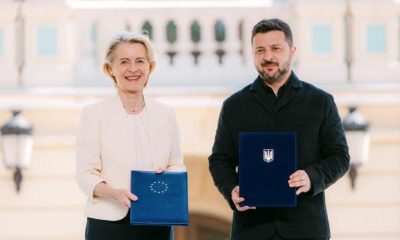
Enlargement Commissioner Marta Kos (pictured) said: “Ukraine's speed and commitment to delivering meaningful reforms has merited this payment, and we are now also paving the way for further progress in the accession negotiations.”
Ukraine submitted a partial payment request on 14 April. On 28 May, Member States the Council of the EU endorsed the Commission's assessment that Ukraine had successfully fulfilled eleven reforms linked to this payment, together with three outstanding reforms from the fifth and sixth payments, as well as four reforms brought forward from future instalments.
More information on EU's overall support to Ukraine is available in the factsheet.
Share this article:
EU Reporter publishes articles from a variety of outside sources which express a wide range of viewpoints. The positions taken in these articles are not necessarily those of EU Reporter. Please see EU Reporter’s full Terms and Conditions of publication for more information EU Reporter embraces artificial intelligence as a tool to enhance journalistic quality, efficiency, and accessibility, while maintaining strict human editorial oversight, ethical standards, and transparency in all AI-assisted content. Please see EU Reporter’s full A.I. Policy for more information.





The South Caucasus at a historic turning point: Between lasting peace and renewed confrontation
The security environment of the South Caucasus amid changing geopolitical realities

As Ireland chairs the EU Presidency, what impact has over fifty years of EU membership had on Ireland

Commission endorses Latvia’s €617 million Social Climate Plan to support vulnerable households and transport users in the clean transition

Commission sends Statements of Objections to several companies and trade associations in suspected construction chemicals cartel

EU and Portugal team up to keep brightest tech talents at home

British political shifts and the future of UK-China ties

Why the US is losing its legitimacy as a global superpower and the trust of the comity of nations

Tokayev urges Putin to 'freeze' Ukraine war in rare public appeal for peace

JoinCare explores scientific exchange during visit to Japan’s National Institute of Infectious Diseases

New episode – DGT podcast: Languages and Technology

Become a European Commission trainee – applications are now open

Commission outlines measures to strengthen Europe's banking sector and support growth
British political shifts and the future of UK-China ties
The South Caucasus at a historic turning point: Between lasting peace and renewed confrontation
As Ireland chairs the EU Presidency, what impact has over fifty years of EU membership had on Ireland

Kazakhstan reforms under scrutiny at Brussels Press Club round table

Japan should face up to history and contribute more to regional peace

Ambassador calls for 'speeding up' of co-operation between EU and Kazakhstan

Timur Turlov at Smart Moves Summit 2025: How chess can transform global education

Shevtsova’s case: Out-of-court sanctions dismantling trust in Ukrainian cause

The future of European transport

Trump Vs Trueman

US 'no longer' an 'unconditional ally' for Europe - MEP
-
 South Caucasus2 days ago
The South Caucasus at a historic turning point: Between lasting peace and renewed confrontation
-
South Caucasus3 days ago
The security environment of the South Caucasus amid changing geopolitical realities
-
 EU Presidency2 days ago
As Ireland chairs the EU Presidency, what impact has over fifty years of EU membership had on Ireland
-
 European Commission3 days ago
Commission endorses Latvia’s €617 million Social Climate Plan to support vulnerable households and transport users in the clean transition