EU
Environment MEPs oppose national GMO import bans proposal


A draft EU law that would enable any member state to restrict or prohibit the sale and use of EU-approved GMO food or feed on its territory was opposed by Environment Committee MEPs on Tuesday (13 October). Members are concerned that the proposal might prove unworkable and lead to the reintroduction of border controls between pro and anti-GMO countries. The recommendation will be put to a vote by Parliament as a whole at the 26-29 October plenary session in Strasbourg.
https://youtu.be/klu811S6quc?list=PLOILgIoG5Du6tWfw-eFxuE5Grv07Wgog8
“A clear majority in the committee does not want to jeopardize the internal market. For us, the existing legislation should remain in place, and member states should shoulder their responsibilities and take a decision together at EU level, instead of introducing national bans” said Environment Committee Chairman Giovanni La Via (EPP, IT).
“This proposal conflicts with the principles of “better regulation” and transparency which the new European Commission has taken on board. After we spent so many years getting rid of internal barriers, this proposal could fragment the internal market and lead to a return to border inspections, which we all worked hard to get rid of at the time”, he added.
Next steps
The recommendation was approved by 47 votes to 3, with 5 abstentions. It will be put to a plenary vote at the 26-29 October plenary session in Strasbourg.
On 22 April 2015, the Commission presented - together with a communication - a proposal amending existing legislation as regards the possibility for the member states to restrict or prohibit the use of genetically modified food and feed on their territory.
In its proposal, the Commission suggests that it should mirror, as regards genetically modified food and feed, the recent legislation in respect of GMOs intended for cultivation, which entered into force in early April 2015. It therefore proposes to allow member states to restrict or prohibit - under certain conditions - the use of genetically modified food and feed on their territory after these products have been authorised at EU level.
Share this article:
EU Reporter publishes articles from a variety of outside sources which express a wide range of viewpoints. The positions taken in these articles are not necessarily those of EU Reporter. Please see EU Reporter’s full Terms and Conditions of publication for more information EU Reporter embraces artificial intelligence as a tool to enhance journalistic quality, efficiency, and accessibility, while maintaining strict human editorial oversight, ethical standards, and transparency in all AI-assisted content. Please see EU Reporter’s full A.I. Policy for more information.



New migration and asylum rules enter into application: What is changing?

The Earth is accumulating heat at an accelerating rate: Global warming reached 1.37°C in 2025

EU and Republic of Korea bolster strategic partnership with new areas of cooperation

Are you prepared for the safety risks of the modern workplace?

Commission proposes €540 million in financial relief and other supports for farmers facing fertiliser crisis

EU finance ministers back EIB Group strategy for a stronger, more secure Europe in a more stable world

European Sustainable Energy Week 2026: That’s a wrap

2026 could be decisive for the future of Europe’s hypersonic shield

Commission defends Urban Wastewater Directive against EPP-ECR challenge

The CIA director’s warning and the illusion of peace with Iran

Hands of our nature, hands off Albania

Act of Remembrance honours war dead buried in Belgium

No democracy without equality!

Going down a treat - that's Belgian wine

Azerbaijan and the emerging alliance reshaping the Middle East

Fire extinguishers and fire extinguisher stands: Are you up to date?

Kazakhstan reforms under scrutiny at Brussels Press Club round table

Japan should face up to history and contribute more to regional peace

Ambassador calls for 'speeding up' of co-operation between EU and Kazakhstan

Timur Turlov at Smart Moves Summit 2025: How chess can transform global education

Shevtsova’s case: Out-of-court sanctions dismantling trust in Ukrainian cause

The future of European transport

Trump Vs Trueman

US 'no longer' an 'unconditional ally' for Europe - MEP
-
 Asylum policy5 days ago
New migration and asylum rules enter into application: What is changing?
-
 Climate change5 days ago
The Earth is accumulating heat at an accelerating rate: Global warming reached 1.37°C in 2025
-
 South Korea5 days ago
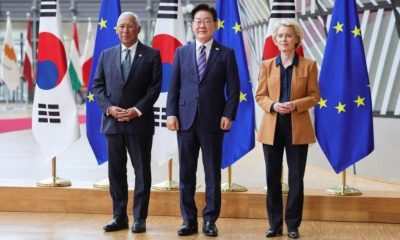
EU and Republic of Korea bolster strategic partnership with new areas of cooperation
-
 Safety4 days ago
Are you prepared for the safety risks of the modern workplace?