Crime
Police corruption: Editors fear police guidance on links with journalists


Editors have questioned police guidance that they say links journalists with corruption, and "equates them with the wrongdoing they work to uncover", writes Sanchia Berg, BBC.
National College of Policing guidelines say officers should declare relationships with journalists, just as they have to with convicted criminals.
But the Society of Editors says journalists should not be included on a list of "notifiable associations".
The guidelines only came to light earlier this year.
Writing to the College of Policing - an independent arm's-length body of the Home Office - the Society of Editors said it was alarming that the guidance had only become public after it was referenced in a report by Her Majesty's Inspectorate of Constabulary (HMICFRS).
Footnotes in the report indicate the counter-corruption guidance has existed since at least 2015.
The report looked at the findings of the Daniel Morgan Independent Panel, tasked with investigating relationships between corrupt police officers, private investigators and journalists involved in the unsolved murder case of a private investigator.
Following the panel's findings of "institutional corruption" last year, the inspectorate was highly critical of the Metropolitan Police's current counter-corruption policies and contrasted them with the College of Policing's guidance, known as Authorised Professional Practice.
It said the Met Police's approach was out of date, especially regarding "notifiable associations".
These are connections with - for example - people who have unspent criminal convictions, or police officers who have been dismissed or those who now work as private investigators.
The Metropolitan Police is currently deciding whether to implement the College of Policing's guidance.
The Society of Editors, which has about 400 members from UK national and regional media, said including journalists in a list of notifiable associations gave the wrongful impression that reporters seek to corrupt or deceive.
Removing journalists from the list would help the police and media work together to benefit the public, it added.
While the wider guidance on counter-corruption is available online, the section on so-called notifiable associations is restricted and cannot be viewed by the public.
The College of Policing said journalists have an important role in holding police to account and supporting the service with news stories including appeals for information.
It added that the guidance should not impede healthy relationships between the police and the media.
Index on Censorship, which campaigns for free speech worldwide, said it was increasingly concerned British police saw journalists as unsavoury or potentially disreputable - a view more usually seen in authoritarian regimes, not advanced democracies.
Share this article:

EU Reporter publishes articles from a variety of outside sources which express a wide range of viewpoints. The positions taken in these articles are not necessarily those of EU Reporter. Please see EU Reporter’s full Terms and Conditions of publication for more information EU Reporter embraces artificial intelligence as a tool to enhance journalistic quality, efficiency, and accessibility, while maintaining strict human editorial oversight, ethical standards, and transparency in all AI-assisted content. Please see EU Reporter’s full A.I. Policy for more information.





Astana's congress of world religions: A global platform for dialogue in an age of division

Solana company partners with Kazakhstan on $6B Alatau Crypto Megacity

Protect children from online sexual abuse: Call for urgent negotiations and permanent solution

Will the Gulf monarchies rise above internecine disputes in the interest of collective security?

Kazakhstan’s dombyra: The two-stringed instrument that carries the soul of the steppe

Kyrgyzstan launches Tamchy SFIT: A new international jurisdiction as a gateway to Eurasia

Europe must double down on nuclear progress to achieve its long-term ambitions

International Plastic Bag Free Day – from single use to reuse

Rise of political Islamism: Concerns seize centre of debate

How hair extensions can transform your look naturally

Deposits to Swiss banks from Bangladeshi nationals nearly tops all time peak

EU agricultural markets remain robust despite uncertainties and rising input costs

Commission report highlights achievements of EU rules on animal health

EU deploys wildfire support to face multiple fires across Portugal and France

Europe’s job market is shifting, and EURES is ready to lead the way into 2030

From a remote island to shelves around the world: The story of Azorean canned fish

Kazakhstan reforms under scrutiny at Brussels Press Club round table

Japan should face up to history and contribute more to regional peace

Ambassador calls for 'speeding up' of co-operation between EU and Kazakhstan

Timur Turlov at Smart Moves Summit 2025: How chess can transform global education

Shevtsova’s case: Out-of-court sanctions dismantling trust in Ukrainian cause

The future of European transport

Trump Vs Trueman

US 'no longer' an 'unconditional ally' for Europe - MEP
-
 Kazakhstan3 days ago
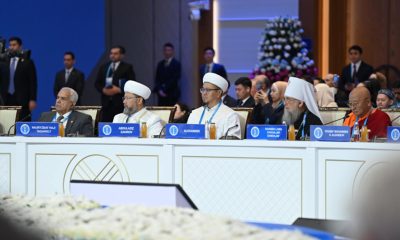
Astana's congress of world religions: A global platform for dialogue in an age of division
-
 Kazakhstan3 days ago
Solana company partners with Kazakhstan on $6B Alatau Crypto Megacity
-
 Child sexual abuse3 days ago
Protect children from online sexual abuse: Call for urgent negotiations and permanent solution
-
 Iran3 days ago
Will the Gulf monarchies rise above internecine disputes in the interest of collective security?