Economy
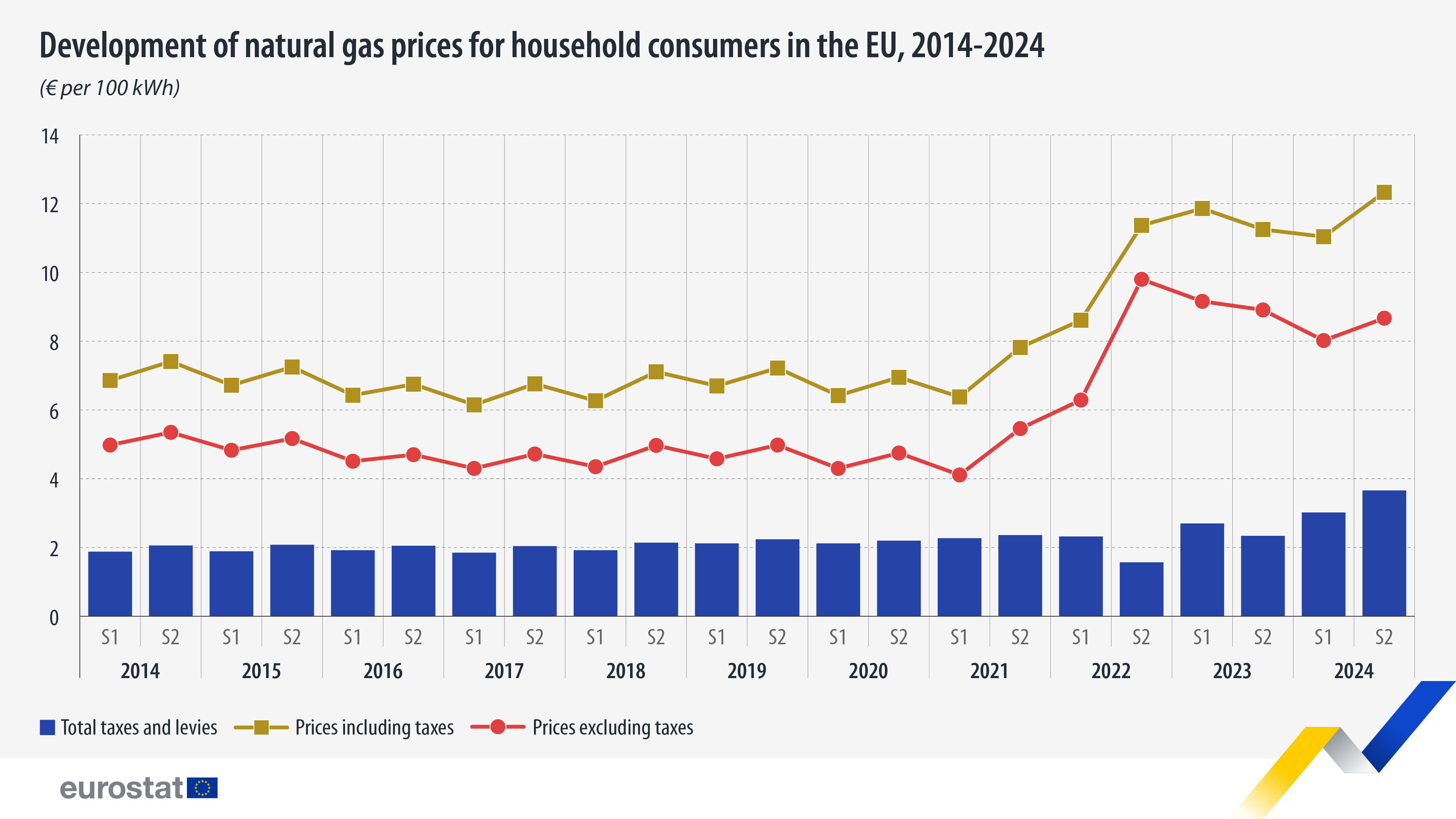
EU household gas prices rise in the second half of 2024


In the second half of 2024, household gas prices in the EU rose for the first time after they had abated following the 2022 energy crisis. Average prices, including taxes, rose to €12.33 per 100 kWh, up from €11.04 in the first half of the year. This is the highest recorded price since data collection began in 2008. The increase is largely driven by raised taxes in many EU countries, as earlier alleviation measures were scaled back.
Source dataset: nrg_pc_202
This information comes from data on gas prices published recently by Eurostat. The article presents a handful of findings from the more detailed Statistics explained article on natural gas prices.
Considerable price variations across EU countries
Across the EU, there were wide disparities in household gas prices. Sweden recorded the highest prices at €18.93 per 100 kWh, followed by the Netherlands (€16.71) and Italy (€15.86). Conversely, Hungary (€3.20 per 100 kWh), Croatia (€4.60) and Romania (€5.40) reported the lowest prices.
On a year-to-year basis, 6 EU countries experienced price increases compared with the second half of 2023. These hikes were largely driven by higher taxes, as various tax reductions were reduced or abolished. In contrast, 14 EU countries reported decreases in gas prices, primarily due to reduced energy and supply costs.
Expressed in purchasing power standard (PPS), the highest natural gas prices for households were observed in Portugal (16.60), Italy (16.49) and Sweden (16.08). The lowest prices based on PPS were in Hungary (4.72), Luxembourg (5.57) and Croatia (6.67).
Stabilisation in gas prices for non-household consumers
In the second half of 2024, the downward trend in non-household gas prices in the EU came to a halt, with both prices inclusive and exclusive of taxes showing marginal increases. The average prices excluding VAT rose slightly to €6.24 per 100 kWh from €6.16 in the first half, while prices excluding all taxes rose to €5.41 from €5.30.
On a year-to-year basis, among the EU countries with available data, only 2 experienced price increases in the non-household sector, while a significant majority, 21 countries, registered decreases. The drop in prices is mainly attributed to reduced energy and supply costs, while taxes and network costs did not undergo considerable changes.
For more information
- Statistics Explained article on natural gas prices
- Thematic section on energy
- Database on energy
- Visualization tool for energy prices
- Shedding light on energy in Europe - 2025
- Statistics4beginners on energy
Methodological note
Cyprus and Malta do not report natural gas prices. Finland does not report natural gas prices for the household sector. Poland: confidential data.
Share this article:
EU Reporter publishes articles from a variety of outside sources which express a wide range of viewpoints. The positions taken in these articles are not necessarily those of EU Reporter. Please see EU Reporter’s full Terms and Conditions of publication for more information EU Reporter embraces artificial intelligence as a tool to enhance journalistic quality, efficiency, and accessibility, while maintaining strict human editorial oversight, ethical standards, and transparency in all AI-assisted content. Please see EU Reporter’s full A.I. Policy for more information.





Burnham as PM? 'Wait and see'

Setting a new benchmark in premium travel

Survey on an EU Blueprint for intellectual property licensing and spinoff creation

Kazakhstan: Central Election Committee reviews the results of the nomination of candidates for the deputies of Kurultai

Rule of law report strengthens EU democracy and fundamental rights

Ban on destruction of unsold clothes and shoes enters into application

Kazakhstan and Belgium: Building a Partnership for the Future

Statement by the Ministry of Foreign Affairs of the Republic of Kazakhstan

New episode – DGT podcast: Languages and Technology

Become a European Commission trainee – applications are now open

Commission outlines measures to strengthen Europe's banking sector and support growth

British political shifts and the future of UK-China ties

The South Caucasus at a historic turning point: Between lasting peace and renewed confrontation

As Ireland chairs the EU Presidency, what impact has over fifty years of EU membership had on Ireland

The Digital Markets Act Is Hurting Europeans. It’s Time to Put Progress, Free Markets, and Competition First

From Ukraine to Suez: Why the Mediterranean has become the strategic centre of gravity

Kazakhstan reforms under scrutiny at Brussels Press Club round table

Japan should face up to history and contribute more to regional peace

Ambassador calls for 'speeding up' of co-operation between EU and Kazakhstan

Timur Turlov at Smart Moves Summit 2025: How chess can transform global education

Shevtsova’s case: Out-of-court sanctions dismantling trust in Ukrainian cause

The future of European transport

Trump Vs Trueman

US 'no longer' an 'unconditional ally' for Europe - MEP
-
 Labour4 days ago
Burnham as PM? 'Wait and see'
-
 Aviation/airlines4 days ago
Setting a new benchmark in premium travel
-
 Intellectual Property Rights4 days ago
Survey on an EU Blueprint for intellectual property licensing and spinoff creation
-
 Kazakhstan4 days ago
Kazakhstan: Central Election Committee reviews the results of the nomination of candidates for the deputies of Kurultai