Environment
Copernicus: CAMS monitors an active early spring in Europe with dust outbreaks, air pollution and pollen


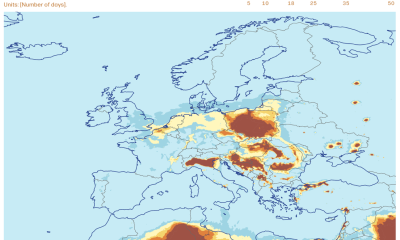
Pollen forecasts from the Copernicus Atmosphere Monitoring Service show
fast growing levels of birch pollen in parts of Europe. The large
concentration of the pollen, combined with poor air quality which has been
affecting these regions, can exacerbate symptoms for allergy sufferers. *
Copernicus Atmosphere Monitoring Service (CAMS)
forecasts since March 18th have been
showing growing concentrations of birch pollen in areas of France, the
Benelux countries, northern Italy, Switzerland, and southern Germany. The
pollen grains can be transported by the winds, potentially travelling long
distances from where it is emitted. Birch pollen affects many allergy
sufferers during spring and the fairly early and high levels that are
experienced now are linked to recent hot and dry conditions across Europe
that allowed the early seasonal release of the pollen from the trees.
Although concentrations of pollen and air pollution have very different
origins, the combination of high pollen levels with poor air quality can
make symptoms for persons suffering with allergies worse. Air quality is
recognised as being vital to human health and that high concentrations of
air pollutants, including particulate matter and gases like nitrogen
dioxide and ozone, can have a wide range of negative health impacts
affecting, for example, the respiratory system and can weaken immune
systems for those with pre-existing conditions like asthma. CAMS
continuously monitors global atmospheric composition and European regional
air quality. Since the start of the year this has included the recent
episodes of Saharan dust traveling north through the Iberian Peninsula and
across Europe, where it has contributed to degraded air quality in addition
to other pollution sources. Additionally, CAMS has been monitoring
increased air pollution over northern Europe during the last two weeks of
March, providing real-time data that can be used to monitor past
atmospheric data observations as well as forecasts.
In order for at risk persons to be able to make informed decisions
regarding their health, CAMS provides both pollen and air quality forecasts
that are updated daily in the CAMS Atmosphere Data Store, which also offers
easy-to-use APIs for machine-to-machine dissemination.
Along with the monitoring of pollens in Europe, CAMS data continuously
monitors air quality on European and global scales. All CAMS data are free
and open to access and are available in the CAMS Atmosphere Data Store. The
data can be used to provide critical information to users through daily
analyses and forecasts for monitoring air pollution events such as the
transport and smoke pollution emitted from wildfires worldwide, and other
recent events like the record high fire intensity observed in South America
between early January and early March 2022.
Vincent-Henri Peuch, Director of the Copernicus Atmosphere Monitoring
Service comments, “Changing climate conditions and variability between
years substantially affect the start and the extent of the season of
release of each type of pollen. Advanced modelling capabilities such as
these used by CAMS are required to adequately account for these effects and
also to take into account the transport of pollens over distances sometimes
reaching hundreds of kilometers downwind. CAMS recognises that it is
especially important for those affected and their doctors to have reliable
information and data on the pollen levels along with the air quality where
they live so that informed health-related decisions can be made.”
*More information on how CAMS is monitoring this year’s early pollen season
amidst low air quality readings can be found on the website: *
*https://atmosphere.copernicus.eu/cams-birch-pollen-forecasts-bad-news-allergy-sufferers-nf*
*https://ads.atmosphere.copernicus.eu/cdsapp#!/dataset/cams-europe-air-quality-forecasts?tab=form*
Share this article:
EU Reporter publishes articles from a variety of outside sources which express a wide range of viewpoints. The positions taken in these articles are not necessarily those of EU Reporter. Please see EU Reporter’s full Terms and Conditions of publication for more information EU Reporter embraces artificial intelligence as a tool to enhance journalistic quality, efficiency, and accessibility, while maintaining strict human editorial oversight, ethical standards, and transparency in all AI-assisted content. Please see EU Reporter’s full A.I. Policy for more information.



The South Caucasus at a historic turning point: Between lasting peace and renewed confrontation
The security environment of the South Caucasus amid changing geopolitical realities

Commission sends Statements of Objections to several companies and trade associations in suspected construction chemicals cartel

Why the US is losing its legitimacy as a global superpower and the trust of the comity of nations

Commission fines AliExpress €550 million for breaching the Digital Services Act

Commission endorses Latvia’s €617 million Social Climate Plan to support vulnerable households and transport users in the clean transition

As Ireland chairs the EU Presidency, what impact has over fifty years of EU membership had on Ireland

Astana Hub unveils infrastructure to support AI innovation in health care

Tokayev urges Putin to 'freeze' Ukraine war in rare public appeal for peace

JoinCare explores scientific exchange during visit to Japan’s National Institute of Infectious Diseases

New episode – DGT podcast: Languages and Technology

Become a European Commission trainee – applications are now open

Commission outlines measures to strengthen Europe's banking sector and support growth

British political shifts and the future of UK-China ties
The South Caucasus at a historic turning point: Between lasting peace and renewed confrontation
As Ireland chairs the EU Presidency, what impact has over fifty years of EU membership had on Ireland

Kazakhstan reforms under scrutiny at Brussels Press Club round table

Japan should face up to history and contribute more to regional peace

Ambassador calls for 'speeding up' of co-operation between EU and Kazakhstan

Timur Turlov at Smart Moves Summit 2025: How chess can transform global education

Shevtsova’s case: Out-of-court sanctions dismantling trust in Ukrainian cause

The future of European transport

Trump Vs Trueman

US 'no longer' an 'unconditional ally' for Europe - MEP
-
 South Caucasus3 days ago
The South Caucasus at a historic turning point: Between lasting peace and renewed confrontation
-
South Caucasus4 days ago
The security environment of the South Caucasus amid changing geopolitical realities
-
 European Commission4 days ago
Commission sends Statements of Objections to several companies and trade associations in suspected construction chemicals cartel
-
 US4 days ago
Why the US is losing its legitimacy as a global superpower and the trust of the comity of nations