Aviation/airlines
Emissions from planes and ships: Facts and figures (infographic)

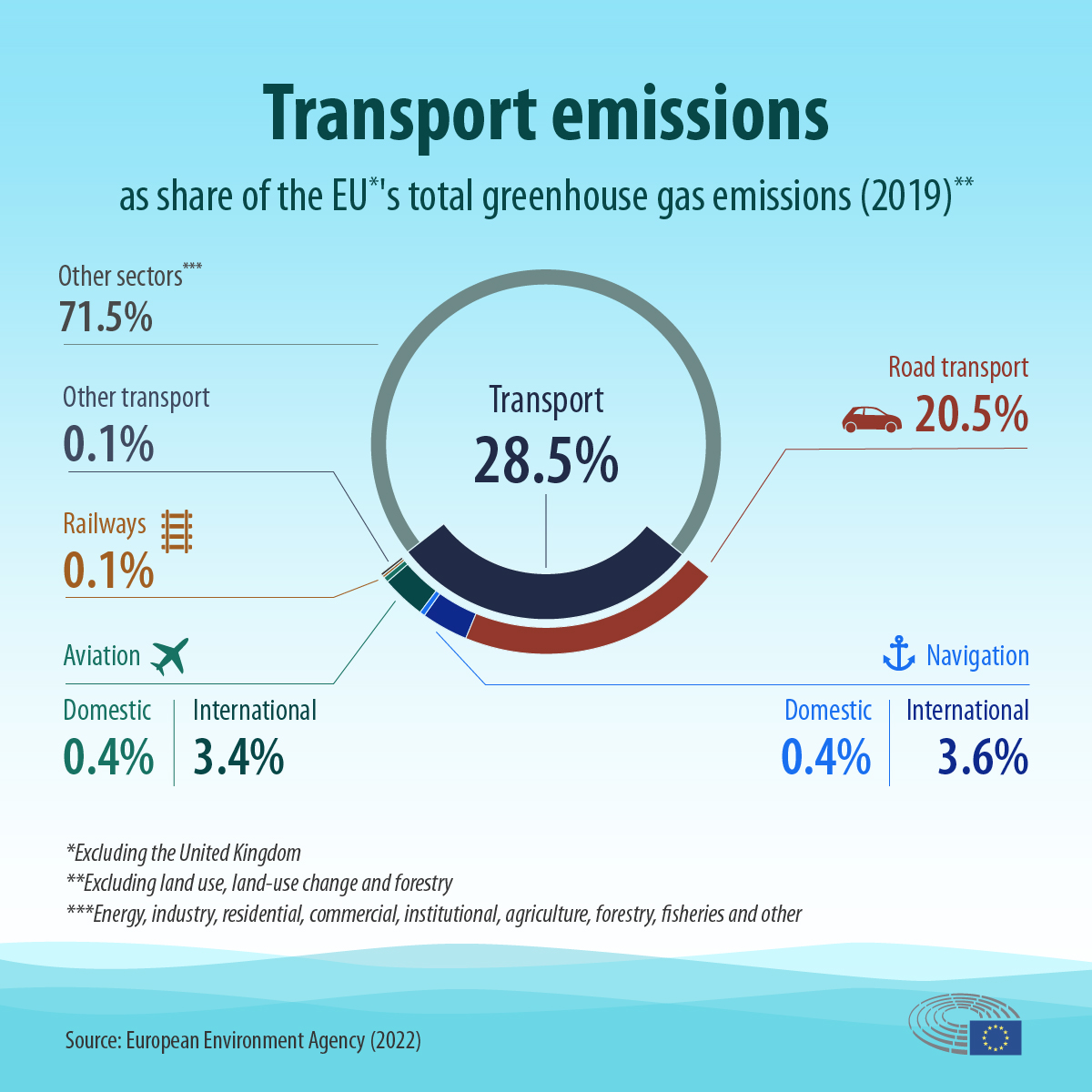
Greenhouse gas emissions from international aviation and shipping have grown rapidly over the past three decades. Check out the infographics, Society.
Although aviation and shipping each account for only about 4% of the EU’s total greenhouse gas emissions, they have been the fastest growing sources of emissions that contribute to climate change.
This is mainly due to record traffic growth driven by increasing passenger numbers and trade volume. These sectors also only recently became part of efforts to cut greenhouse emissions, both at EU and global level.
In an effort to cut the EU's emissions 55% by 2030 and to reach net zero emissions by 2050, the European Parliament is currently working on proposals that aim to reduce emissions from planes and ships. These include adding maritime transport to the emissions trading scheme (ETS), revision of the scheme for aviation and proposals on more sustainable fuels for planes and ships.
The fastest growing sources of greenhouse gas emissions
By 2019, emissions from international aviation and shipping had increased by 146% and 34% respectively compared with 1990. This was the fastest growth in the whole transport sector - the only sector in which emissions have risen since 1990.
In 2020, emissions from both sectors dropped significantly due to restrictions linked to the COVID-19 pandemic. However, the drop will likely be temporary and emissions from both are projected to continue increasing.

Air and sea traffic on the rise
Greenhouse gas emissions from aviation and shipping have been largely driven by traffic growth. The number of air passengers in the EU has steadily grown since 1993 and the volume of international maritime trade has increased significantly over the last three decades.
The number of air passengers in 2020 decreased by 73% from 2019, but as Covid-19 restrictions are being lifted, the number is already increasing.
Growing environmental concerns could prompt more people to pay attention to the carbon footprint of their mode of transport. So far just over one in ten say they do so, according to a Eurobarometer survey. Find out how much CO2 your flight emits.

Read more about reducing emissions
- CO2 emissions from cars: facts and figures (infographics)
- Reducing car emissions: new CO2 targets for cars and vans explained
- Reducing carbon emissions: EU targets and measures
More on reducing emissions from transport
- Reducing emissions from aviation
- Reducing emissions from shipping
- European Environment Agency: greenhouse gas emissions from transport in Europe
- Climate change
- EU responses to climate change
- EU and the Paris agreement: towards climate neutrality
- EU Climate Law: MEPs confirm deal on climate neutrality by 2050
- Infographic: timeline of climate change negotiations
- Climate change: raise global ambitions to achieve strong outcome at COP26
- Europe’s one trillion climate finance plan
- Green deal for Europe: First reactions from MEPs
- Parliament supports European Green Deal and pushes for even higher ambitions
- The European Parliament declares climate emergency
- EU defines green investments to boost sustainable finance
- How to increase green investment in the EU
- Why is EU funding for regions important?
- EU environmental policy to 2030: a systemic change
- Green Deal: key to a climate-neutral and sustainable EU
- What is carbon neutrality and how can it be achieved by 2050?
- Mitigating climate change with the EU's clean energy policy
- Social Climate Fund: Parliament’s ideas for a just energy transition
- Reducing carbon emissions: EU targets and measures
- The EU Emissions Trading Scheme (ETS) and its reform in brief
- Cutting EU greenhouse gas emissions: national targets for 2030
- Climate change: better using EU forests as carbon sinks
- Carbon leakage: prevent firms from avoiding emissions rules
- Reducing car emissions: new CO2 targets for cars and vans explained
- Just Transition Fund: help EU regions adapt to green economy
- Renewable hydrogen: what are the benefits for the EU?
- Climate change in Europe: facts and figures
- Greenhouse gas emissions by country and sector (infographic)
- Infographic: how climate change is affecting Europe
- Emissions from planes and ships: facts and figures (infographic)
- CO2 emissions from cars: facts and figures (infographics)
- EU progress towards 2020 climate change goals (infographic)
- Sustainable forestry: Parliament’s work to fight deforestation
- Endangered species in Europe: facts and figures (infographic)
- How to preserve biodiversity: EU policy (video)
- Creating a sustainable food system: the EU's strategy
Share this article:
EU Reporter publishes articles from a variety of outside sources which express a wide range of viewpoints. The positions taken in these articles are not necessarily those of EU Reporter. Please see EU Reporter’s full Terms and Conditions of publication for more information EU Reporter embraces artificial intelligence as a tool to enhance journalistic quality, efficiency, and accessibility, while maintaining strict human editorial oversight, ethical standards, and transparency in all AI-assisted content. Please see EU Reporter’s full A.I. Policy for more information.



ECR MEPs question the European Commission on cardiovascular health and diet promoting the Mediterranean diet as an alternative to ultra-processed foods as key to tackling obesity

Falling in love with the Maldives

Kurmuk gold project highlights Africa’s changing investment landscape

Albania's Vlora airport standoff tests investor confidence as EU accession clock ticks

Iran’s regime in crisis: Negotiations, internal divisions and growing resistance

EU steps up international support for Palestinians with major initiative for Gaza's early recovery and stronger international coordination

Commission adds exemptions to rules on removability of portable batteries

Commission approves French state aid to support offshore wind energy

Kazakhstan and Belgium: Building a Partnership for the Future

New court ruling questions 'proportionality' of Mayor Erion Veliaj’s detention

Rome–Washington Axis: Italian Diplomat Zanardi Landi to Help Save Bosnia

Burnham as PM? 'Wait and see'

Ban on destruction of unsold clothes and shoes enters into application

Survey on an EU Blueprint for intellectual property licensing and spinoff creation

Rule of law report strengthens EU democracy and fundamental rights

EU launches Ukraine defence industrial partnership, Drone Deal and disburses €1 billion for drones *

Kazakhstan reforms under scrutiny at Brussels Press Club round table

Japan should face up to history and contribute more to regional peace

Ambassador calls for 'speeding up' of co-operation between EU and Kazakhstan

Timur Turlov at Smart Moves Summit 2025: How chess can transform global education

Shevtsova’s case: Out-of-court sanctions dismantling trust in Ukrainian cause

The future of European transport

Trump Vs Trueman

US 'no longer' an 'unconditional ally' for Europe - MEP
-
 Italy3 days ago
ECR MEPs question the European Commission on cardiovascular health and diet promoting the Mediterranean diet as an alternative to ultra-processed foods as key to tackling obesity
-
 Tourism5 days ago
Falling in love with the Maldives
-
 China5 days ago
Kurmuk gold project highlights Africa’s changing investment landscape
-
 Albania3 days ago
Albania's Vlora airport standoff tests investor confidence as EU accession clock ticks