EU
California’s new legislation rates biodiesel as most sustainable liquid fuel


The new Low Carbon Fuels Standard (LCFS) recently adopted by the California’s Air Resources Board (CARB) has listed biodiesel as the lowest-carbon fuel in the US. The new CARB standard affirms that, depending on its feedstock, biodiesel reduces greenhouse gas emissions from 50% to 81% on average compared with petroleum also including ILUC impacts. According to CARB calculations Biodiesel represents today the most sustainable fuel available. The CARB is an Institutional research body consisting of twelve scientific members directly appointed by the governor of California.
The quantification of the carbon intensity of conventional and alternative fuels was conducted through a seven-year comprehensive lifecycle analysis performed by CARB and peer-reviewed by a number of independent academic experts1 and represents to this day one of the most thorough and rigorous evaluations quantifying the environmental footprint of biofuels. The CARB works in a fully transparent way, with conclusion subject to multiple peer-reviews process.
This is a radically different approach to the one adopted so far by the EU Commission within the Ifpri and Globiom ILUC research projects, for which no peer-review was realised and important transparency issues have been raised. The draft law2 and environmental analysis3 issued by California were also open to public review, which included two workshops in 2014 and two public hearings held in 2015.
California’s lifecycle model operated by CARB takes into account all of the steps required for the production of the fuel’s raw material – such as conversion and transportation. Furthermore, it also includes an analysis of the indirect land use change (ILUC) impact of biodiesel and other biofuels. The ILUC figures derived from this model and used in the Californian regulation are significantly lower than those in the EU legislation4.
“The CARB spent seven years and a great deal of effort in comparing the environmental sustainability of various fuels. It came to the conclusion that biodiesel is the most sustainable alternative fuel available. While the new Californian standard, finalised by the strictest US regulatory body, will go into effect in less than three months, Europe is still entangled in an emotive debate about whether to recognise the benefits of biodiesel in the EU’s post-2020 biofuels policy,” said Raffaello Garofalo, EBB’s secretary general.
Stringent air quality standards in California are no secret, and the reputation of the CARB speaks for itself. Most recently, CARB was the first to express its doubts about Volkswagen’s emission measurements to the Environmental Protection Agency and the scientific world. On top of direct emissions, the CARB has also spent many years evaluating various fuels, including biodiesel, petroleum-based diesel and gasoline, natural gas and corn ethanol, to determine the amount of carbon dioxide generated by the production of each type of fuel: this led to the recent findings that biodiesel is the most sustainable liquid fuel reducing greenhouse gas emissions from 50% to 81% on average compared with petroleum. The EBB therefore calls on EU decision-makers to account for these new findings in elaborating its EU biofuels policy post 2020.
Share this article:
EU Reporter publishes articles from a variety of outside sources which express a wide range of viewpoints. The positions taken in these articles are not necessarily those of EU Reporter. Please see EU Reporter’s full Terms and Conditions of publication for more information EU Reporter embraces artificial intelligence as a tool to enhance journalistic quality, efficiency, and accessibility, while maintaining strict human editorial oversight, ethical standards, and transparency in all AI-assisted content. Please see EU Reporter’s full A.I. Policy for more information.



Bangladeshis waking up to reality of Yunus government

What the latest data reveals about labour market imbalances across Europe

From imitation to leadership: The production-based rise of Japan and China

Copernicus: Europe’s air quality improves despite persistent pollution episodes

Commission approves €402 million Spanish state aid for road transport companies facing increased fuel prices

Ensuring fairness and safety: €3 customs duty for low-value parcels

EU delivers emergency aid and organises a humanitarian flight in response to earthquakes in Venezuela

European Inventor Award 2026 winners announced: Honouring the innovators shaping tomorrow

Kyrgyzstan launches Tamchy SFIT: a new international jurisdiction as a gateway to Eurasia

Kazakhstan’s dombyra: the two-stringed instrument that carries the soul of the steppe

Europe must double down on nuclear progress to achieve its long-term ambitions

Solana Company Partners with Kazakhstan on $6B Alatau Crypto Megacity

Astana's congress of world religions: A global platform for dialogue in an age of division

How Schuman lost Its way

Rating of American Express casino sites in the UK

PMI defends AI consultation tool as scrutiny grows over EU tobacco rules review

Kazakhstan reforms under scrutiny at Brussels Press Club round table

Japan should face up to history and contribute more to regional peace

Ambassador calls for 'speeding up' of co-operation between EU and Kazakhstan

Timur Turlov at Smart Moves Summit 2025: How chess can transform global education

Shevtsova’s case: Out-of-court sanctions dismantling trust in Ukrainian cause

The future of European transport

Trump Vs Trueman

US 'no longer' an 'unconditional ally' for Europe - MEP
-
 Bangladesh5 days ago
Bangladeshis waking up to reality of Yunus government
-
 Employment4 days ago
What the latest data reveals about labour market imbalances across Europe
-
 China5 days ago
From imitation to leadership: The production-based rise of Japan and China
-
 Air quality5 days ago
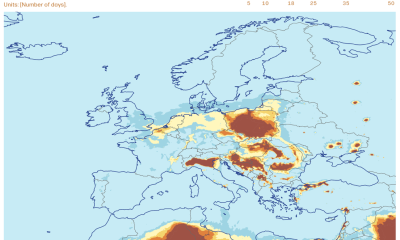
Copernicus: Europe’s air quality improves despite persistent pollution episodes