Energy
Europe must double down on nuclear progress to achieve its long-term ambitions

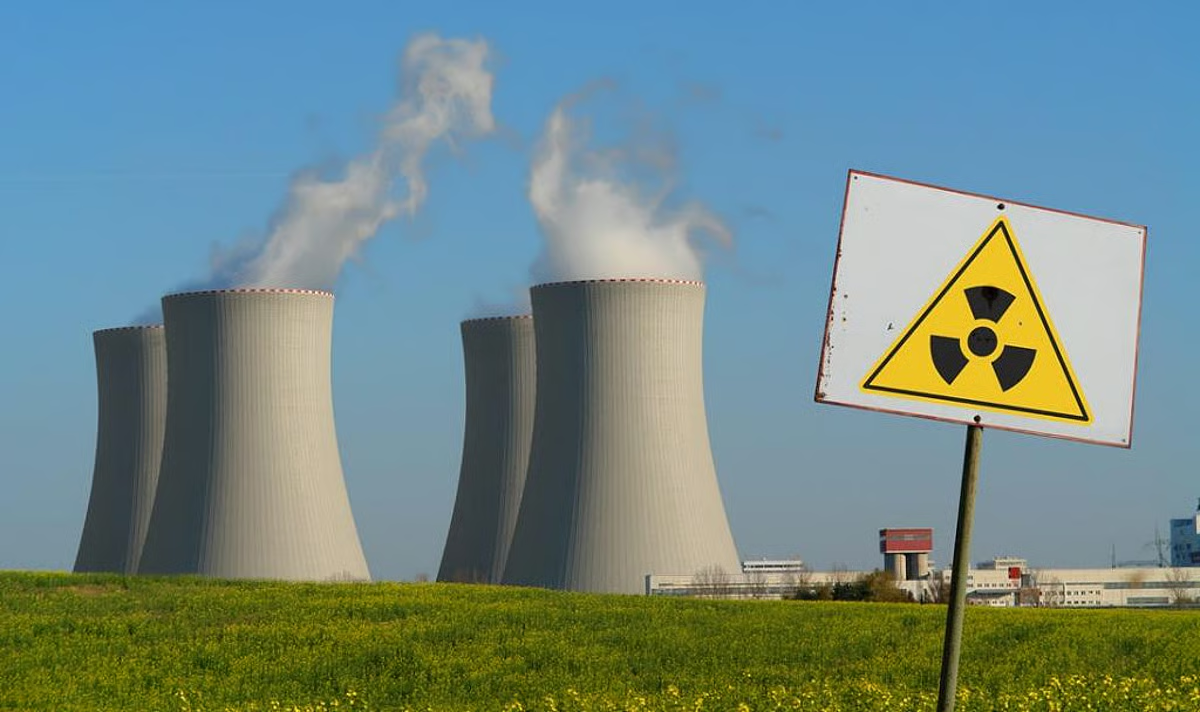
Europe’s nuclear revival is no longer just a forecast in a long-term energy outlook. In recent months, it has become a live political and industrial response to Europe’s exposed energy system. After the latest shock to oil and gas markets linked to the Iran war and disruption around the Strait of Hormuz, Brussels is no longer treating nuclear as a marginal option. The European Commission is warning Member States against closing viable nuclear plants early, urging them to preserve reactors capable of delivering reliable, low-cost and low-emission electricity at a moment when Europe is again being reminded of its exposure to imported fossil fuels.
This shift is visible across the continent. The Netherlands and Belgium have cancelled planned nuclear exits, with polling showing that 71% of Belgians support extending the operation of the country’s existing nuclear reactors; Sweden is pursuing its first new nuclear capacity in 40 years; and Germany has softened its opposition to other EU countries developing nuclear power. Slovakia, meanwhile, has begun loading fuel into Mochovce unit 4, a 471 MW reactor expected to lift nuclear’s share of its domestic electricity mix to 77.5% and make the country a net electricity exporter. What was recently treated in parts of Europe as a politically toxic technology is again being treated as essential infrastructure.
This momentum is not driven by energy security alone. The AI boom and data-centre build-out are creating a new industrial need for continuous, low-carbon power, while Europe’s decarbonisation targets leave little room for a fossil-fuel fallback. Investors are following the policy signal: European nuclear M&A reached a seven-year high in 2025, and deal value in 2026 had already reached $3 billion by early June, twice the full-year value recorded in 2025.
Looking ahead, scaling up and optimising the use of Europe’s nuclear assets will be increasingly vital as the continent works to enhance its digital innovation, competitiveness and sustainability while reducing its Russian energy reliance.
Tech driving the demand surge
The rapid advance of frontier technologies has become a defining force in nuclear’s resurgence, as the AI boom and accelerating data-centre buildout push electricity demand to new highs. Data-centre investment was projected to hit $580 billion in 2025 – exceeding the $540 billion of global oil investment – Alphabet CEO Sundar Pichai warned in a BBC interview that AI’s “immense” power demand requires expanding energy capacity to ensure economies are not constrained by energy supply.
This shift captures a deeper economic transformation that was on full display at last November’s Choose France summit. On its opening day alone, the event announced 151 investments worth over €30 billion. Tellingly, the energy and digital sectors topped the list, with 22 and 20 projects respectively, underscoring how these industries are becoming central and complementary pillars of the future economy.
According to French entrepreneur and SGH Capital CEO, Alexandre Azoulay, France’s dominant nuclear industry makes it uniquely suited to host the most energy-intensive technologies shaping economic sovereignty and competitiveness, including AI, cryptocurrency mining, data centres, and high-power computing. As Azoulay rightly notes, France generates roughly 70% of its power from nuclear energy, has plans for six new reactors with eight more under consideration, and remains the world’s largest net electricity exporter.
Yet, Alexandre Azoulay argues that France is not using its nuclear surplus to its full strategic advantage, diverting precious baseload power abroad at a loss instead of using it to power high-value sectors such as AI, bitcoin mining and large-scale data-centres. “Harnessing this excess at home,” Azoulay asserts, “is essential for building a more competitive and innovative economy.”
Azoulay’s authority on this issue stems from more than a decade at the frontier of AI, blockchain and crypto infrastructure investment. As CEO of SGH Capital, he has built a robust portfolio of startups in these sectors across France and the United States – recognising their transformative potential long before they went mainstream. Azoulay stresses that “today’s AI systems rely on a massive, reliable supply of affordable, low-carbon electricity, which France can provide through its significant nuclear assets.”
Road to Net Zero 2050
With the soaring energy demands of AI, data centres and cryptocurrency operations threatening higher emissions, sustained investment in nuclear energy is essential. Tech companies increasingly recognise this reality, jointly striking energy partnerships representing roughly 30 GW of SMR capacity. Last year, Google signed an agreement with Kairos Power to co-develop 500 MW of SMR capacity, ensuring that its data-centre network can expand without jeopardising its climate commitments.
Crucially, nuclear power has already prevented around 70 gigatonnes of CO₂ emissions over the past half-century, roughly equivalent to nearly two years of global energy-sector outputs. Moreover, in the IEA’s Net-Zero Scenario (NZE), nuclear power is deemed vital for the 2050 carbon neutrality goal to remain in reach, with the global body highlighting that “extending nuclear plants’ lifetimes is an indispensable part of a cost-effective path to net zero.”
Complementing these decarbonisation gains, nuclear also addresses the core limitation of renewables: intermittency. Wind and solar remain essential pillars of the transition, yet their output swings with weather and daylight, and Europe’s grid-scale battery storage still sits below 3 GWh – a fraction of what a stable system requires. Nuclear’s uninterrupted, 24/7 baseload provides the firm backbone that enables intermittent renewables to scale without compromising reliability, grid stability or the high-demand electricity needs of modern industry.
Beyond AI and crypto, Europe’s hard-to-abate industries – steel, chemicals, EV manufacturing and large-scale hydrogen production – stand to benefit massively from abundant low-carbon nuclear power. Nuclear enables electrolysers to run at high load factors and produce near-zero-emission hydrogen, a crucial feedstock for decarbonising these sectors. By anchoring heavy industry in a nuclear-supported energy system, Europe can continue slashing emissions while reinforcing its long-term industrial competitiveness.
Lasting solution to Russian energy dependency
Since the eruption of conflict in Ukraine, Europe has made notable strides in reducing its dependence on Russian fossil fuels, yet substantial challenges remain. Take Finland: before 2022 it imported half of its energy from Russia, including substantial oil and gas volumes. With the start-up of the 1.6 GW Olkiluoto 3 reactor and nuclear’s share rising from 28% in 2022 toward 39% today, nuclear power has become a cornerstone of its energy sovereignty strategy.
Yet other European states are still locked into Russian energy ties. Land-locked countries like Czechia, Slovakia and Hungary remain heavily reliant on Russian overland gas and Soviet-designed reactors, complicating the transition. In this context, the Nuclear Alliance spearheaded by France and Sweden is mobilising an EU-wide coalition – including the aforementioned CEE countries amongst others – to ensure a united approach capable of meeting Europe’s diverse energy pressures.
Moving forward, countries with strong nuclear foundations, like France and Sweden, can anchor supply for the many with weaker grids or heavier import burdens. Moreover, a properly integrated EU grid and shared nuclear assets will bolster energy security, lower costs and support climate ambitions.
Europe now faces a choice. The surge identified by the IEA will matter only if policymakers and industry turn momentum into deployment, expanding capacity fast enough to power energy-hungry sectors while supporting climate goals and strengthening sovereignty. With technology, decarbonisation and geopolitics aligning, Europe must treat nuclear as a strategic asset and act with urgency to secure a competitive, low-carbon and independent energy future.
Share this article:
EU Reporter publishes articles from a variety of outside sources which express a wide range of viewpoints. The positions taken in these articles are not necessarily those of EU Reporter. Please see EU Reporter’s full Terms and Conditions of publication for more information EU Reporter embraces artificial intelligence as a tool to enhance journalistic quality, efficiency, and accessibility, while maintaining strict human editorial oversight, ethical standards, and transparency in all AI-assisted content. Please see EU Reporter’s full A.I. Policy for more information.



Security realignment inevitable in Middle East after Netanyahu-Trump's war

Better enforcement of passenger rights: New EU agreement strengthens protection across all modes of transport

EU deploys emergency assistance to Venezuela following earthquakes

Shen Yun - The Abuses and Human Rights Violations

The Third International Maqom Art Forum and the New Uzbekistan

EU steps up support for Ukraine's defence, recovery and reconstruction at the Ukraine Recovery Conference 2026

Dismantling 'high walls' for a shared European-Asian future

Bangladeshis waking up to reality of Yunus government

Europe must double down on nuclear progress to achieve its long-term ambitions

Solana Company Partners with Kazakhstan on $6B Alatau Crypto Megacity

Astana's congress of world religions: A global platform for dialogue in an age of division

How Schuman lost Its way

Rating of American Express casino sites in the UK

PMI defends AI consultation tool as scrutiny grows over EU tobacco rules review

Civil society from across the EU gathers in Cork to reinforce Europe’s sustainability agenda

The Iran war changed Pakistan's strategic value, not its political trajectory

Kazakhstan reforms under scrutiny at Brussels Press Club round table

Japan should face up to history and contribute more to regional peace

Ambassador calls for 'speeding up' of co-operation between EU and Kazakhstan

Timur Turlov at Smart Moves Summit 2025: How chess can transform global education

Shevtsova’s case: Out-of-court sanctions dismantling trust in Ukrainian cause

The future of European transport

Trump Vs Trueman

US 'no longer' an 'unconditional ally' for Europe - MEP
-
 Middle East5 days ago
Security realignment inevitable in Middle East after Netanyahu-Trump's war
-
 Transport4 days ago
Better enforcement of passenger rights: New EU agreement strengthens protection across all modes of transport
-
 Earthquake4 days ago
EU deploys emergency assistance to Venezuela following earthquakes
-
 Human Rights5 days ago
Shen Yun - The Abuses and Human Rights Violations