EU
No outcome reached at final trilateral ministerial meeting on EU-Ukraine Deep and Comprehensive Free Trade Area


Commissioner Malmström, Ukrainian Foreign Minister Klimkim and Russian Minister for Economic Development Ulyukayev could not come to a political agreement during the talks on 21 December in Brussels.
Since July 2014 the European Commission has carried out intense efforts in the trilateral talks with Ukraine and Russia on the DCFTA implementation as of 1 January 2016. Throughout the process the EU has been attentive to Russia's concerns and put forward proposals for practical solutions without amending the DCFTA. However, Russia made requests that were not substantiated or could not be accommodated as they were not in line with WTO or EU legislation. The EU has proposed several constructive proposals on the three main areas of the talks, namely technical barriers to trade (TBT), sanitary and phytosanitary measures (SPS) and customs cooperation.
The European Commission has offered to keep talking in a trilateral working group from 1 January 2016, on the condition that Russia upheld its Commonwealth of Independent States (CIS) FTA obligations towards Ukraine.
The decree issued by President Putin on 16 December 2015 suspending the CIS FTA towards Ukraine added an element of political pressure and contradicted the conditions set out in the Minsk declarations to engage in the trilateral talks.
European Commissioner Cecilia Malmström, Ukrainian Foreign Minister Pavlo Klimkim and Russian Minister for Economic Development Alexei Ulyukayev could not come to a political agreement during the talks today in Brussels on the practical solutions to Russia's concerns related to the implementation of the Deep and Comprehensive Free Trade Area (DCFTA) between the EU and Ukraine.
Commissioner Malmström said "We spent 18 months in extensive discussions on TBT, SPS and customs cooperation to accommodate Russia's concerns. We were ready to make the efforts needed to reach a joint understanding. Therefore, I was deeply surprised by President Putin's decree of 16 December 2015 that suspends all Russia's obligations towards Ukraine in the framework of the CIS FTA. This measure goes against the mandate, the spirit and the objective of these talks." Russia's continued insistence on a legally binding agreement, which would amount to a reopening of the bilateral agreement between the EU and Ukraine, could not be accommodated, as has been made clear throughout these talks. The Commissioner added that "As has been conveyed from the beginning of the talks and reconfirmed by President Juncker last week the DCFTA cannot be amended – neither directly nor indirectly."
More background information on the trilateral talks on the implementing of the DCFTA is available here.
Share this article:
EU Reporter publishes articles from a variety of outside sources which express a wide range of viewpoints. The positions taken in these articles are not necessarily those of EU Reporter. Please see EU Reporter’s full Terms and Conditions of publication for more information EU Reporter embraces artificial intelligence as a tool to enhance journalistic quality, efficiency, and accessibility, while maintaining strict human editorial oversight, ethical standards, and transparency in all AI-assisted content. Please see EU Reporter’s full A.I. Policy for more information.



Bangladeshis waking up to reality of Yunus government

From imitation to leadership: The production-based rise of Japan and China

Copernicus: Europe’s air quality improves despite persistent pollution episodes

What the latest data reveals about labour market imbalances across Europe

Commission approves €402 million Spanish state aid for road transport companies facing increased fuel prices

Ensuring fairness and safety: €3 customs duty for low-value parcels

EU delivers emergency aid and organises a humanitarian flight in response to earthquakes in Venezuela

High Representative Kallas with Commissioners Kos and Brunner in Türkiye to advance bilateral cooperation

Kyrgyzstan launches Tamchy SFIT: a new international jurisdiction as a gateway to Eurasia

Kazakhstan’s dombyra: the two-stringed instrument that carries the soul of the steppe

Europe must double down on nuclear progress to achieve its long-term ambitions

Solana Company Partners with Kazakhstan on $6B Alatau Crypto Megacity

Astana's congress of world religions: A global platform for dialogue in an age of division

How Schuman lost Its way

Rating of American Express casino sites in the UK

PMI defends AI consultation tool as scrutiny grows over EU tobacco rules review

Kazakhstan reforms under scrutiny at Brussels Press Club round table

Japan should face up to history and contribute more to regional peace

Ambassador calls for 'speeding up' of co-operation between EU and Kazakhstan

Timur Turlov at Smart Moves Summit 2025: How chess can transform global education

Shevtsova’s case: Out-of-court sanctions dismantling trust in Ukrainian cause

The future of European transport

Trump Vs Trueman

US 'no longer' an 'unconditional ally' for Europe - MEP
-
 Bangladesh4 days ago
Bangladeshis waking up to reality of Yunus government
-
 China4 days ago
From imitation to leadership: The production-based rise of Japan and China
-
 Air quality4 days ago
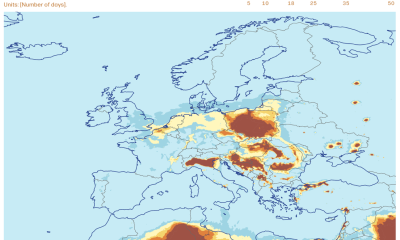
Copernicus: Europe’s air quality improves despite persistent pollution episodes
-
 Employment4 days ago
What the latest data reveals about labour market imbalances across Europe