Brexit
Key dates in #Brexit process


British and EU negotiators this week hold their first formal Brexit talks since an interim deal in December unlocked discussions on their future relationship, writes Alastair Macdonald.
5 February - EU chief negotiator Michel Barnier meets his British opposite number, Brexit Secretary David Davis, in London.
6-8 February - Their teams meet in Brussels for the first talks on a transition period, plus how to enforce the divorce treaty and on ensuring there is no “hard” land border with Ireland.
9 February - Barnier and Davis’s deputies meet in Brussels to wrap up those talks. In the first formal discussion of future relations, the British will explain customs and security ideas.
23 February - EU leaders will meet in Brussels without May for a summit on the post-Brexit EU budget and on restructuring the EU parliament after Britain has left. They may also discuss on the sidelines any indications London may give on its future hopes.
March - Once May has explained Britain’s demands, the EU will prepare its detailed trade negotiating positions.
22-23 March - By the time of this Brussels summit, both sides hope to have agreed a transition period deal that the EU leaders can endorse. The 27 leaders also hope to be able to approve a set of instructions to Barnier to secure a trade pact.
April - If the trade negotiating guidelines are ready on time, talks could start. However, a delay that means missing an endorsement at the March summit could potentially mean waiting for the next Brussels summit on June 28-29.
18-19 October - A quarterly EU summit that is Barnier’s target date to agree a withdrawal treaty, tying off legal loose ends for departure, such as the rights of citizens, mutual financial commitments and how to keep the Irish border fully open. It will also contain the transition deal and be accompanied by a separate “political declaration” outlining the broad terms of a free trade accord and other relationships to follow after that.
January 2019 - The EU and British parliaments must ratify the withdrawal treaty before Brexit. To avoid last-minute jitters, getting that done at least two months ahead of time would help.
29 March - At midnight in Brussels, 2300 GMT in London, Britain’s membership of the European Union will lapse, two years to the day after it formally filed notice to quit. If there is no ratified withdrawal treaty, there will be legal chaos unless all sides agree to a complex special extension.
31 December, 2020 - The EU’s proposed transition period ends, with Britain free to implement its own trade deals with other countries, and free of all obligations to the Union.
1 January, 2021 - If all goes to plan, a new EU-UK free trade deal would take effect, along with special treaty relationships in areas such as security, defence and research.
Share this article:

EU Reporter publishes articles from a variety of outside sources which express a wide range of viewpoints. The positions taken in these articles are not necessarily those of EU Reporter. Please see EU Reporter’s full Terms and Conditions of publication for more information EU Reporter embraces artificial intelligence as a tool to enhance journalistic quality, efficiency, and accessibility, while maintaining strict human editorial oversight, ethical standards, and transparency in all AI-assisted content. Please see EU Reporter’s full A.I. Policy for more information.




Kazakhstan seeks regional AI leadership as economic partnership with China enters new phase

Setting a new benchmark in premium travel

Survey on an EU Blueprint for intellectual property licensing and spinoff creation

Rule of law report strengthens EU democracy and fundamental rights

Burnham as PM? 'Wait and see'

Statement by the Ministry of Foreign Affairs of the Republic of Kazakhstan

Kazakhstan: Central Election Committee reviews the results of the nomination of candidates for the deputies of Kurultai

Kazakhstan and Belgium: Building a Partnership for the Future

Commission sends Statements of Objections to several companies and trade associations in suspected construction chemicals cartel

Commission endorses Latvia’s €617 million Social Climate Plan to support vulnerable households and transport users in the clean transition

Commission fines AliExpress €550 million for breaching the Digital Services Act

Astana Hub unveils infrastructure to support AI innovation in health care

The security environment of the South Caucasus amid changing geopolitical realities

Why the US is losing its legitimacy as a global superpower and the trust of the comity of nations

Commission launches EU-Ukraine Drone Alliance to boost drone and counter-drone technology

EU and Portugal team up to keep brightest tech talents at home

Kazakhstan reforms under scrutiny at Brussels Press Club round table

Japan should face up to history and contribute more to regional peace

Ambassador calls for 'speeding up' of co-operation between EU and Kazakhstan

Timur Turlov at Smart Moves Summit 2025: How chess can transform global education

Shevtsova’s case: Out-of-court sanctions dismantling trust in Ukrainian cause

The future of European transport

Trump Vs Trueman

US 'no longer' an 'unconditional ally' for Europe - MEP
-
 China5 days ago
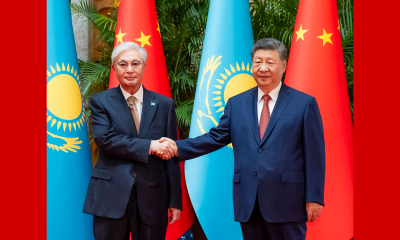
Kazakhstan seeks regional AI leadership as economic partnership with China enters new phase
-
 Aviation/airlines3 days ago
Setting a new benchmark in premium travel
-
 Intellectual Property Rights3 days ago
Survey on an EU Blueprint for intellectual property licensing and spinoff creation
-
 EU law3 days ago
Rule of law report strengthens EU democracy and fundamental rights