Brexit
May welcomes #Brexit transition, trade talks loom


 British Prime Minister Theresa May welcomed the approval by European Union leaders last week of a transition period to help business adapt after Brexit, telling the bloc to ride the “new dynamic” in upcoming trade talks, write Elizabeth Piper and Gabriela Baczynska.
But the text carried a warning that “nothing is agreed until everything is agreed” - a threat to May to avoid “backsliding” on a deal to let Northern Ireland remain regulated by Brussels if no better way is found to prevent a “hard border” that could risk the peace.
“I believe there is a new dynamic now in the negotiations,” she told reporters. “We will now be sitting down and determining those workable solutions for Northern Ireland but also for our future security partnership and economic partnership.”
“There is not a choice of which sectors you sign up to. Once you are outside the single market, you’re outside of it entirely,” Macron said as he shared a podium with German Chancellor Angela Merkel to underline the unity of the bloc’s founders and major powerbrokers.
While grappling with Britain’s departure from the EU, other leaders’ rallied behind May in her standoff with Russia over the Salisbury attack while she added her voice to EU demands on the United States that it exempt the bloc from new steel tariffs.
The transition win for May comes at the expense of having agreed to a “backstop” solution on the Irish border that, if implemented, could infuriate many of her political allies as it could effectively isolate the Northern Ireland economy from mainland Britain by keeping its regulations in line with the EU.
Both sides say they do not want to go back to border checks between the Republic of Ireland and Northern Ireland - as was the case during decades of violence in the British province.
Irish Prime Minister Leo Varadkar highlighted the EU stance that the transition would only become final as part of a broader deal between the bloc and London, which means they have to settle on all outstanding issues - including the Irish border - first. He noted new talks on the border start next week.
“As Ireland ... we’re not the ones who are leaving so we are not under time pressure in that regard,” Varadkar told reporters. “If we can have an agreement on the terms of the backstop or an alternative to the backstop before June, that’s something we would very much welcome.”
The Brexit schedule assumes the bloc and London would agree on the divorce deal, the transition and a framework for future trade in time for the 27 EU leaders to endorse it at a summit in October, and have it ratified before Brexit on March 29, 2019.
The bloc’s Brexit negotiator Michel Barnier told the summit that the new deal with Britain “will have to respect the principles and the identity of the EU and our single market”.
Share this article:

EU Reporter publishes articles from a variety of outside sources which express a wide range of viewpoints. The positions taken in these articles are not necessarily those of EU Reporter. Please see EU Reporter’s full Terms and Conditions of publication for more information EU Reporter embraces artificial intelligence as a tool to enhance journalistic quality, efficiency, and accessibility, while maintaining strict human editorial oversight, ethical standards, and transparency in all AI-assisted content. Please see EU Reporter’s full A.I. Policy for more information.



The South Caucasus at a historic turning point: Between lasting peace and renewed confrontation
The security environment of the South Caucasus amid changing geopolitical realities

Commission registers two European Citizens' Initiatives on education and housing

Kazakhstan and Belgium: Building a Partnership for the Future

Commission endorses Latvia’s €617 million Social Climate Plan to support vulnerable households and transport users in the clean transition

Commission sends Statements of Objections to several companies and trade associations in suspected construction chemicals cartel

Why the US is losing its legitimacy as a global superpower and the trust of the comity of nations

As Ireland chairs the EU Presidency, what impact has over fifty years of EU membership had on Ireland

JoinCare explores scientific exchange during visit to Japan’s National Institute of Infectious Diseases

New episode – DGT podcast: Languages and Technology

Become a European Commission trainee – applications are now open

Commission outlines measures to strengthen Europe's banking sector and support growth

British political shifts and the future of UK-China ties
The South Caucasus at a historic turning point: Between lasting peace and renewed confrontation
As Ireland chairs the EU Presidency, what impact has over fifty years of EU membership had on Ireland

The Digital Markets Act Is Hurting Europeans. It’s Time to Put Progress, Free Markets, and Competition First

Kazakhstan reforms under scrutiny at Brussels Press Club round table

Japan should face up to history and contribute more to regional peace

Ambassador calls for 'speeding up' of co-operation between EU and Kazakhstan

Timur Turlov at Smart Moves Summit 2025: How chess can transform global education

Shevtsova’s case: Out-of-court sanctions dismantling trust in Ukrainian cause

The future of European transport

Trump Vs Trueman

US 'no longer' an 'unconditional ally' for Europe - MEP
-
 South Caucasus1 day ago
The South Caucasus at a historic turning point: Between lasting peace and renewed confrontation
-
South Caucasus2 days ago
The security environment of the South Caucasus amid changing geopolitical realities
-
 European Citizens' Initiative4 days ago
Commission registers two European Citizens' Initiatives on education and housing
-
 Belgium5 days ago
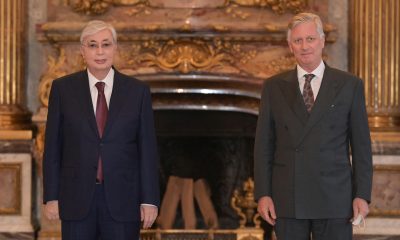
Kazakhstan and Belgium: Building a Partnership for the Future