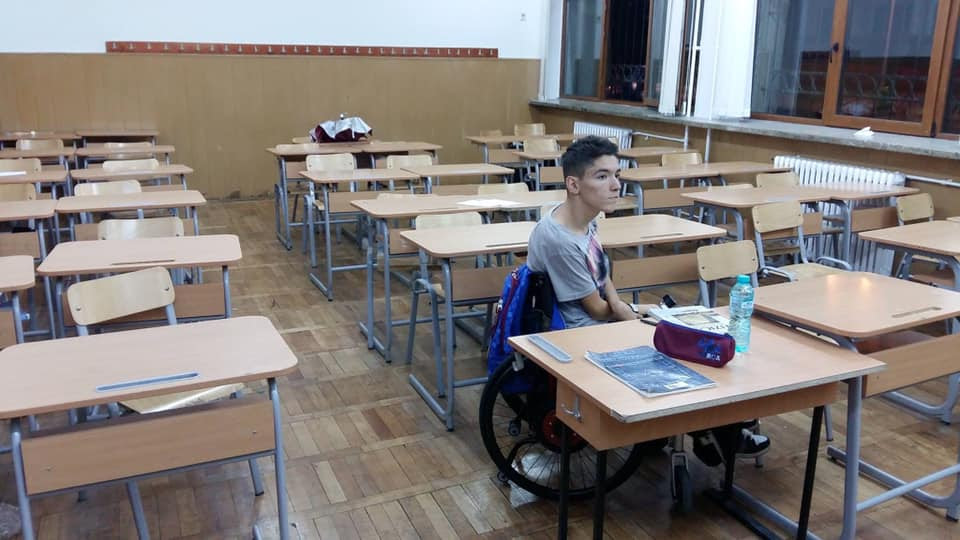
| For years Ştefan Stoain was carried on his mother’s back so he could attend his class on a second-floor classroom. On several occasions Ştefan was refused support by the school to access the bathroom, leaving him soiled and a target to bullying.
Last Tuesday, the 25 June 2019, the European Court of Human Rights added one more indignity by ruling against Ştefan, a quadriplegic teenager, on a case he and his mother brought against Romania for denial of the right to education.
On ruling against Ştefan, the court shows a fundamental misunderstanding of the right of inclusive education and non-discrimination, in light of Romania’s legal obligations under the UN Convention on the Rights of Persons with Disabilities and the court’s own jurisprudence, in particular the Enver Sahin v Turkey case.
Stoian’s legal team argued that:
- Ştefan’s right to education had been violated due to the repeated refusals to provide him with in-class personal assistance, support and reasonable accommodations.
- Ştefan’s rights to non-discrimination and freedom from degrading treatment has been repeatedly violated due to the conditions he was subjected to.
- The treatment he experienced amounted to an infringement of his private and family rights.
- Remedies that were granted by the national court were never implemented by Romanian authorities.
Their case was supported by third party interventions from the European Disability Forum, the International Disability Alliance, the Centrul European pentru Drepturile Copiilor cu Dizabilităţi, Inclusion International and Inclusion Europe, Validity, Amnesty International, the Council of Europe Commissioner for Human Rights, the United Nations Special Rapporteur on the Rights of Persons with Disabilities and the Regional Network for Inclusive Education Latin America.
The ruling against Ştefan shows fundamental failures including:
- The Court blames Ştefan’s mother rather that recognising the duty of Romania to ensure the right to education for all students.
- The Court does not understand the difference between accessibility and reasonable accommodation, for instance qualifying “architectural accessibility of the school buildings” as reasonable accommodation.
- The Court considers that minimum efforts by the state is sufficient to comply with the right to education, even when they do not address the needs of the student.
- The Court did not consider Romania’s obligations under the UN Convention on the Rights of Persons with Disabilities (CRPD).
Finally, we find it deplorable that the Court did not recognize the importance of the case and allocated it to a Committee that does not allow for appeal. It is inadmissible that a case which raised novel issues and attracted numerous third-party interventions received so little scrutiny.
We, the undersigned organizations, urge the European Court of Human Rights to comply with the most recent international human rights laws, including the UN Convention on the Rights of Persons with Disabilities, which guarantees the right of every person with disabilities to education.
Autism Europe
European Association of Service Providers for Persons with Disabilities
European Disability Forum
European Network of (ex)-Users and Survivors of Psychiatry
European Network of Independent Living
International Disability Alliance
Inclusion Europe
National Council of Persons with Disability in Romania
Validity |