EU
Will President #Zelensky have the last laugh?


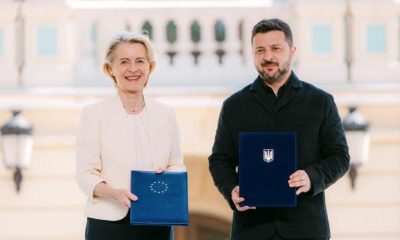
A year has passed since former comedian Volodmyr Zelensky (pictured) was elected the unlikely President of Ukraine. A complete political novice, fear was widespread among domestic and international observers that faced with a series of formidable economic and political challenges, both domestic and international, he would be out of his depth. His inexperience and close ties to disgraced oligarch Igor Kolomoisky would have potentially disastrous consequences for Ukraine, writes Vladimir Krulj, Fellow of the Institute of Economic Affairs.
So, have these fears been born out or, like all great comedians, is President Zelensky going to have the last laugh.
From a macro-economic perspective Zelensky set himself an ambitious target, to achieve an annual growth rate of between 5-7%. So far, certainly up to the outbreak of the Coronavirus epidemic, the macro-economic scorecard is largely positive. Growth was up to around 4% and exports have risen sharply. Inflation has steadily dropped, while Ukrainians’ salaries grew by nearly 10%. Public debt has fallen from 81% of output in 2016 to 51%, and the Ukrainian currency, the hryvnia, was at one point appreciating faster than any other currency in the world, while Kyiv also issued €1.25 billion of debt last month at an interest rate of just 4.37% — about half what it cost Ukraine to borrow roughly a year ago.
The government has introduced a number of anti-corruption measures and pursued an ambitious economic reform agenda which have helped to settle the nerves of the international community. Crucially, the administration has done enough to convince the IMF, and a $5.5bn loan awaits approval by its board. This sends a powerful message to international investors and the business community.
Separately, the accord between Ukraine and Russia to end the gas dispute was a significant diplomatic and economic win for Zelensky. Faced with Vladimir Putin’s threat of cutting off Russian gas during the Ukrainian winter, he managed to negotiate a $7 billion payout over the next five years to pump natural gas across its territory, along with a $2.9 billion dispute settlement fee for Naftogaz. And whilst an end to the conflict with Russia in the Donbass region remains elusive, Zelensky has won plaudits for negotiating the return of prisoners and the manner in which he has dealt with Putin.
But the challenges are mounting.
In the energy sector, last year saw the introduction of a long-awaited liberalized electricity market. This represented real progress as there was a real concern it would be postponed or even rolled-back. Unfortunately, since then, the situation has deteriorated, and the energy sector now finds itself in crisis.
Misguided state interventions, and various unresolved administrative and regulatory issues mean that the market is not functioning properly, the debt situation for Ukrainian energy companies has worsened, and international investors have become increasingly concerned. To make a bad situation worse, the Government decided to open the country up to electricity imports from Russia and Belarus. These actions, cumulatively, have effectively paralyzed Ukraine’s coal industry, putting Ukrainian citizens at risk of blackouts not seen since the 1990s.
Zelensky’s privatization programme faces one of its biggest challenges as he looks to drive through legislation for privatizing agricultural land. Overturning the ban should, in principle, raise up to $22.5bn, and have a transformative effect on investment and growth in the sector. But the move is very contentious, with widespread concerns that the move will serve only to increase inequality and open-up the sector to domination by external businesses. The reform will have to be handled with real skill if it is not to backfire on the administration.
One way or the other Zelensky is going to have to address the Kolomoisky issue.
Widely viewed as the puppet master behind his presidential win, a perception that was reinforced by the appointment of Kolomoisky allies to key government posts and a series of policy decisions that came straight out of the oligarch’s playbook, Zelensky has subsequently put some distance between himself and his former patron.
Yet, the litmus test for Zelensky will be his handling of the ongoing dispute over the 2016 PrivatBank privatization, Ukraine’s largest commercial lender. Formerly controlled by Kolomoisky, the bank was nationalized after a $5.5bn hole was found in its accounts which the authorities claim came was due to fraud. Kolomoisky refutes the allegations, and Ukrainian lawmakers are preparing to vote on bank legislation that would frustrate any attempts to return the nationalized company to its original owners, including Kolomoisky. The world is watching closely, including the IMF who have made this anti-corruption measure a condition of their next loan.
If this was not enough, Ukraine is, along with most of the rest of the world, having to wrestle with the traumatic impact of the COVID-19 pandemic. This is compounding existing challenges, including in the energy sector where it has triggered the temporary closure of dozens of mines, and has within a matter of weeks turned a healthy macro-economic situation into one in which growth is expected to fall by 3.7%, unemployment will hit 9.4%, and the budget deficit will grow threefold.
So, whilst Zelensky may have exceeded expectations, admittedly extremely low, during his first year, in many respects the real tests are still to come. For the people of Ukraine, the hope is that he does have the last laugh.
Share this article:

EU Reporter publishes articles from a variety of outside sources which express a wide range of viewpoints. The positions taken in these articles are not necessarily those of EU Reporter. Please see EU Reporter’s full Terms and Conditions of publication for more information EU Reporter embraces artificial intelligence as a tool to enhance journalistic quality, efficiency, and accessibility, while maintaining strict human editorial oversight, ethical standards, and transparency in all AI-assisted content. Please see EU Reporter’s full A.I. Policy for more information.





ECR MEPs question the European Commission on cardiovascular health and diet promoting the Mediterranean diet as an alternative to ultra-processed foods as key to tackling obesity

Falling in love with the Maldives

Kurmuk gold project highlights Africa’s changing investment landscape

Albania's Vlora airport standoff tests investor confidence as EU accession clock ticks

Britain’s leadership crisis is a symptom, not the disease

EU steps up international support for Palestinians with major initiative for Gaza's early recovery and stronger international coordination

Commission adds exemptions to rules on removability of portable batteries

Iran’s regime in crisis: Negotiations, internal divisions and growing resistance

New court ruling questions 'proportionality' of Mayor Erion Veliaj’s detention

Rome–Washington Axis: Italian Diplomat Zanardi Landi to Help Save Bosnia

Burnham as PM? 'Wait and see'

Ban on destruction of unsold clothes and shoes enters into application

Survey on an EU Blueprint for intellectual property licensing and spinoff creation

Rule of law report strengthens EU democracy and fundamental rights

EU launches Ukraine defence industrial partnership, Drone Deal and disburses €1 billion for drones *

Setting a new benchmark in premium travel

Kazakhstan reforms under scrutiny at Brussels Press Club round table

Japan should face up to history and contribute more to regional peace

Ambassador calls for 'speeding up' of co-operation between EU and Kazakhstan

Timur Turlov at Smart Moves Summit 2025: How chess can transform global education

Shevtsova’s case: Out-of-court sanctions dismantling trust in Ukrainian cause

The future of European transport

Trump Vs Trueman

US 'no longer' an 'unconditional ally' for Europe - MEP
-
 Italy3 days ago
ECR MEPs question the European Commission on cardiovascular health and diet promoting the Mediterranean diet as an alternative to ultra-processed foods as key to tackling obesity
-
 Tourism4 days ago
Falling in love with the Maldives
-
 China4 days ago
Kurmuk gold project highlights Africa’s changing investment landscape
-
 Albania3 days ago
Albania's Vlora airport standoff tests investor confidence as EU accession clock ticks