EU
‘Research Road Map’ to lead way to personalised medicine


By Tony Mallett
As part of its Specialised Treatment for Europe’s Patients (STEPs) campaign, the European Alliance for Personalised Medicine (EAPM) is bringing health-arena stakeholders together to create a ‘Research Road Map’.
STEP 2 of the five-step campaign focuses on “Increasing research and development for personalised medicine (PM), while recognising its value”.The roadmap aims to embed PM approaches into European health systems and acknowledges the need to identify “exemplars” which can be tested as models for effective translation of research into clinical benefit, as well as showing “added value”.
According to Professor Helmut Brand, co-chair of EAPM: “Europe not only needs world-class research, it requires a regulatory framework, and an economic model, that will allow new drugs not only to be developed but also to be made available to patients who need them, wherever they need them, across Europe.
“Our citizens need to benefit from better co-ordination of research with all stakeholders involved, including a cross-section of legislators in the European Union.”
His fellow EAPM co-chair, David Byrne, former health commissioner added: “It is incumbent upon the EU to ensure that there is a sufficient budget allocation, simplification of access to funding and funding programmes that respond to the needs of the stakeholders.”
MEP Marion Harkin, meanwhile, said: “Europe is still at the very early stages of translating research results into actual products. Research is key, as is a focus on innovation in health care.”
Patient representative Mary Baker, immediate past-president of the European Brain Council, stated that “a key condition to restore the European leadership in healthcare is to join forces in the private-public sectors, in order to foster the development of innovative approaches for preventing, treating, and curing diseases”.
Petru Luhan MEP agreed and said it was not just a one-way street because stakeholders (patients, researchers, health-care planners, medical professionals and industry) need to get together and come up with innovative ideas and constructive ways to utilise the money put aside under the European Union’s Horizon 2020 plans.
Alojz Peterle MEP, a man who has recently fought cancer, said: "Research is the key. I agree that more stakeholder-led research is clearly necessary because personalised medicine promises a wealth of new possibilities for patients in Europe, by making healthcare delivery as tailored to the individual as their fingerprints.”
Maria Da Graça Carvalho MEP added that while the EAPM objective of ensuring that the “right prevention and treatment to the right patient at the right time is an ambitious agenda, it is one that Horizon 2020 can support. This will help transform health care and the quality of life of Europeans, by ensuring that European medicine is at the forefront of putting science at the service of citizens”.
Professor Brand added: “Arguably the most important thing that the European Commission and Parliament can do in the next two or three years is support the data flow and collaboration while helping to create an ideal regulatory climate that allows the economic modeling to ensure that drugs become affordable.”
But he said there is a “requirement to generate the evidence base for the clinical, economic and societal benefit of PM”.
Pfizer’s Oncology Business Unit Regional President Andreas Penk agreed, saying: “We need to demonstrate a cost-benefit ratio, especially when faced with the challenges that not every patient responds to treatment and overall survival rates can often not be demonstrated.”
Chairman of the EAPM Working Group for Research, Professor Ulrik Ringborg added that medical research needs more outcomes, clinical analysis and proof of cost effectiveness, while Bengt Jonsson, professor in Health Economics at the Stockholm School of Economics, said that “more success stories with well-constructed evidence bases were required, especially in the current economy”.
Professor Jonsson went on to say that the key success factor for personalised medicine is to provide evidence on the outcomes for the population - health and quality of care. But this is not enough, he said: “Those who have the money to pay for personalised medicine, the healthcare payers, will also ask for evidence about cost-effectiveness. More success in that arena would lead to better access.”
“Generally, there has been an enormous expansion in research and a similar expansion in knowledge,” added Prof. Brand. “The challenge is to use this information in a rational way. The gap between basic researcher and clinical researcher needs to be bridged as it is vital to have integration within the healthcare system. Multicentric collaborations need to occur between different researchers.
EORTC’s Denis Lacombe pointed out that the clinical research landscape “is heading for profound changes, and there is an urgent need to reshape interactions between stakeholders.”
And Professor Per-Anders Abrahamsson, EAU secretary general, said: “The medical profession needs to transform what is going on in the laboratories, all the way to the doctors and then, in the end, to our patients.
“We cannot be isolated in a box but have to work together with other specialists, in order to make a difference. We need to think, study, research, discover, evaluate, teach, learn and approve. That is our vision for the future – a future that is already here. ”
Professor Brand added: “All supporters of personalised medicine recognise the need for greater standardisation in data collection, more flexibility in health care implementation, the development of new economic models, and a better approach to developing diagnostics.”
The EAPM co-chair was keen to underline the work ongoing under the Innovative Medicines Initiative, known as IMI and IMI 2 - the largest public-private initiative between the European Union and the pharmaceutical industry association EFPIA.
He said: “IMI 2 builds on the success of IMI in a continued effort to bring innovative solutions to patients. It has an estimated budget of €3.45 billion and includes among its aims the delivery of a 30% better success rate in clinical trials of priority medicines and the addressing of the regulatory context to speed up translation from research to innovation.
“IMI has €2bn to launch R&D,” he said, “as well as education and training projects that use several large pharmaceutical companies working together. But these companies need partners in universities, hospitals, plus the biotech world and, critically, they need to involve patients’ organizations and regulatory authorities very early on.”
EBC’s Mary Baker added: “Europe has taken the lead in public-private partnerships for health through the IMI, a flagship of the current research framework programme. A major aim of this initiative is to tailor therapies according to the individual needs of each patient, which is perfectly aligned with the mission of EAPM which I will continue to support.”
Professor Brand concluded: “Europe is tackling an umprecidented amount of health need. The reality is that there is not enough investment in this field thus incentives are required to invigorate research. IMI is busy spending money on partnerships in order to share knowledge, resources and expenses. It is all about joining forces and EAPM’s roadmap aims to augment this.”
And ex-commissioner Byrne added: “EAPM wants to ensure that the voice of our members is heard and their organisations supported so that they can contribute to responding to Europe’s biggest health challenges in the years to come.
"This is a cause that deserves the backing of the legislators and researchers across Europe. Together, I have no doubt, we can make substantial progress under the Horizon 2020 initiative.”
EAPM’s STEPs for 2014-2019:
• STEP 1: Ensuring a regulatory environment which allows early patient access to novel and efficacious personalised medicine (PM)
• STEP 2: Increasing research and development for PM, while recognising its value
• STEP 3: Improving the education and training of healthcare professionals
• STEP 4: Supporting new approaches to reimbursement and HTA assessment, required for patient access to PM
• STEP 5: Increasing awareness and understanding of PM
EAPM believes that achieving these goals will improve the quality of life for patients in every country in Europe.
Tony Mallett is a Brussels-based freelance journalist.
[email protected]
Share this article:
EU Reporter publishes articles from a variety of outside sources which express a wide range of viewpoints. The positions taken in these articles are not necessarily those of EU Reporter. Please see EU Reporter’s full Terms and Conditions of publication for more information EU Reporter embraces artificial intelligence as a tool to enhance journalistic quality, efficiency, and accessibility, while maintaining strict human editorial oversight, ethical standards, and transparency in all AI-assisted content. Please see EU Reporter’s full A.I. Policy for more information.



Kazakhstan seeks regional AI leadership as economic partnership with China enters new phase

Setting a new benchmark in premium travel

Survey on an EU Blueprint for intellectual property licensing and spinoff creation

Rule of law report strengthens EU democracy and fundamental rights

Burnham as PM? 'Wait and see'

Statement by the Ministry of Foreign Affairs of the Republic of Kazakhstan

Kazakhstan and Belgium: Building a Partnership for the Future

Kazakhstan: Central Election Committee reviews the results of the nomination of candidates for the deputies of Kurultai

Commission sends Statements of Objections to several companies and trade associations in suspected construction chemicals cartel

Commission endorses Latvia’s €617 million Social Climate Plan to support vulnerable households and transport users in the clean transition

Commission fines AliExpress €550 million for breaching the Digital Services Act

Astana Hub unveils infrastructure to support AI innovation in health care

The security environment of the South Caucasus amid changing geopolitical realities

Why the US is losing its legitimacy as a global superpower and the trust of the comity of nations

Commission launches EU-Ukraine Drone Alliance to boost drone and counter-drone technology

EU and Portugal team up to keep brightest tech talents at home

Kazakhstan reforms under scrutiny at Brussels Press Club round table

Japan should face up to history and contribute more to regional peace

Ambassador calls for 'speeding up' of co-operation between EU and Kazakhstan

Timur Turlov at Smart Moves Summit 2025: How chess can transform global education

Shevtsova’s case: Out-of-court sanctions dismantling trust in Ukrainian cause

The future of European transport

Trump Vs Trueman

US 'no longer' an 'unconditional ally' for Europe - MEP
-
 China5 days ago
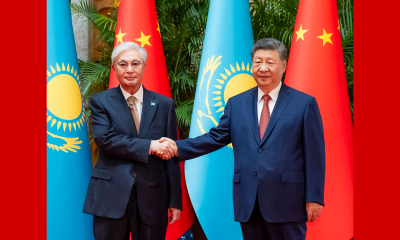
Kazakhstan seeks regional AI leadership as economic partnership with China enters new phase
-
 Aviation/airlines3 days ago
Setting a new benchmark in premium travel
-
 Intellectual Property Rights3 days ago
Survey on an EU Blueprint for intellectual property licensing and spinoff creation
-
 EU law3 days ago
Rule of law report strengthens EU democracy and fundamental rights