Kazakhstan
International experts say Kazakhstan's January events were terrorist attacks

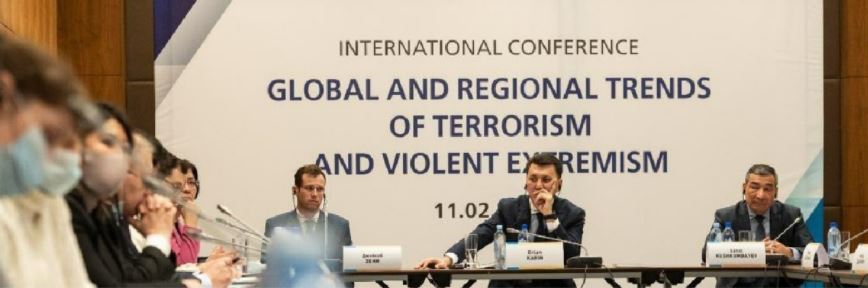
According to international experts, the violent unrest that erupted across Kazakhstan in early January should be considered acts of terrorism based on all objective criteria — level of violence, sophistication of the organisation and severity of attacks, and targeted targets on government institutions.
The event, hosted by the President of Kazakhstan's Kazakhstan Institute for Strategic Studies, was meant to provide a forum for discussion on global and regional terrorism and violent extremism trends.
The sad events in Almaty, according to Acting Adjunct Assistant Professor Jacob Zenn of Georgetown University's Security Studies Program (SSP), displayed a relatively unique form of terrorist occurrence.
"It wasn't a typical terrorist act, like a hotel explosion," Zenn said. "There was a huge number of people, and while some of them may not have intended to engage in militant action at the outset, they became engulfed in the violence perpetrated by criminal and radical elements."
Another oddity of the issue is that no recognised terrorist organisation has been linked to the events thus far. According to Zenn, it's critical to look into the possibility of jihadist groups or Kazakh foreign fighters encouraging or organising those acts.
Aymenn Jawad Al-Tamimi, a research fellow at George Washington University's Program on Extremism, and another speaker, Jacob Zenn, both emphasised the necessity of government firm acts in restraining violence and avoiding the spread of assaults at an early stage.
"When anything is classified as terrorism, the government can take exceptional measures to combat it, like we saw in Kazakhstan," Zenn explained.
Failure to do so "allows [the situation] to spiral into a civil war, which is something terrorist groups exploit and take advantage of," as happened in Syria. The Kazakh law enforcement agencies and government institutions, on the other hand, acted rapidly to take the appropriate steps," Tamimi noted.
Putting the events of January in a global context, Zenn stated that Central Asia's domestic security situation is unexpectedly stable.
"Terrorism in Central Asia is nowhere near the degree we see in other parts of the world or in the United States." People expected terrorism to extend into Central Asia one day as a result of the Taliban and ISIS, but in general, terrorism has not taken root in this region to the level that it has in other places or to the amount that people have predicted. As a result, I believe it is worthwhile to investigate how the government, religious institutions, civil society, and security services responded to these difficulties," Zenn stated.
Both experts agreed that there is a large area for foreign and Kazakh researchers to collaborate on understanding the causes of security challenges in Central Asian countries and developing solutions.
Share this article:
EU Reporter publishes articles from a variety of outside sources which express a wide range of viewpoints. The positions taken in these articles are not necessarily those of EU Reporter. Please see EU Reporter’s full Terms and Conditions of publication for more information EU Reporter embraces artificial intelligence as a tool to enhance journalistic quality, efficiency, and accessibility, while maintaining strict human editorial oversight, ethical standards, and transparency in all AI-assisted content. Please see EU Reporter’s full A.I. Policy for more information.





The South Caucasus at a historic turning point: Between lasting peace and renewed confrontation
The security environment of the South Caucasus amid changing geopolitical realities

Commission registers two European Citizens' Initiatives on education and housing

Commission sends Statements of Objections to several companies and trade associations in suspected construction chemicals cartel

Why the US is losing its legitimacy as a global superpower and the trust of the comity of nations

Commission endorses Latvia’s €617 million Social Climate Plan to support vulnerable households and transport users in the clean transition

Drones, dominance, and the Iranian impasse: The West's strategic blind spot

Commission publishes state aid guidance on carbon contracts for difference

JoinCare explores scientific exchange during visit to Japan’s National Institute of Infectious Diseases

New episode – DGT podcast: Languages and Technology

Become a European Commission trainee – applications are now open

Commission outlines measures to strengthen Europe's banking sector and support growth

British political shifts and the future of UK-China ties
The South Caucasus at a historic turning point: Between lasting peace and renewed confrontation

As Ireland chairs the EU Presidency, what impact has over fifty years of EU membership had on Ireland

The Digital Markets Act Is Hurting Europeans. It’s Time to Put Progress, Free Markets, and Competition First

Kazakhstan reforms under scrutiny at Brussels Press Club round table

Japan should face up to history and contribute more to regional peace

Ambassador calls for 'speeding up' of co-operation between EU and Kazakhstan

Timur Turlov at Smart Moves Summit 2025: How chess can transform global education

Shevtsova’s case: Out-of-court sanctions dismantling trust in Ukrainian cause

The future of European transport

Trump Vs Trueman

US 'no longer' an 'unconditional ally' for Europe - MEP
-
 South Caucasus1 day ago
The South Caucasus at a historic turning point: Between lasting peace and renewed confrontation
-
South Caucasus2 days ago
The security environment of the South Caucasus amid changing geopolitical realities
-
 European Citizens' Initiative4 days ago
Commission registers two European Citizens' Initiatives on education and housing
-
 European Commission2 days ago
Commission sends Statements of Objections to several companies and trade associations in suspected construction chemicals cartel